Practice using the formulas for work and power to understand how force moves objects over a distance.
Read each problem carefully. Use the formulas work = force x distance and power = work ÷ time when needed. Show your work and include units.
Calculating work, power, force, distance, and time
Physics - Grade 6-8
- 1
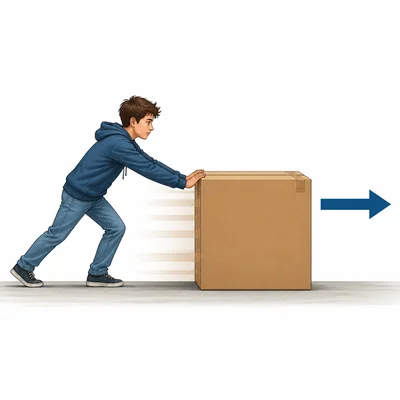
A student pushes a box with a force of 50 newtons for a distance of 4 meters. How much work does the student do on the box?
- 2
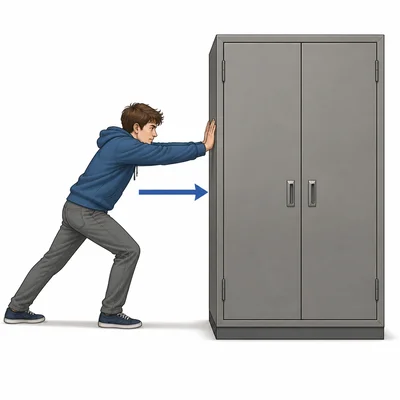
A student pushes hard on a heavy cabinet with a force of 100 newtons, but the cabinet does not move. How much work is done on the cabinet by the student? Explain.
- 3
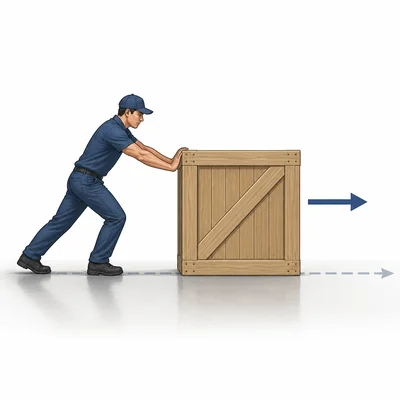
A mover does 120 joules of work while pushing a crate 6 meters across the floor. What force did the mover use?
- 4
A student lifts a stack of books and does 90 joules of work in 3 seconds. What is the student's power output?
- 5
Two students each do 600 joules of work moving boxes. Student A takes 10 seconds, and Student B takes 5 seconds. Which student has the greater power output, and what is each power output?
- 6
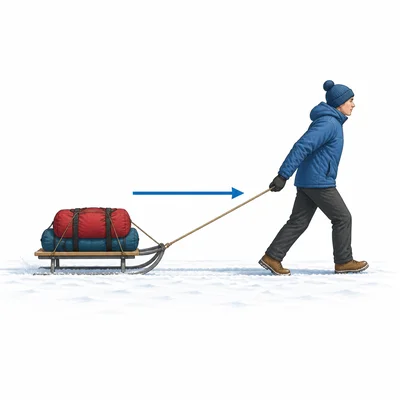
A person pulls a sled 5 meters using a horizontal force of 40 newtons. How much work is done on the sled in the direction of motion?
- 7
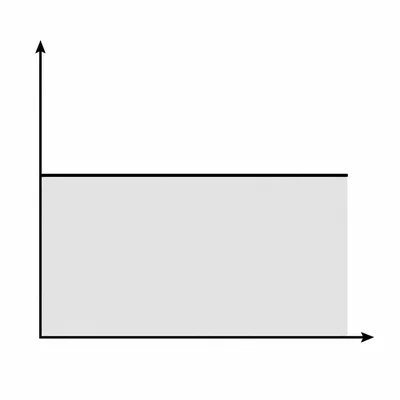
A force-distance graph shows a constant force of 10 newtons acting over a distance of 8 meters. What is the work done?
- 8
Complete the calculation: A machine does 240 joules of work in 12 seconds. What is the machine's power output?
- 9
Write the correct unit for each quantity: force, distance, work, time, and power.
- 10
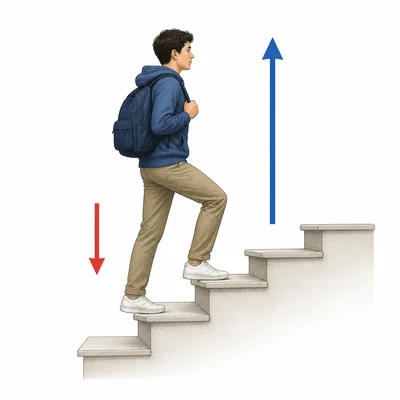
A student with a weight of 450 newtons climbs stairs that are 3 meters high. How much work does the student do against gravity? If the climb takes 9 seconds, what is the student's power output?
- 11
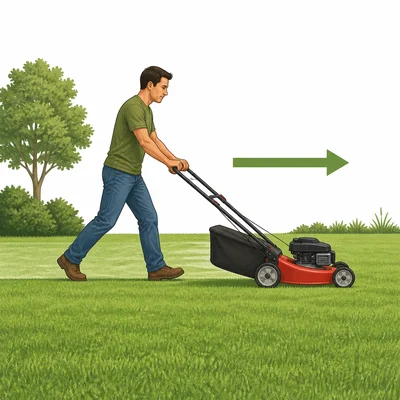
A person pushes a lawn mower with a force of 80 newtons for 12 meters. The push takes 6 seconds. How much work is done, and what is the person's power output?
- 12
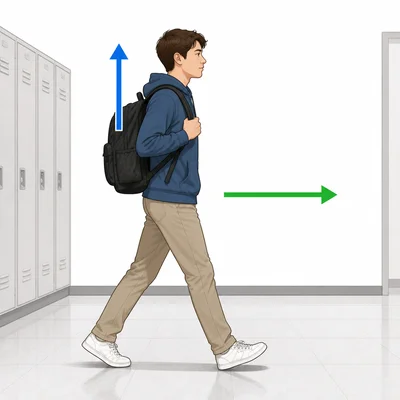
A student carries a backpack while walking 20 meters down a level hallway. The student's upward force on the backpack is 60 newtons. How much work does the upward force do on the backpack in the direction of walking? Explain.
- 13
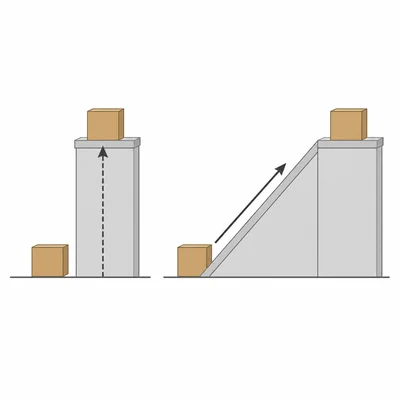
A ramp lets a worker move a box to a platform 2 meters high. Lifting the box straight up requires 300 newtons of force for 2 meters. Pushing it up the ramp requires 100 newtons of force for 6 meters. In an ideal situation with no friction, how much work is done in each case?
- 14
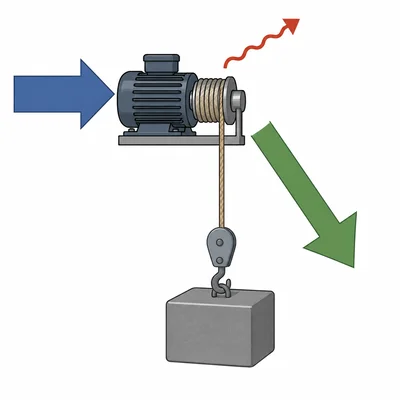
A motor uses 500 joules of input energy to lift an object, but only 400 joules of useful work is done on the object. What percent of the input energy becomes useful work?
- 15
A small motor has a power output of 100 watts. How long will it take the motor to do 800 joules of work?