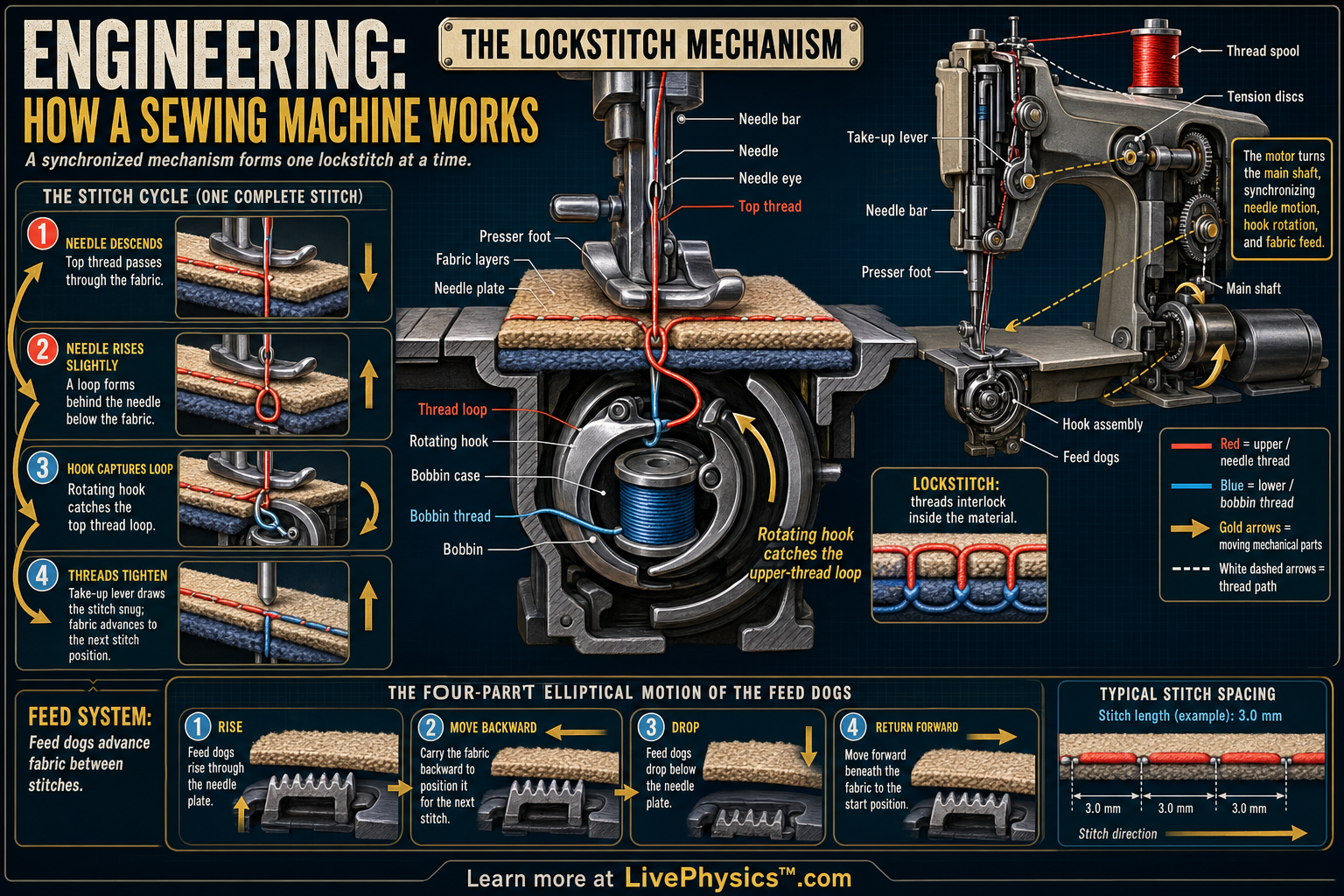
A sewing machine converts the rotary motion of a motor or handwheel into precisely timed needle, hook, and fabric-feed motions. Its most common stitch, the lockstitch, joins two threads inside the fabric to make a strong, neat seam. The upper thread travels through the needle, while the lower thread comes from a bobbin beneath the needle plate.
Understanding this mechanism shows how timing, tension, and motion control work together in an everyday engineered device.
As the needle descends, it carries the upper thread through the fabric and then rises slightly, leaving a loop below the material. A rotating hook catches this loop and carries it around the bobbin case, linking the upper thread with the bobbin thread. The take-up lever then pulls the upper thread tight, locking the stitch near the middle of the fabric layers.
While the needle is raised, toothed feed dogs move the fabric forward by one stitch length, then drop and return to repeat the cycle.
Understanding Engineering, How a Sewing Machine Works
The machine depends on a shared drive shaft, gears, cranks, and linkages. One turn of the handwheel coordinates several jobs in a fixed order. A crank changes circular motion into the needle bar's up and down travel.
Another linkage moves the take-up lever through its larger arc. Gears set the hook speed and direction. This is a good example of mechanical synchronization.
The parts do not need electronic sensors to know where they are. Their positions are built into the shape and connection of the moving parts. If a gear slips by even a small amount, the hook can miss the thread loop or strike the needle.
Needle design matters more than it first appears. A sewing needle has a long groove that shelters the upper thread as it passes through fabric. On the other side is a shallow cut called the scarf.
The hook point reaches into this space to catch the loop without hitting the needle. Thick denim, stretchy knit fabric, and fine silk need different needle sizes and point shapes.
A needle that is bent, blunt, or fitted the wrong way can cause skipped stitches. The hook may arrive at the correct time, yet it cannot catch a loop that is too small or in the wrong position.
Thread tension is controlled by friction. The upper thread passes between tension discs that squeeze it with an adjustable spring. It then travels through guides and the take-up lever.
The bobbin thread has its own smaller resistance system in the bobbin case or hook area. These forces must suit the fabric and thread. Excess upper tension pulls the thread join toward the top surface.
Excess bobbin tension pulls it underneath. Loose thread can form tangled nests below the needle plate.
Students can see this principle in shoelaces, fishing line, or a rope wrapped around a post. More contact and more squeezing create more friction, which resists motion.
The fabric feeding system is a separate motion problem. Feed dogs rise through slots in the needle plate, grip the fabric, carry it a chosen distance, then drop before sliding back. A presser foot holds the layers down with controlled pressure so they do not lift with the needle.
Stitch length changes the distance travelled on each cycle, not usually the motor speed. Thick layers can feed unevenly because the upper layer meets more resistance than the lower layer. This causes shifting near seams and hems.
When learning from a machine, turn the handwheel slowly toward yourself and watch one full cycle. Notice when the needle is safely out of the fabric before it moves forward. Watch the thread path, test stitches on scrap fabric, and change only one setting at a time when diagnosing a problem.
Key Facts
- A lockstitch uses an upper thread and a bobbin thread that interlock within the fabric.
- The needle bar changes rotary shaft motion into vertical reciprocating motion.
- The rotating hook must catch the upper-thread loop just after the needle begins to rise.
- Stitch frequency is f = N/60, where N is the machine speed in stitches per minute and f is stitches per second.
- Fabric advance distance is d = nL, where n is the number of stitches and L is the stitch length.
- For a balanced seam, upper-thread tension and bobbin-thread tension must pull the thread interlock toward the fabric's center.
Vocabulary
- Lockstitch
- A stitch formed when an upper thread and a bobbin thread interlock between layers of fabric.
- Bobbin
- A small spool that holds the lower thread used to form a lockstitch.
- Rotating hook
- A curved rotating part below the needle plate that catches the upper-thread loop and carries it around the bobbin case.
- Feed dogs
- Toothed bars beneath the presser foot that grip and move fabric forward between stitches.
- Take-up lever
- A moving lever that supplies thread during needle descent and removes slack to tighten the completed stitch.
Common Mistakes to Avoid
- Assuming the needle pushes both threads through the fabric is wrong because only the upper thread passes through the needle; the bobbin thread stays below the needle plate.
- Thinking the hook catches the thread while the needle is still descending is wrong because the needle must rise slightly first to create a catchable upper-thread loop.
- Expecting the feed dogs to move the fabric while the needle is embedded is wrong because fabric movement at that moment could bend or break the needle.
- Pulling fabric forcefully from behind the presser foot is wrong because the feed dogs are designed to control the advance distance, and extra pulling can cause uneven stitches or needle damage.
Practice Questions
- 1 A machine operates at 900 stitches per minute. Calculate its stitch frequency in stitches per second.
- 2 A seam is made with a stitch length of 2.5 mm. How far should the fabric advance after 36 stitches, in millimeters and centimeters?
- 3 A seam has loose loops of upper thread visible on the underside of the fabric. Explain whether the upper-thread tension is likely too low or too high, and describe how this changes the position of the thread interlock.