Action-Reaction Lab
Two carts share a spring push-off on a frictionless track. The spring applies equal force in opposite directions on each cart, so see what happens to their velocities, momenta, and energies when the masses differ.
Guided Experiment Equal and Opposite Forces
If two carts on a frictionless track push each other with a spring, what do you predict about the magnitude and direction of the force each cart feels?
Write your hypothesis in the Lab Report panel, then click Next.
Cart Masses
Push Parameters
Action-Reaction Pair
Readings
Impulse (same on both)
Cart A
Cart B
Data Table
(0 rows)| # | Trial | m_A(kg) | m_B(kg) | Force(N) | Duration(s) | Impulse(N·s) | v_A(m/s) | v_B(m/s) | Σp(kg·m/s) |
|---|
Reference Guide
Newton's Third Law
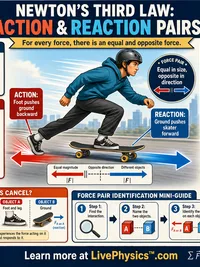
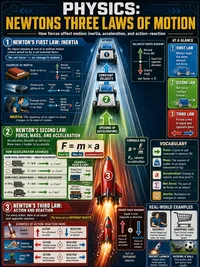
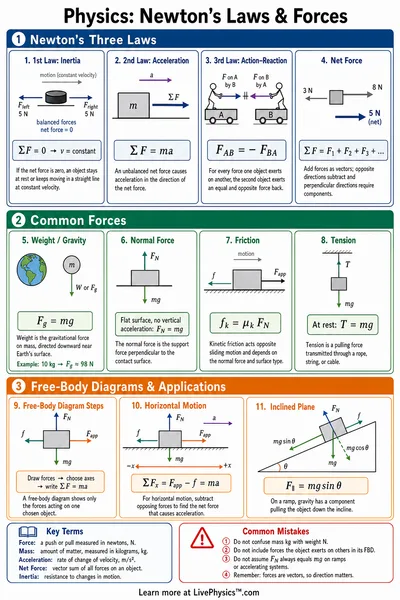
Newton's Third Law says that when one object exerts a force on a second object, the second exerts an equal-magnitude force back on the first, in the opposite direction.
The two forces always come together as a pair and always act on different objects. They never cancel because they act on different things.
Impulse and Momentum
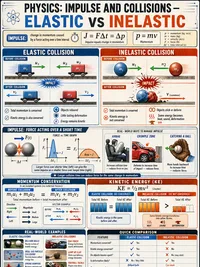
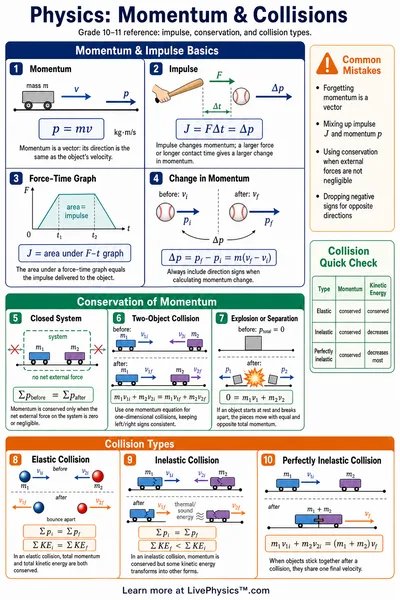
The impulse on each cart equals the force times the contact time. Impulse changes momentum, Δp equals F·t.
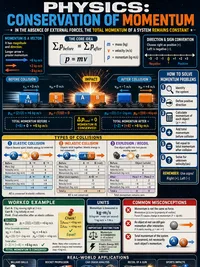
Because the forces are equal and opposite, the impulses are equal and opposite, so the total momentum of the pair is conserved.
Different Masses, Different Velocities
The forces are the same but the accelerations are not. Newton's Second Law says a equals F over m, so a lighter cart picks up more speed than a heavier one for the same force.
This is why a skater bounces back when she pushes off a heavy wall while the wall barely moves.
Conservation of Momentum
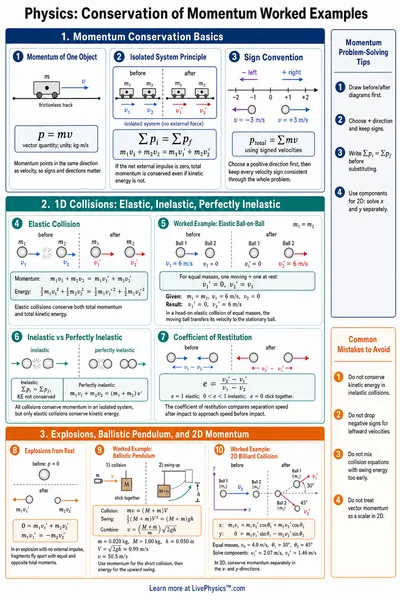
When no outside forces act on a pair of interacting objects, the total momentum stays the same before, during, and after the interaction.
If the system starts at rest, the total momentum is zero forever. This is how rockets and recoil are explained.