Why Do Astronauts Float in Space?
Orbit is falling without hitting the ground
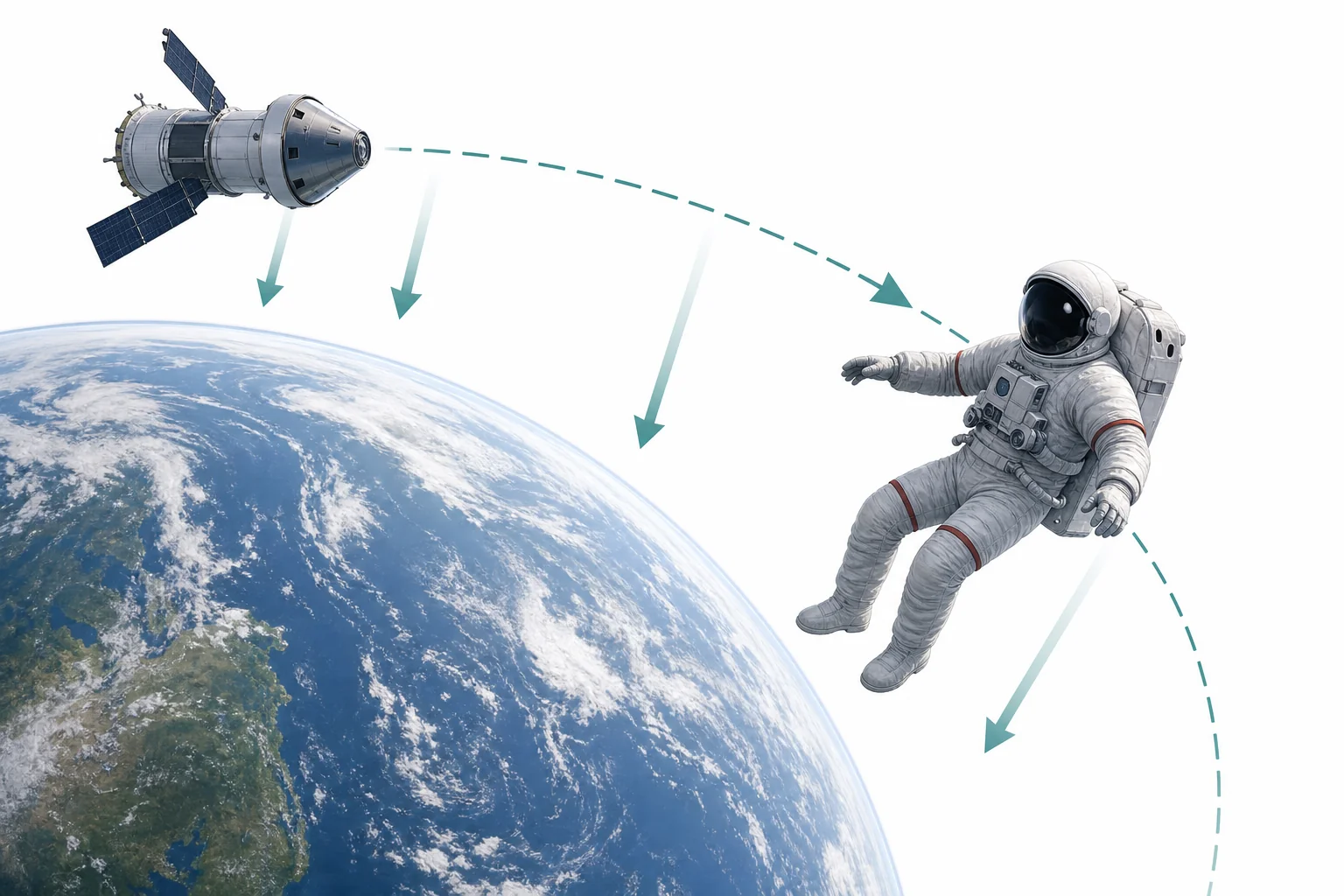
Astronauts float because they and their spacecraft are falling around Earth together. Gravity is still pulling on them, but there is no floor pushing up on their bodies. That makes them feel weightless even though Earth’s gravity has not disappeared.
Astronauts on the International Space Station seem to drift as if gravity is gone. That is a useful first guess, but it is not right. Earth’s gravity still reaches the station. In fact, gravity there is only a little weaker than it is on the ground. The key idea is motion. The station, the astronauts, their tools, and even drops of water are all falling toward Earth at the same time. They also move sideways so fast that Earth curves away beneath them. The result is orbit. Inside the spacecraft, everything falls together, so objects do not press hard on the floor, seats, or hands. A bathroom scale would not read the astronaut’s true gravitational pull. It would read almost zero because there is almost no support force. This lesson separates weight from apparent weight and shows why floating in space is really a special kind of falling.
Gravity is still there
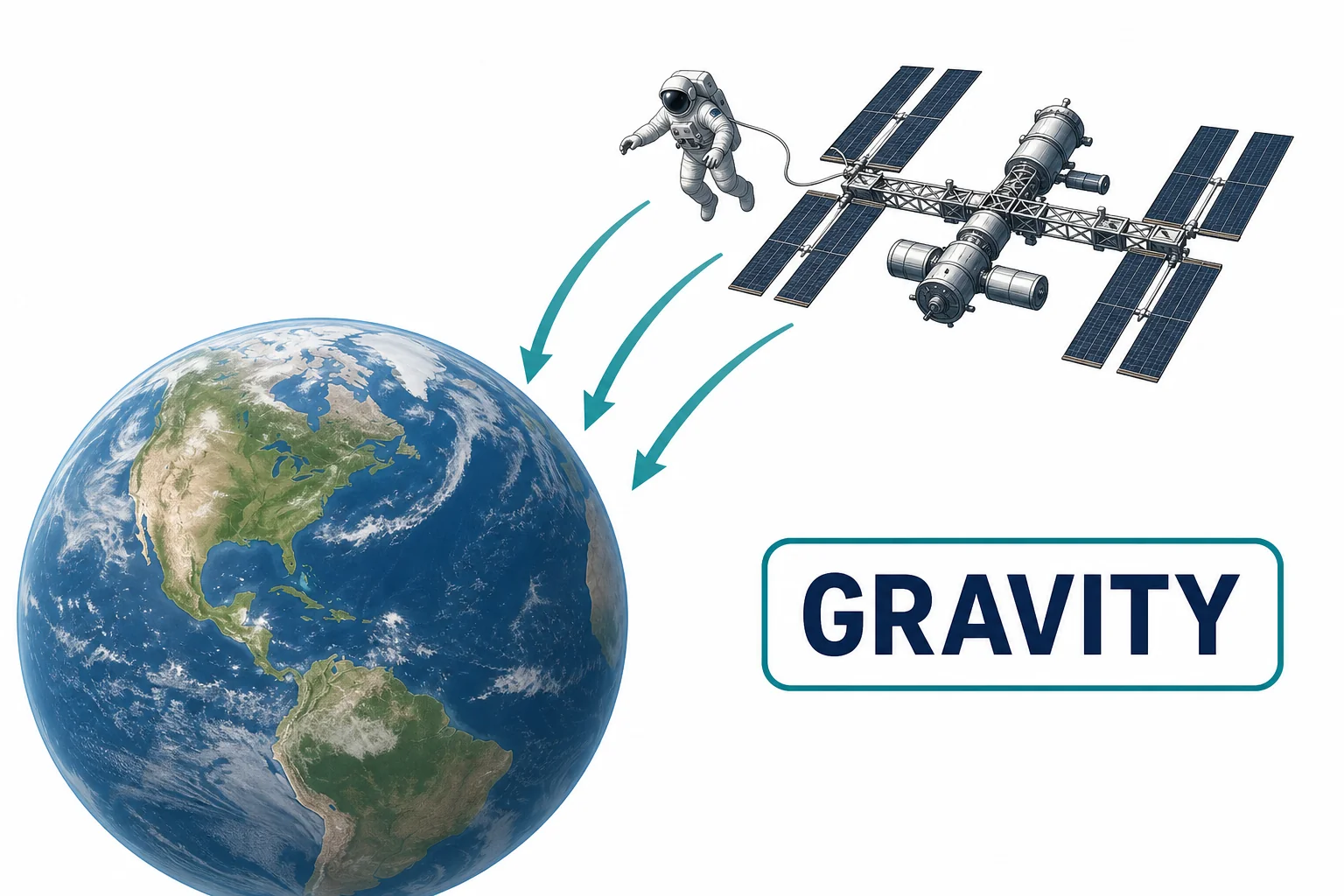
Orbit is not a place without gravity.
Weight is not just gravity
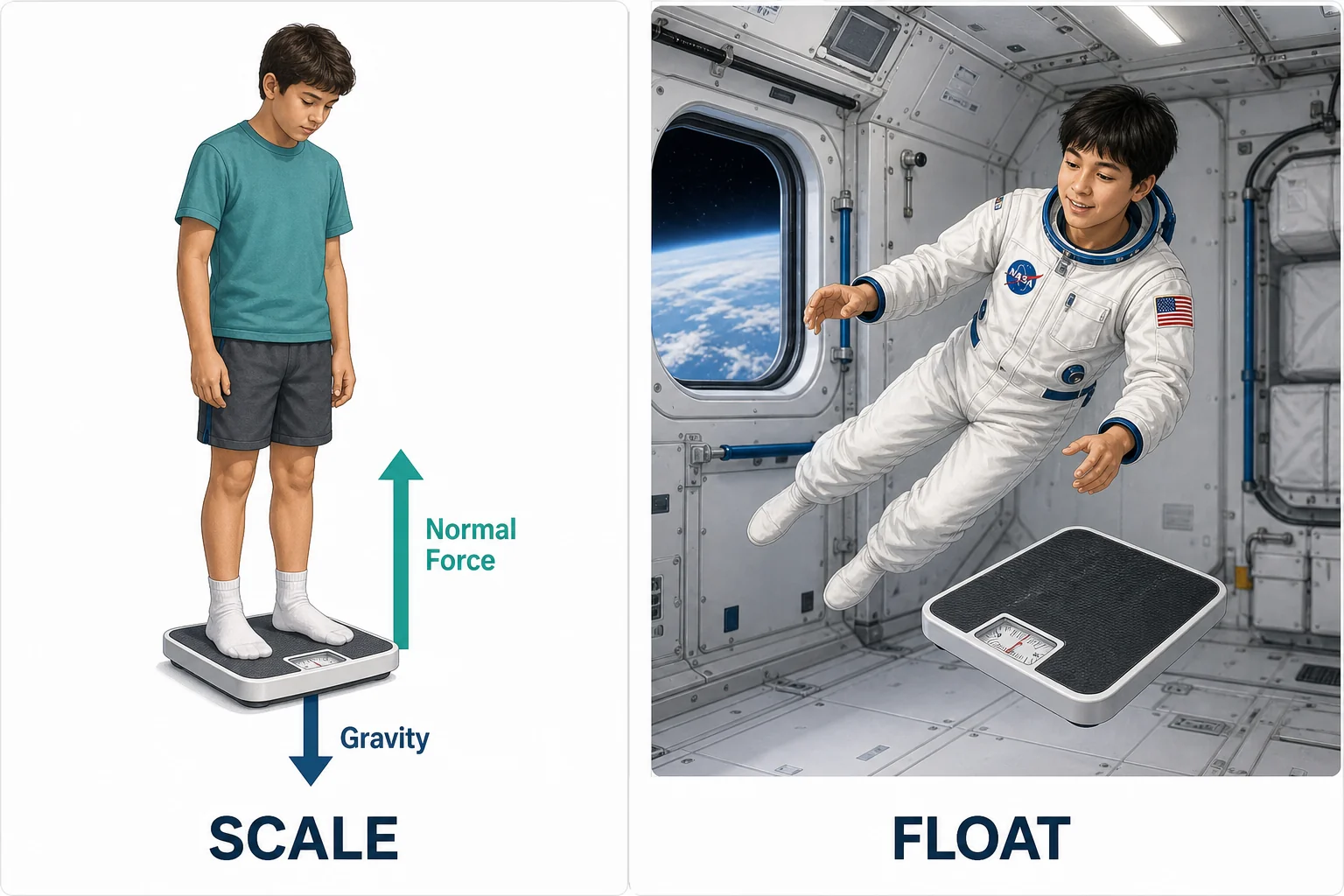
A scale measures the push on you, not just gravity.
Orbit means falling around Earth
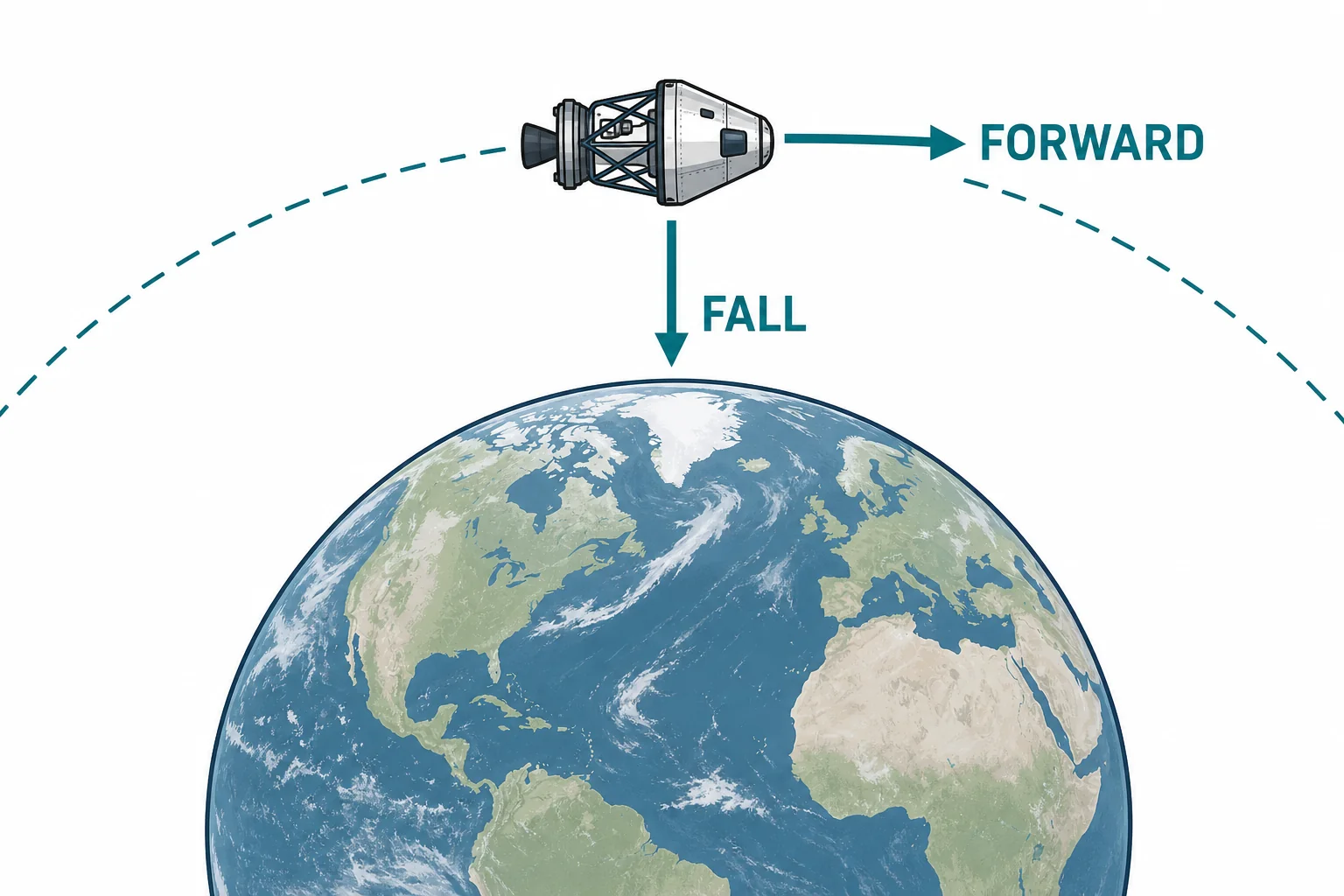
An orbiting spacecraft is always falling, but it keeps missing Earth.
Free fall makes a cabin feel weightless
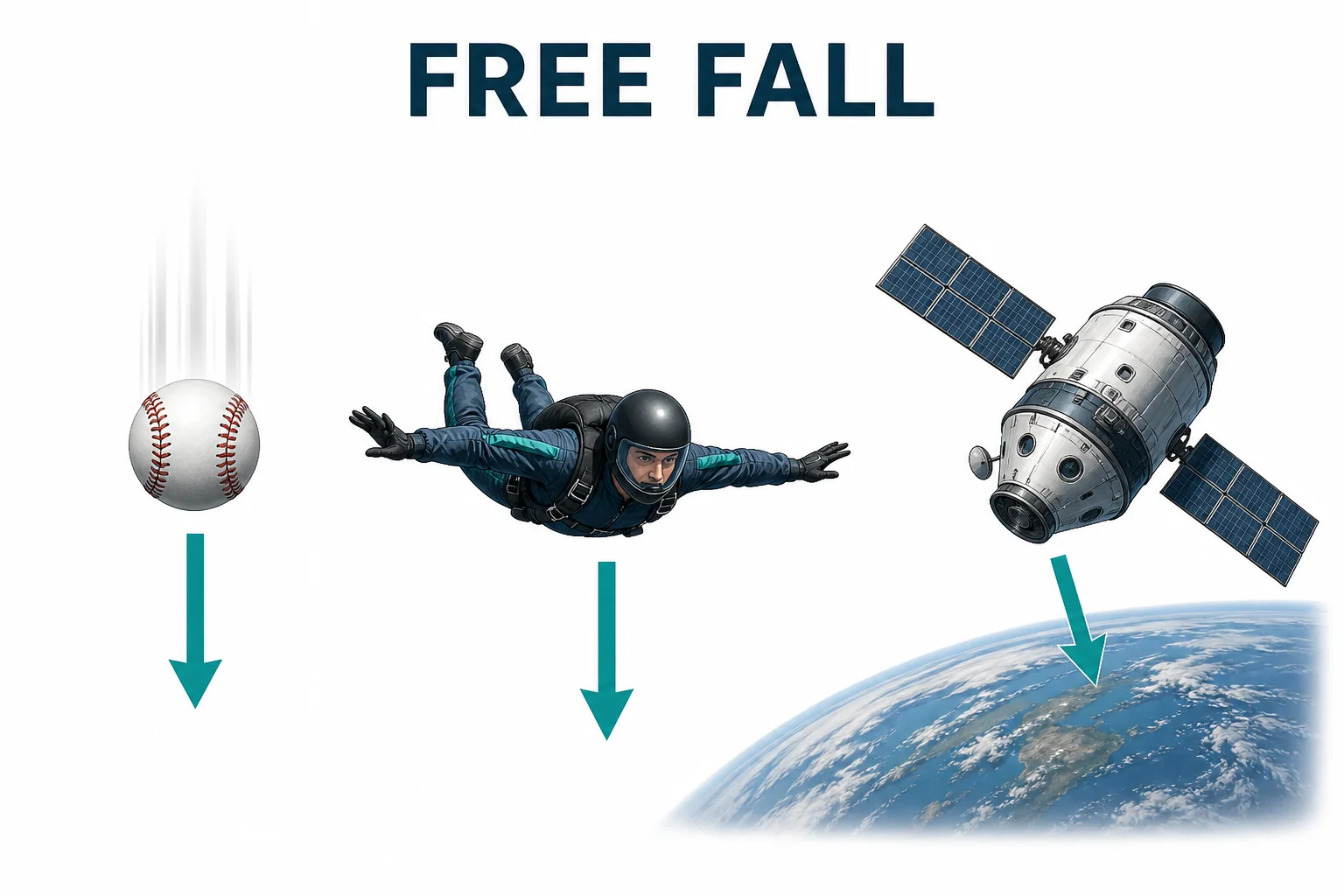
Weightlessness is what free fall feels like from the inside.
Microgravity is not zero gravity

Microgravity means objects behave as if they have almost no apparent weight.
Vocabulary
- Gravity
- The attractive force between objects that have mass, such as Earth and an astronaut.
- Orbit
- The curved path of an object that falls around a planet, moon, or star while moving forward.
- Free fall
- Motion caused mainly by gravity, with little or no support force pushing on the object.
- Weight
- The force of gravity on an object.
- Apparent weight
- The support force a person feels or a scale reads, which can be different from the force of gravity.
- Microgravity
- A condition in which objects seem almost weightless because they are falling together.
In the Classroom
Scale in an elevator model
20 minutes | Grades 6-8
Students predict what a scale would read when a person is still, speeding up, and slowing down in an elevator. They connect each case to support force and apparent weight.
Falling together demo
25 minutes | Grades 6-8
Students drop a small open box with a lightweight object inside, such as a foam ball. They observe that the object appears to float relative to the box during the short fall, then compare the model to orbit.
Orbit as two motions
30 minutes | Grades 6-8
Students draw motion diagrams that combine forward velocity with inward gravitational force. They use arrows to explain why a spacecraft can keep falling without hitting Earth.
Key Takeaways
- • Astronauts float because they and their spacecraft are in free fall together.
- • Earth’s gravity still pulls strongly on objects in low Earth orbit.
- • A scale reads apparent weight, which depends on support force.
- • Orbit happens when forward motion combines with falling toward Earth.
- • Microgravity means objects act nearly weightless, not that gravity is absent.