Story Plot Arc Lab
Map any story's structure from start to finish. Record exposition, rising action events, climax, falling action, and resolution as you read, then analyze how the plot arc reveals the story's central theme.
Guided ExperimentMapping Plot Structure
What is the central conflict of the story you are analyzing? How do you expect each plot stage to connect to that conflict?
Write your hypothesis in the Lab Report panel, then click Next.
Plot Diagram
Story Context
Plot Stages
Introduce characters, setting, and the initial situation.
First complication or conflict that creates tension.
The moment of highest tension. The turning point of the story.
Events after the climax that lead toward the resolution.
How the conflict is resolved and the story concludes.
What lesson or message does the author want readers to take away?
Controls
Plot Completion
Data Table
(0 rows)| # | Plot Stage | Key Event | Character(s) Involved | Conflict/Resolution |
|---|
Reference Guide
Plot Arc Structure
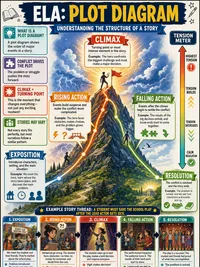
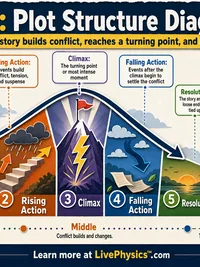
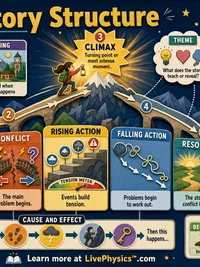
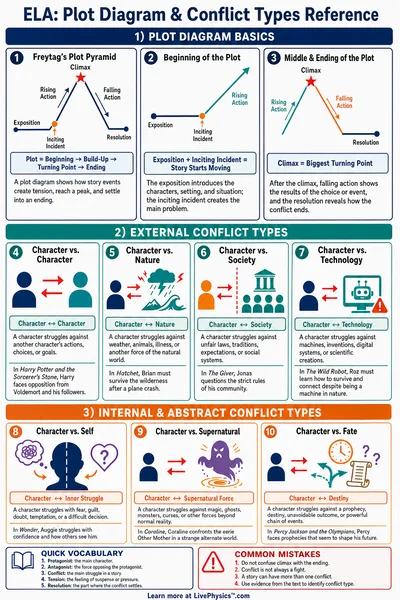
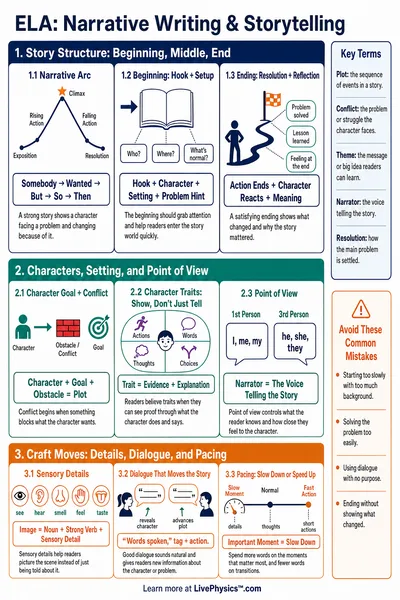
The plot arc is the shape of a story's events over time. It is usually shown as a mountain or triangle diagram that rises to a peak and then falls back down.
Every complete story follows this arc, no matter how long or short. A picture book and a novel both have an exposition, a central conflict, and a resolution.
Understanding the arc helps readers follow complex stories and helps writers plan their own. The arc is a map of where tension comes from and where it goes.
Tension is what keeps readers engaged. The arc shows how an author builds tension deliberately, event by event, until releasing it at the resolution.
The Five Stages
Exposition. Introduces the characters, setting, and background information. No conflict yet, just the normal world before things change.
Rising Action. A series of events that introduce and escalate the central conflict. Each event raises the stakes a bit more. Most of the story lives here.
Climax. The turning point. The moment of highest tension where the central conflict reaches its peak. After this, things can only go one way.
Falling Action. Events after the climax that wind the story down. Loose ends get tied up and characters react to what happened at the climax.
Resolution. The new normal. The conflict is resolved and we see the final outcome for the characters.
Identifying the Climax
The climax is often the hardest stage to identify. Many students label the last exciting event as the climax, but the true climax is the moment of greatest tension - not necessarily the last one.
Ask yourself, at what point does the central conflict come to a head? When does the main character face their biggest decision or challenge? That is the climax.
In "The Three Little Pigs," the wolf climbing down the chimney is the climax because it is the moment of peak danger. The wolf burning himself is falling action.
A climax usually involves a choice, a confrontation, or a revelation that determines the outcome of everything that came before it.
Theme and Resolution
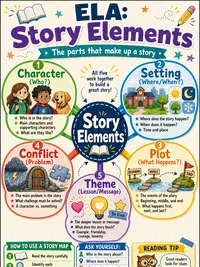
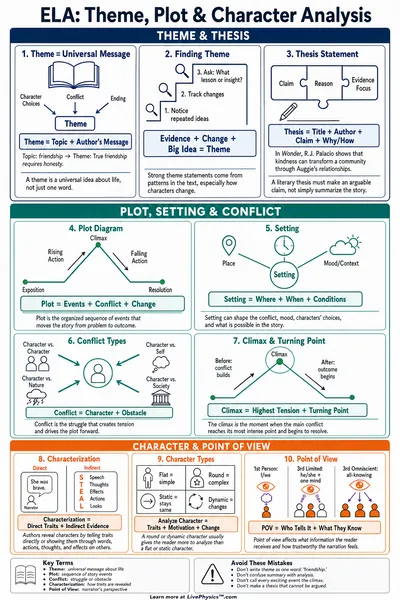
Theme is the central message or insight about life that a story communicates. It is different from the plot, which is what happens. Theme is what it means.
The resolution reveals theme. How a conflict ends shows what the author believes about the world. A villain who reforms suggests people can change. A hero who fails suggests not everything works out.
To find the theme, ask, what does the main character learn? What does the ending say about how the world works? What would be different if the story ended another way?
A single story can support multiple themes. "Cinderella" is about kindness rewarded, but also about patience, perseverance, and the idea that outer circumstances do not define inner worth.