Reading Strategies Lab
Work through three non-fiction passages using four proven active reading strategies. Make connections, generate questions, form and evaluate predictions, and write concise summaries to build lasting comprehension skills.
Guided ExperimentMaking Connections
Which type of connection (text-to-self, text-to-text, or text-to-world) do you think will help you understand the passage most deeply? Why?
Write your hypothesis in the Lab Report panel, then click Next.
Reading Passage
The Moon Landing
On July 20, 1969, astronauts Neil Armstrong and Buzz Aldrin became the first humans to walk on the Moon. Their spacecraft, Apollo 11, traveled about 240,000 miles from Earth. Armstrong's famous words, "That's one small step for man, one giant leap for mankind," were broadcast live to millions of people watching on television. The mission required over 400,000 engineers, scientists, and technicians working together for nearly a decade. The astronauts collected rock samples and planted an American flag before safely returning home. The Moon landing showed that with determination and teamwork, humanity could achieve almost anything.
Controls
Current Passage
The Moon Landing
Active Strategy
connections
Strategies Completed
0 of 4
Connections
Making connections links the text to your own life, other texts you have read, and events in the wider world. This deepens understanding and makes the text more memorable.
Data Table
(0 rows)| # | Strategy | My Response | Strength (1-5) | What I Learned |
|---|
Reference Guide
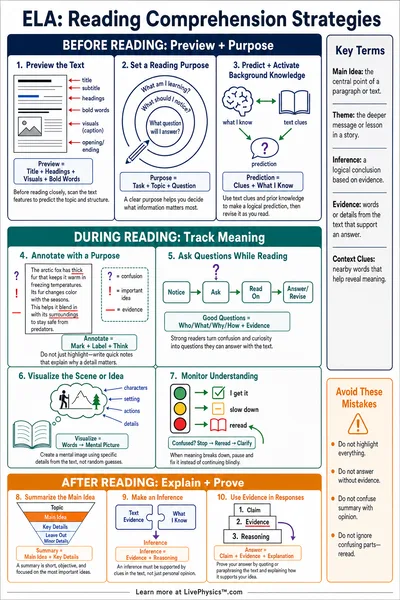
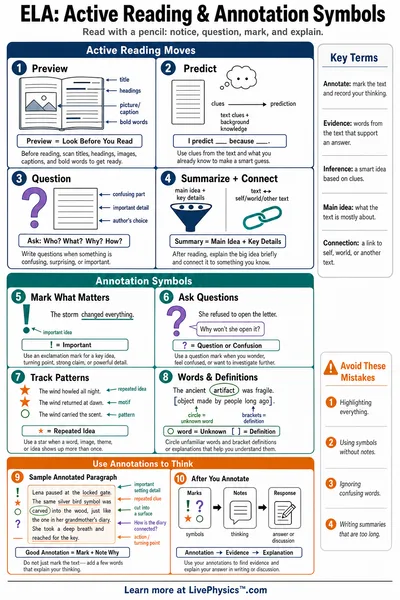
The Four Key Strategies
Active readers use specific mental strategies to engage with a text and build understanding. Research shows that readers who use these strategies consistently retain more information and think more critically about what they read.
- Connections link new information to prior knowledge, making it easier to remember.
- Questions create a purpose for reading and identify gaps in understanding.
- Predictions build engagement and sharpen focus on specific information.
- Summaries force the reader to identify and synthesize the most important ideas.
Making Connections (3 Types)
Strong readers constantly connect the text to what they already know. There are three categories of connections
Text-to-Self
Links between the text and your personal experiences, memories, or feelings. Example, "This character's problem reminds me of a time I..."
Text-to-Text
Links to other books, articles, films, or media you have encountered. These connections reveal themes and patterns across different texts.
Text-to-World
Links between the text and broader events in history, society, science, or the news. These connections reveal the real-world significance of what you read.
Asking Questions Before, During, and After
Questions at each stage of reading serve a different purpose and build on each other to create deep understanding.
Before Reading
What do you already know about this topic? What do you want to find out? These questions set a purpose and activate prior knowledge.
During Reading
What is confusing? What do I need to re-read? These questions identify places where comprehension breaks down so you can fix them.
After Reading
What do I still wonder? These questions push thinking beyond the text and can lead to further research or discussion.
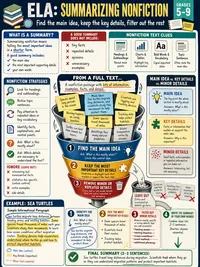
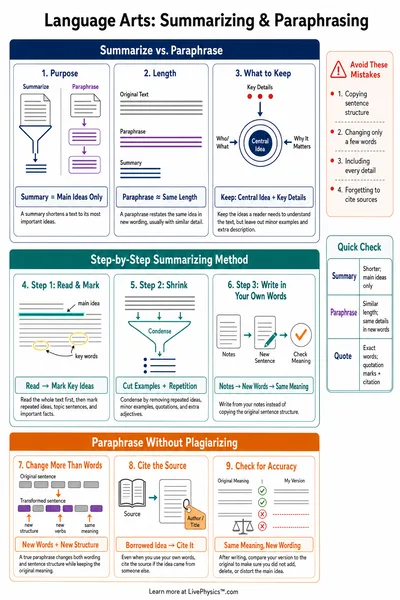
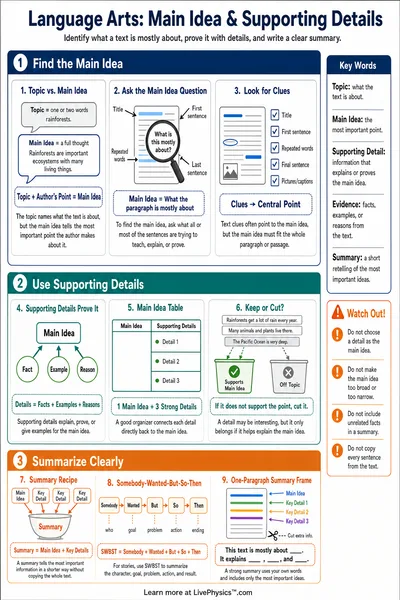
Writing a Strong Summary
A summary restates the most important information from a text in your own words. A strong summary is brief, accurate, and focused on the main idea.
Identify the main idea first. Ask, what is the text mostly about?
Select only the 2-3 most important supporting details. Leave out examples and minor points.
Write in your own words. Do not copy sentences from the original text.
Aim for 2-3 sentences. A summary of a short passage should rarely exceed 50-60 words.
Avoid starting with "This text is about..." or "The author says..." Use direct statements instead.