Grammar Patterns Explorer
Browse 10 grammar patterns with definitions, examples, and error corrections. Switch to Practice Mode to identify grammar issues in real sentences. Works entirely in your browser.
10 patterns
Click any card to expand examples and correct errors.
Grammar Reference
Agreement Rules
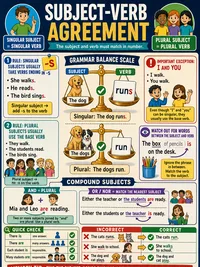
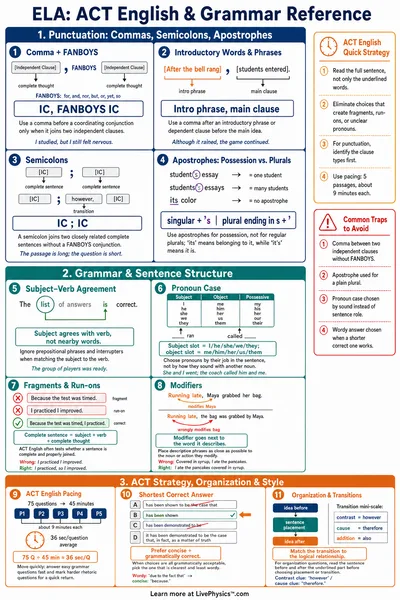
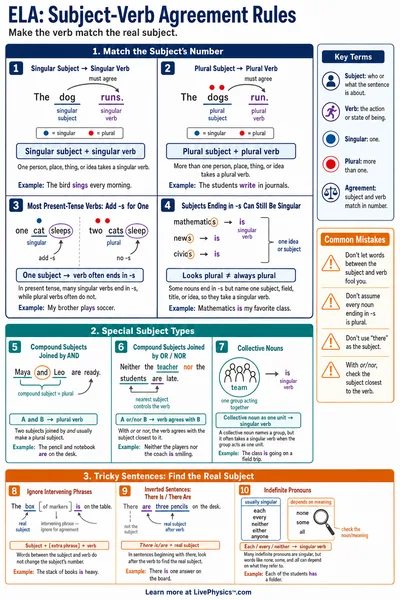
Both subject-verb and pronoun-antecedent agreement follow the same principle, matching parts of a sentence must agree in number.
- Subject-Verb Agreement. Collective nouns like "team" or "committee" are usually singular. "The team wins" not "The team win."
- Pronoun-Antecedent Agreement. Indefinite pronouns like "each," "every," and "anyone" are singular and take singular or gender-neutral pronouns.
Sentence Structure
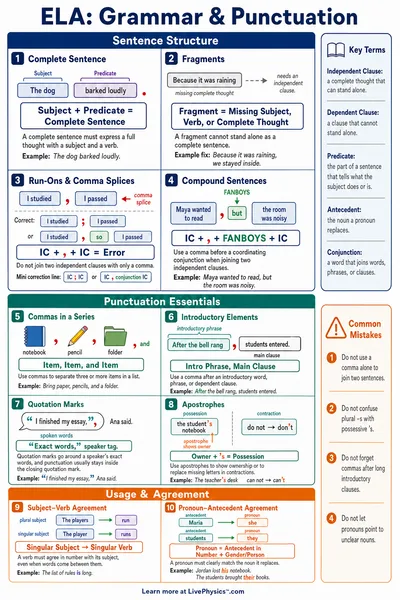
Comma splices and run-on sentences are the two most common ways independent clauses are incorrectly joined.
- Comma Splice. Two independent clauses joined by only a comma. Fix with a period, semicolon, or a coordinating conjunction (for, and, nor, but, or, yet, so).
- Run-On Sentence. Two independent clauses with no punctuation or conjunction at all. Same fixes apply.
Modifiers and Clarity
Misplaced and dangling modifiers both cause confusion about what is being described. Place modifiers directly next to the word they modify.
- Dangling Modifier. The phrase has no logical subject in the sentence. "Walking to school, the rain started" implies rain was walking.
- Misplaced Modifier. The modifier is present but placed too far from its target. "Only" and "almost" are especially prone to this.
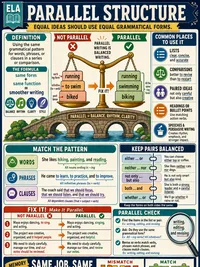
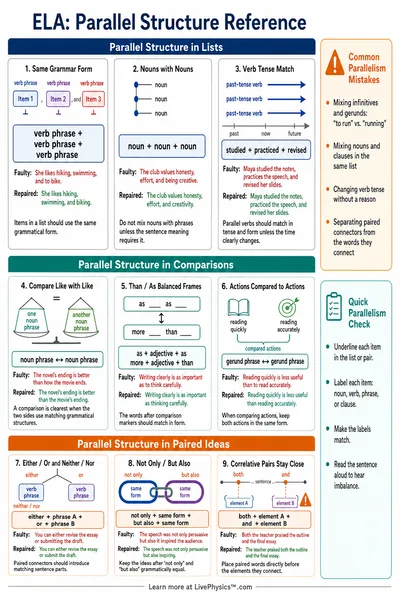
- Parallel Structure. Items in a list or paired constructions must share the same grammatical form.
Voice, Punctuation, and Usage
Active voice, correct apostrophes, and choosing the right word all sharpen writing clarity.
- Active Voice. Subject performs the action. Shorter and clearer than passive constructions.
- Apostrophes. Mark possession (dog's) or contractions (it's = it is). Never use for simple plurals.
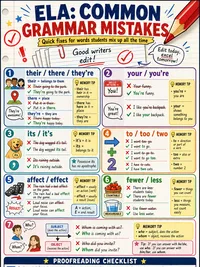
- Commonly Confused Words. There/their/they're, its/it's, your/you're. Expand contractions to check, "they are going" = "they're going."