School Schedule & Elapsed Time Lab
Read analog clocks, build your own school day schedule, and solve elapsed time puzzles. Discover how to measure how long activities last and how time passes throughout the day.
Guided ExperimentBuilding a School Day Schedule
How long do you think your favorite subject lasts? Predict how many minutes are in your school day from arrival to dismissal.
Write your hypothesis in the Lab Report panel, then click Next.
Controls
School starts at 8:00
What time does this clock show?
Clock 1 of 7
Data Table
(0 rows)| # | Activity | Start Time | End Time | Duration (min) | Notes |
|---|
Reference Guide
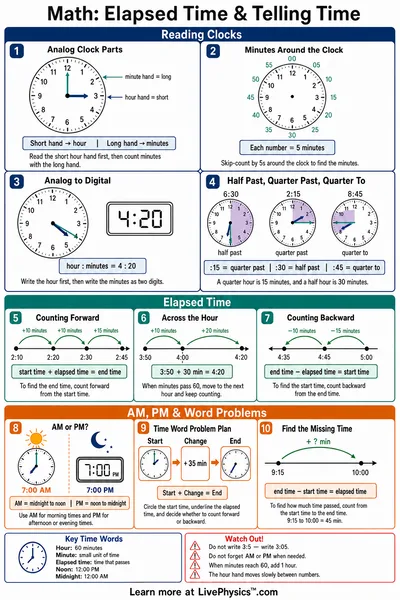
Parts of an Analog Clock
An analog clock has three hands that rotate around the center
- Hour hand (short) - points to the current hour
- Minute hand (long) - points to the minutes; each number = 5 minutes
- Second hand (thin) - counts individual seconds
To read minutes, count the minute hand position and multiply by 5. When the hand is at 3 the minutes are 15; at 6 the minutes are 30.
Calculating Elapsed Time
Elapsed time is how long something takes from start to end.
Count-up method, start at the start time and jump in increments (by 5 or 10 minutes) until you reach the end time.
Example, From 9:15 to 10:00 - add 45 minutes (9:15 + 45 min = 10:00).
AM and PM
The day is divided into two 12-hour halves
- AM (ante meridiem) - from midnight to just before noon
- PM (post meridiem) - from noon to just before midnight
School typically runs from about 8:00 AM to 3:00 PM. Noon (12:00 PM) is the midpoint of the day.
Number Line Strategy
Draw a number line with the start time on the left and end time on the right.
Jump in friendly chunks, first to the next hour, then count remaining minutes.
Example, 8:45 to 10:00
- 8:45 + 15 min = 9:00 (reach the hour)
- 9:00 + 60 min = 10:00 (add another hour)
- Total, 15 + 60 = 75 minutes