Spanish Conversation Lab
Practice talking in Spanish. Read what the other speaker says, choose the best response from the choices, and check your answer. Five conversations cover greetings, introductions, asking how someone is, small talk, and goodbyes.
Choose a Conversation
Controls
Saludos (Greetings)
Read the other speaker's line, then choose the best Spanish response. Check your answer and move on to the next exchange.
¡Hola! Buenos días.
Greet the person back with a polite good morning.
Choose your response
Data Table
(0 rows)| # | Exchange | My Response | Correct Response | Result |
|---|
Reference Guide
Greetings and Goodbyes
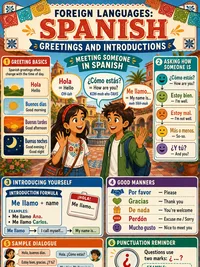
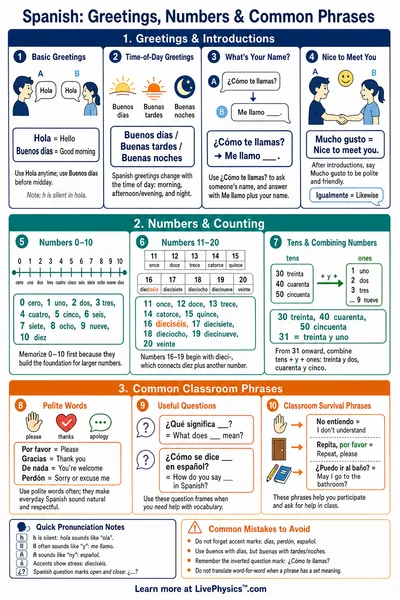
Spanish greetings change with the time of day. Use these as building blocks for the start and end of any conversation.
- Buenos días. Good morning, used until about noon.
- Buenas tardes. Good afternoon, used in the afternoon and early evening.
- Buenas noches. Good evening or good night.
- Hasta luego. See you later. Hasta mañana means see you tomorrow.
- Adiós. Goodbye. Cuídate means take care.
Introducing Yourself
To introduce yourself, give your name and a few facts about where you are from and how old you are.
- Me llamo Carlos. My name is Carlos. Soy Carlos works too.
- Soy de España. I am from Spain. Use de plus the place.
- Tengo catorce años. I am fourteen years old. Spanish uses tener for age.
- Mucho gusto. Nice to meet you. Reply with igualmente or el gusto es mío.
Practice tip. Notice that age uses the verb tener (to have), not ser (to be). You literally say you have a number of years.
Asking How Someone Is
There are several ways to ask how a person is doing, and the answer usually uses the verb estar for feelings and conditions.
- ¿Cómo estás? How are you? ¿Qué tal? is a more casual version.
- Estoy bien, gracias. I am well, thank you. Muy bien means very well.
- Estoy un poco cansado. I am a little tired.
- Estoy contento. I am happy. Estoy triste means I am sad.
Practice tip. Use estar (estoy, estás, está) for temporary states like feelings, and ser for permanent traits like where you are from.
Small Talk Tips
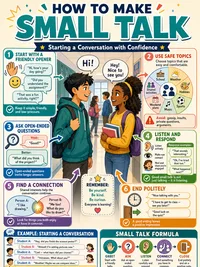
Small talk keeps a conversation going. Talk about your free time, the weather, and plans to meet up.
- Me gusta leer. I like to read. Me gusta plus a verb shares what you enjoy.
- Hace sol. It is sunny. Hace calor means it is hot, hace frío means it is cold.
- Me encantaría. I would love to. A warm way to accept an invitation.
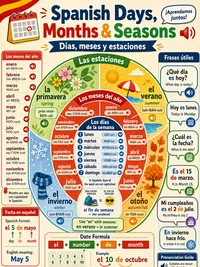
- A las tres. At three o'clock. Use a las plus the hour to set a time.
Practice tip. Switch to Practice mode to hide the English hint and respond from the Spanish line alone. Pay attention to accent marks like cómo and años, which change a word's stress and meaning.