Spanish Classroom Objects Lab
Learn the Spanish words for everyday classroom objects together with their article. Every noun in Spanish is masculine or feminine, so el libro and la mesa each carry their own article. Practice with multiple choice or by typing the full phrase, and the lab tells you when the word is right but the article is wrong.
Practice Mode
Progress
Object 1 of 22
pencil
What is this in Spanish (with its article)?
1. Choose the article
2. Choose the noun
Controls
Learn classroom objects in Spanish
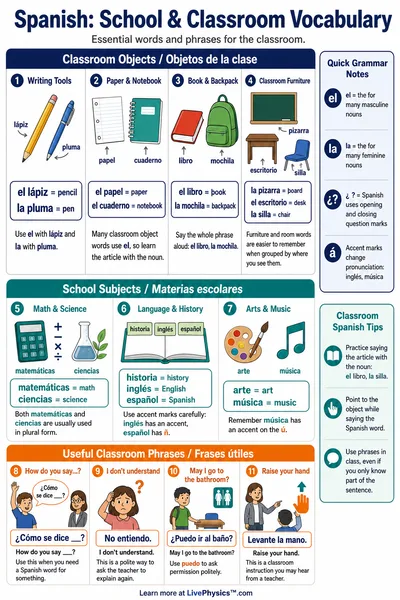
Each noun has a gender. Masculine nouns use el, feminine nouns use la. Learn the article together with the word.
Data Table
(0 rows)| # | English | Spanish (with article) | My Answer | Result | Attempts |
|---|
Reference Guide
Classroom Objects (singular)
- el lápiz pencil
- la mochila backpack
- el libro book
- la pizarra whiteboard
- el escritorio desk
- la regla ruler
- el bolígrafo pen
- la silla chair
- la mesa table
- el cuaderno notebook
- la goma eraser
- las tijeras scissors
- el marcador marker
- el reloj clock
- el mapa map
- la calculadora calculator
- la puerta door
- la ventana window
- la computadora computer
- la carpeta folder
El or La (gender of nouns)
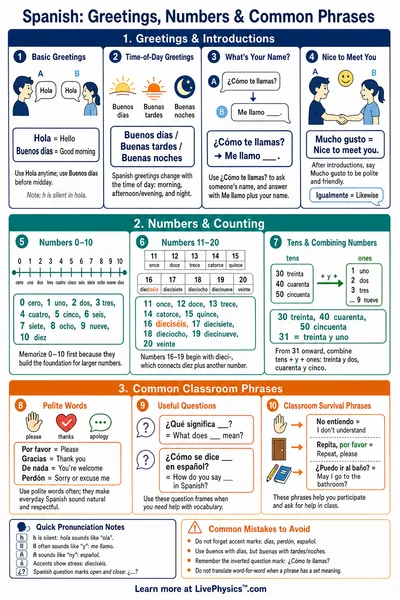
Every Spanish noun is either masculine or feminine. Masculine nouns use the article el, and feminine nouns use the article la. The article is part of the word, so it is best to learn them together from the very start.
- Most nouns ending in -o are masculine. el libro, el cuaderno, el bolígrafo.
- Most nouns ending in -a are feminine. la mesa, la silla, la regla.
- Common exceptions exist. el mapa and el día end in -a but are masculine; el lápiz and el papel are also masculine.
When you are unsure, picture the word with its article. Saying el libro and la mesa as set phrases builds the right habit.
Singular and Plural Articles
Spanish uses four definite articles. They change with both gender and number.
- el. masculine singular, as in el libro.
- la. feminine singular, as in la mesa.
- los. masculine plural, as in los libros.
- las. feminine plural, as in las mesas.
A few words are normally used in the plural. Scissors is one of them, las tijeras, just like in English.
Accents and Spelling
Written accents matter in Spanish. The accent mark shows which syllable is stressed and can change the meaning of a word, so lápiz and bolígrafo each keep their accent. The letter ñ is its own letter and is not the same as n.
In typed mode this lab gives partial credit when only an accent is missing, then shows you the correct spelling so you can fix it. Use the accent helper row to add á, é, í, ó, ú, and ñ without a Spanish keyboard.
A good study routine is to look at the object, say the full phrase out loud with its article, then write it. Reviewing this way each day builds lasting memory.