Spanish Restaurant Ordering Lab
Practice ordering a meal in Spanish from start to finish. You move through every stage of a restaurant visit, being greeted and seated, ordering a drink, ordering food, asking a question, requesting the bill, and paying. At each stage you choose the correct Spanish phrase for the situation, and the lab builds your order from la carta.
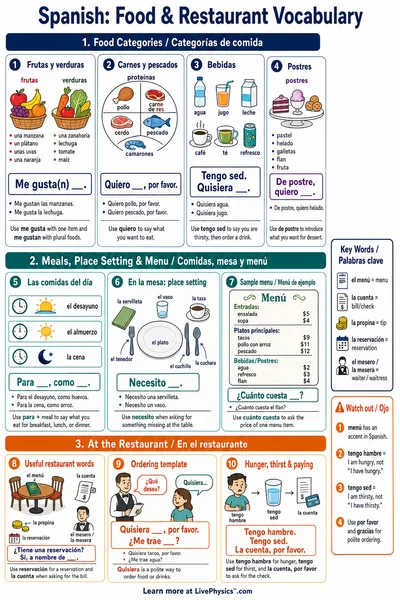
La Carta
The Menu
Bebidas
(Drinks)- agua mineral- mineral water2.00 €
- un refresco- a soft drink2.50 €
- zumo de naranja- orange juice3.00 €
- un café con leche- coffee with milk1.80 €
Entradas
(Starters)- gazpacho- cold tomato soup5.50 €
- ensalada mixta- mixed salad6.00 €
- croquetas de jamón- ham croquettes6.50 €
- tortilla española- Spanish potato omelette5.00 €
Platos principales
(Main courses)- paella de mariscos- seafood paella14.00 €
- pollo asado- roast chicken11.50 €
- pescado a la plancha- grilled fish13.00 €
- filete de ternera- beef steak15.50 €
Postres
(Desserts)- flan casero- homemade caramel custard4.00 €
- helado de vainilla- vanilla ice cream3.50 €
- tarta de queso- cheesecake4.50 €
- fruta del tiempo- seasonal fruit3.00 €
Una visita al restaurante (Stages of a restaurant visit)
0/6 stages complete · 0 correct phrases
Controls
Roleplay ordering a meal in Spanish
At each stage, pick the correct Spanish phrase for the situation, then build your order. Your choices are logged in the data table below.
El saludo
You walk in and the waiter greets you. There are two of you.
Greet the waiter and ask for a table for two.
Choose the right phrase
Mi pedido (My order)
Nothing ordered yet. Order a drink and a main course to build your bill.
Data Table
(0 rows)| # | Stage | Phrase I used (Spanish) | Meaning (English) | Item ordered | Price (€) |
|---|
Reference Guide
Arriving and Being Seated
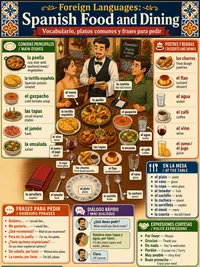
When you walk into a Spanish restaurant, greet the waiter politely before asking for a table. The greeting depends on the time of day.
- Buenos días. Good morning.
- Buenas tardes. Good afternoon.
- Buenas noches. Good evening or good night.
- Una mesa para dos, por favor. A table for two, please.
- ¿Tiene una mesa libre? Do you have a free table?
Notice that questions in Spanish open with an inverted question mark, ¿, and close with a normal one.
Ordering Food and Drink
The polite way to order is with quisiera (I would like) rather than the blunter quiero (I want). Many meals are organized into a first course (de primero), a main course (de segundo), and a dessert (de postre).
- Para beber, quisiera... To drink, I would like...
- De primero, para mí... For the starter, for me...
- De segundo, voy a tomar... For the main, I'll have...
- ¿Qué me recomienda? What do you recommend?
- Para mí, sin carne, por favor. For me, no meat, please.
Asking Questions Politely
To get the waiter's attention politely, start with Perdone (excuse me) or Disculpe. Use these phrases to ask about the food or to make a request.
- ¿Qué lleva este plato? What is in this dish?
- ¿Tiene opciones vegetarianas? Do you have vegetarian options?
- ¿Me trae más pan, por favor? Could you bring me more bread, please?
- ¿Dónde está el baño? Where is the bathroom?
- Soy alérgico a los frutos secos. I'm allergic to nuts.
Paying and Saying Goodbye
When you are ready to leave, ask for la cuenta (the bill). In Spain, service is usually included and tipping is modest. Finish with a polite thank you.
- La cuenta, por favor. The bill, please.
- ¿Me trae la cuenta? Could you bring me the bill?
- ¿Puedo pagar con tarjeta? Can I pay by card?
- ¿Está incluido el servicio? Is service included?
- Todo estaba muy rico, gracias. Everything was very tasty, thank you.