Spanish Sentence Builder
Arrange Spanish word tiles into correct sentences. Practice word order, adjective placement after nouns, and gender and number agreement with instant feedback.
No distractor tiles. The grammar note is shown up front.
The adjective follows the noun, and rojo agrees with the masculine singular coche.
How it works
Read the English prompt, then tap Spanish word tiles to move them into the sentence tray. Tap a tile in the tray to send it back to the pool. Press Check to test your order. If a tile sits in the wrong position, it is highlighted so you can fix it.
Three modes change the challenge. Learn removes distractor tiles and shows the grammar note up front. Practice adds a few wrong tiles. Challenge adds more distractors and hides the note until you reveal the answer. Use Share to copy a link to your current mode, sentence, and score.
Curriculum alignment
This tool supports middle school and high school world languages courses. It targets sentence construction, basic word order, adjective placement, and agreement, which are core goals of introductory and intermediate Spanish.
It aligns with the ACTFL communication standards for presentational and interpretive language and gives learners low stakes repetition that builds toward writing full sentences.
Spanish word order
Basic Spanish sentences usually follow subject, verb, object, much like English. Yo como una manzana means I eat an apple. Subject pronouns like yo, tú, and ella are often optional because the verb ending already shows who is acting, but this tool includes them so you can practice full forms.
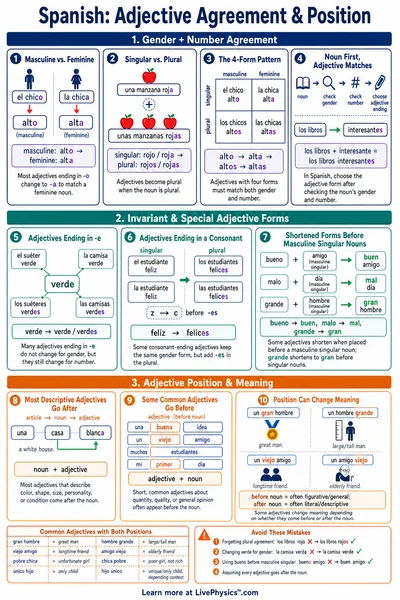
The biggest difference from English is where adjectives go. Descriptive adjectives usually come after the noun. El coche rojo means the red car, with rojo placed after coche rather than before it.
Adjective agreement
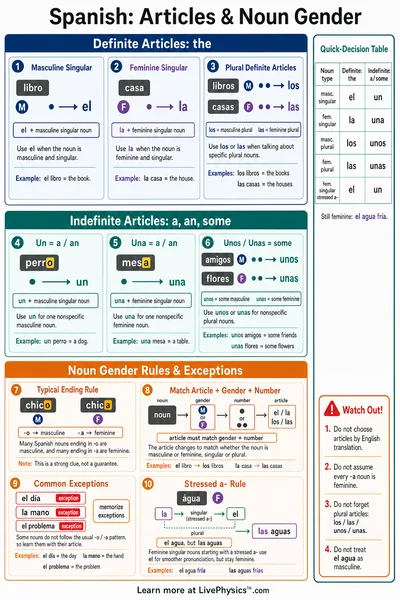
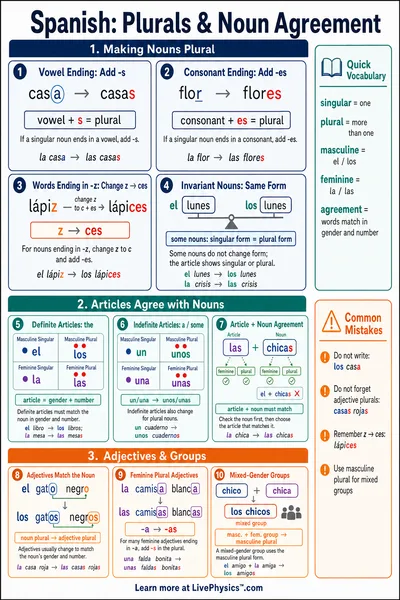
Adjectives and articles must match the noun in gender and number. A masculine singular noun takes a masculine singular adjective, so el perro pequeño. A feminine plural noun takes a feminine plural adjective, so las flores bonitas.
Some adjectives have one form for both genders. Grande and verde do not change for gender, though verde still adds es in the plural to become verdes. Watch for spelling shifts too, since feliz becomes felices in the plural.