Spanish Family Tree Lab
Practice the Spanish vocabulary of la familia using a small family tree. The lab points to a person relative to Ana and asks you to name the relationship in Spanish, or gives a Spanish term and asks you to pick the right person. An accent helper makes typing á, é, í, ó, ú, and ñ easy, and answers are logged for your lab report.
La familia de Ana
Progress
Elena is Ana's mother. What is Elena to Ana?
Possessive practice Elena es mi ___ (use mi for 'my'). Spanish possessives are mi (my), tu (your), su (his/her/their), and nuestro/nuestra (our).
Controls
Practice la familia vocabulary in Spanish
Read the relationship, name it in Spanish, then check or reveal. Your answers are logged in the data table below.
Data Table
(0 rows)| # | Question | My Answer | Correct Term | Result |
|---|
Reference Guide
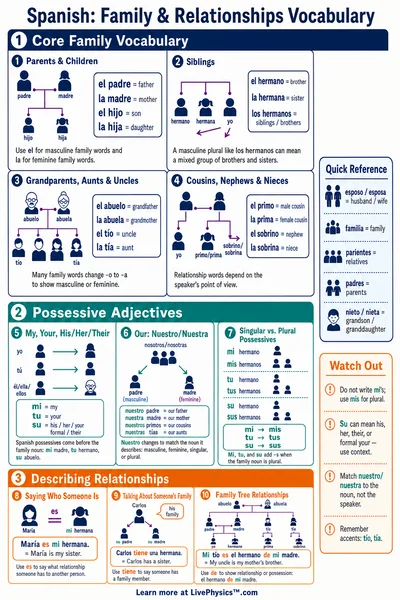
Core Family Vocabulary
Most Spanish family words come in a masculine and feminine pair. The masculine form usually ends in -o and the feminine in -a.
- madre / padre. Mother and father. Plural padres means parents.
- hijo / hija. Son and daughter.
- hermano / hermana. Brother and sister.
- abuelo / abuela. Grandfather and grandmother.
- nieto / nieta. Grandson and granddaughter.
- esposo / esposa. Husband and wife.
Extended Family Terms
Aunts, uncles, cousins, nieces, and nephews follow the same -o and -a gender pattern. Two of them carry a written accent that is part of the spelling, not optional.
- tío / tía. Uncle and aunt. Note the accent on the i.
- primo / prima. Cousin (male and female).
- sobrino / sobrina. Nephew and niece.
- bisabuelo / bisabuela. Great-grandfather and great-grandmother.
A relationship by marriage often uses político, as in tío político (uncle by marriage). In this lab the spouse of an aunt or uncle is treated simply as tío or tía.
Possessive Adjectives
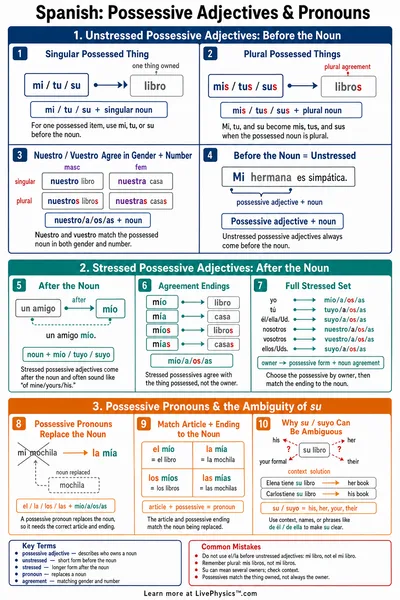
Spanish possessives agree with the thing owned, not the owner. They go before the noun.
- mi / mis. My. Mi madre, mis hermanos.
- tu / tus. Your (informal). Tu primo, tus tíos.
- su / sus. His, her, your (formal), their. Su abuela.
- nuestro / nuestra. Our. Nuestro padre, nuestra casa.
Only nuestro changes for gender (nuestro / nuestra) and number (nuestros / nuestras). Mi, tu, and su only change for number.
How to Read the Tree
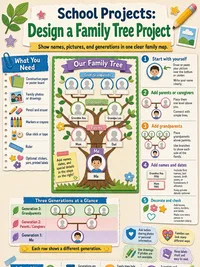
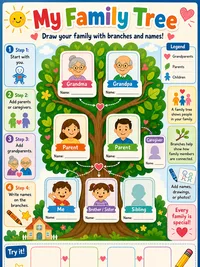
Work out a relationship by tracing the path step by step. The mother of your mother is your abuela. The brother of your mother is your tío. The child of your aunt or uncle is your primo or prima.
Gender follows the person you are naming, not the person you start from. Carlos is an abuelo and Rosa is an abuela, even though both are grandparents of the same child.
In this lab, dashed gold lines connect a married couple (esposo and esposa) and solid gray lines connect parents to their children. The person marked with a star is the reference point for each question.