Arc Length & Surface of Revolution Explorer
Choose a function and interval, pick an axis of revolution, and read off the arc length and surface area. Both are computed numerically with Simpson's rule so you can see how the integral formulas turn into a single number.
Results for y = x
Arc length
Surface of revolution (about x-axis)
Revolving the curve generates a surface whose radius at each slice is the distance from the curve to the axis. Here the radius is y.
Reference Guide
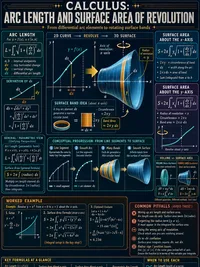
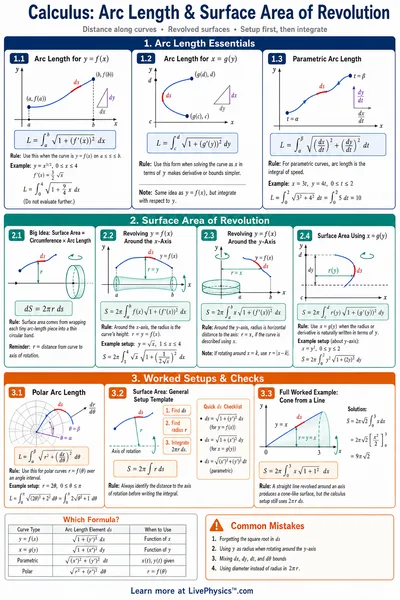
Arc Length
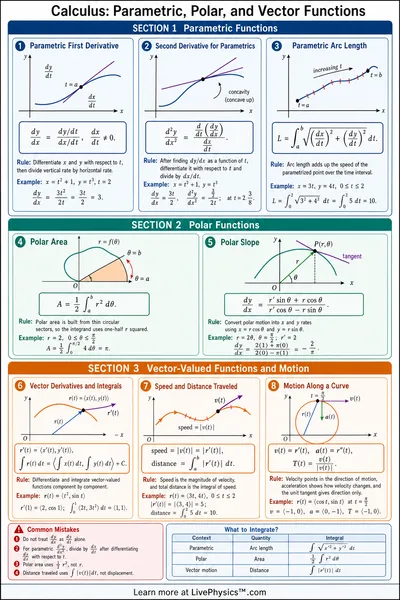
The arc length of y = f(x) over an interval comes from adding up tiny hypotenuses ds along the curve. Each piece has horizontal run dx and vertical rise f'(x) dx, so by the Pythagorean theorem ds = sqrt(1 + (f'(x))^2) dx.
Integrating ds from a to b accumulates the full length of the curve.
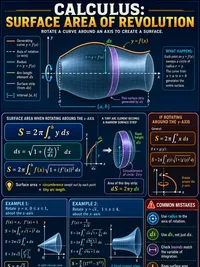
Surface of Revolution
Revolving the curve about an axis sweeps out a surface. A slice of length ds at distance r from the axis traces a band of area 2 pi r ds, so the surface area is the integral of 2 pi r ds.
About the x-axis the radius is r = y; about the y-axis it is r = x. This is surface area only. Volume of a solid of revolution is a different integral.
Endpoints Where the Slope Diverges
Some curves have a vertical tangent at an endpoint. For y = sqrt(x) the derivative is f'(x) = 1 / (2 sqrt(x)), which blows up as x approaches 0. The integrand sqrt(1 + (f'(x))^2) still gives a finite arc length, but a naive sample exactly at x = 0 is undefined.
This tool starts the sqrt interval at a small positive value and Simpson's rule skips any non-finite sample, so the computed length stays accurate without dividing by zero.