Function Graph Explorer
Plot Cartesian, polar, and parametric curves. Trace points along each curve, explore properties, and see step-by-step derivative analysis. Updated in real-time.
Functions
f
g
h
Display
Properties
Enter a function and click Graph to see properties.
scroll to zoom · drag to pan
Quick Reference
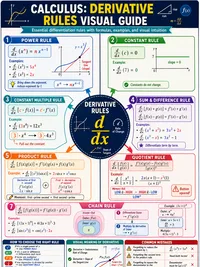
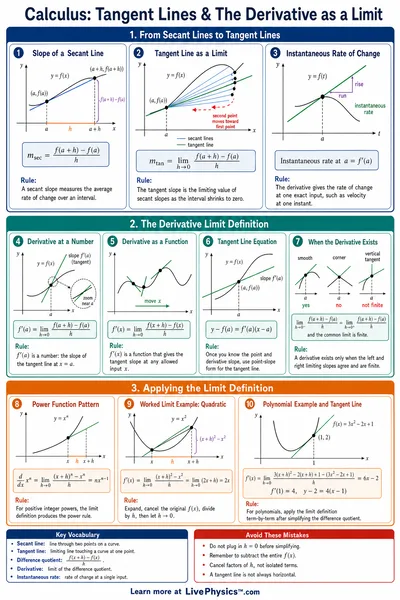
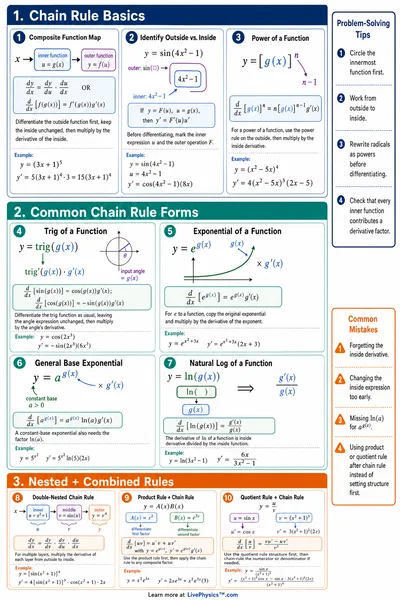
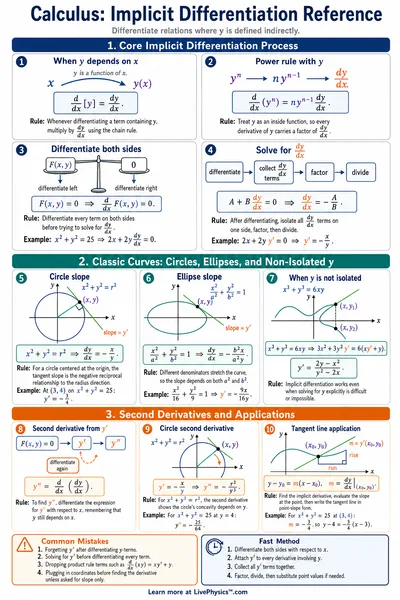
Derivative Rules
Power Rule
Product Rule
Chain Rule
Trig Derivatives
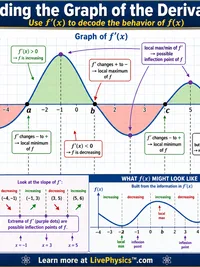
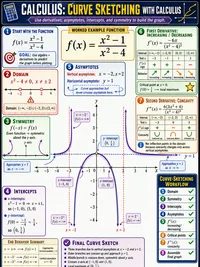
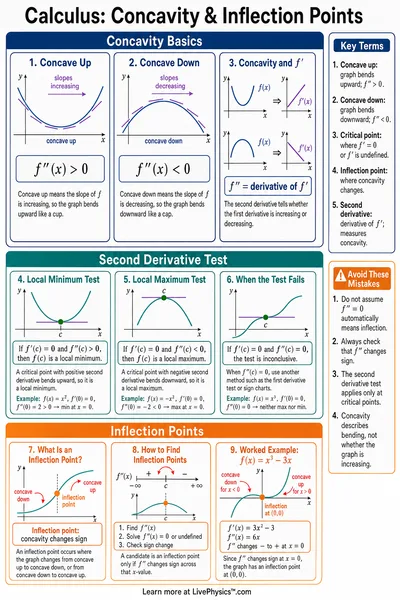
Graph Features
Roots Where . The function crosses the x-axis.
Extrema Where . Local maxima or minima.
Inflection Where . Concavity changes.
Increasing | Decreasing
Polar Curves
A polar curve gives the distance from the origin as a function of the angle, . Convert to Cartesian with and .
Cardioid
Rose gives
petals for odd , for even.
Enclosed area
Parametric Curves
A parametric curve traces as the parameter runs from 0 to . It can loop and cross itself, unlike a function graph.
Circle
Lissajous
Arc length
Interval Notation
Open interval Excludes endpoints.
Closed interval Includes endpoints.
Unbounded or
Union Combines intervals.
Example means
all less than or greater than .
Related Content
Related Tools
Derivative & Integral Visualizer
Plot f(x), f'(x), and F(x) together. Drag a point to see the tangent line slope and accumulated area with step-by-step differentiation.
Sequence & Series Explorer
Explore arithmetic and geometric sequences with terms, partial sums, and convergence analysis.
Polar & Parametric Graph Explorer
Graph roses, cardioids, Lissajous curves, cycloids, and more with animated tracing and area/arc length computation.
Riemann Sum Explorer
Approximate definite integrals with left, right, midpoint, and trapezoidal methods. Slider for number of rectangles shows convergence.
Related Labs
Derivatives & Tangent Lines Lab
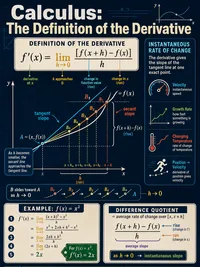
Visualize derivatives as slopes of tangent lines, animate secant lines approaching tangents as h approaches 0, explore derivative rules step by step, and compute slopes on implicit curves
Optimization & Related Rates Lab
Solve optimization problems with interactive diagrams showing the objective function and critical points. Explore related rates with animated geometry and chain rule applications
Limits & Continuity Lab
Explore the formal epsilon-delta definition of limits, apply the squeeze theorem, and classify removable, jump, and infinite discontinuities by testing continuity conditions
Parametric, Polar & Vector Lab
Trace parametric curves with velocity vectors, compute polar areas and arc lengths, and analyze vector-valued motion with speed, curvature, and tangential-normal acceleration decomposition