Vocabulary in Context Lab
Practice determining word meanings from context clues. Read each sentence, infer the definition, identify the type of clue used, and write the word in a new sentence. Three word sets cover academic, science, and social studies vocabulary.
Word Sets
Progress
0% complete
Controls
Current set Academic Vocabulary
For each word, read the sentence, write your definition, identify the clue type, then reveal the answer.
hypothesis(noun)
Context Sentence
Before starting the experiment, Maria wrote her hypothesis, which was her educated guess about what results she expected to find based on prior research.
What type of context clue helped you?
analyze(verb)
Context Sentence
The scientist needed to analyze the data carefully, examining each number and identifying patterns before drawing any conclusions.
What type of context clue helped you?
conclude(verb)
Context Sentence
After reviewing all of the results, the team was able to conclude that the new medicine was effective - unlike before the study, when they were unsure.
What type of context clue helped you?
evidence(noun)
Context Sentence
The lawyer presented evidence to the jury, including fingerprints, photographs, and witness statements, all of which supported her argument.
What type of context clue helped you?
infer(verb)
Context Sentence
From the muddy boots by the door and the smell of rain, we could infer that someone had recently come in from outside.
What type of context clue helped you?
significant(adjective)
Context Sentence
The difference between the two test scores was significant; one student scored 62% while the other scored 98%, a gap of 36 percentage points.
What type of context clue helped you?
Data Table
(0 rows)| # | Word | My Definition | Actual Definition | Clue Type | Accuracy |
|---|
Reference Guide
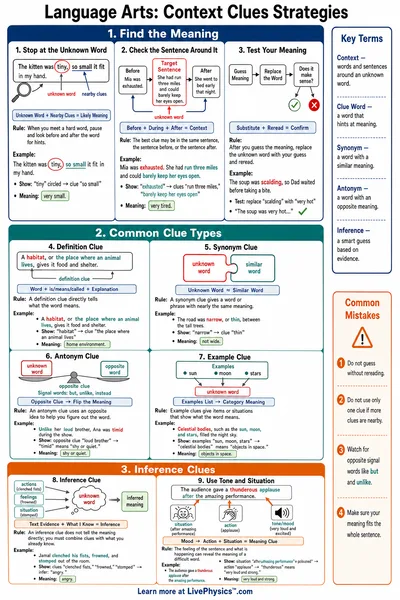
Types of Context Clues
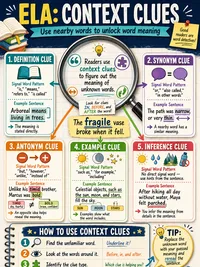
Context clues are hints within a sentence or paragraph that help you figure out the meaning of an unfamiliar word. There are five main types.
- Definition. The sentence directly states the word's meaning, often using "is," "means," or commas.
- Synonym. A word with a similar meaning appears nearby.
- Antonym/Contrast. An opposite word or contrasting idea reveals the meaning, often signaled by "unlike," "but," or "however."
- Example. Specific examples of the word are given, often introduced by "such as," "including," or "for example."
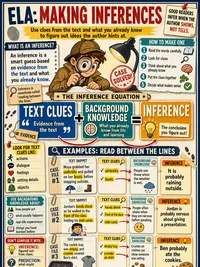
- Inference. You combine background knowledge with surrounding text to deduce the meaning.
Using Definition Clues
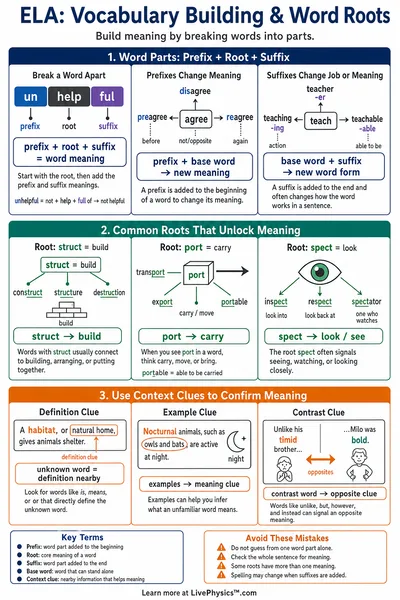
Definition clues are the most direct type. Authors often embed a definition right in the sentence when they introduce a technical or academic term.
Signal phrases to look for include "is defined as," "which means," "known as," "in other words," and "also called."
Commas and dashes can also signal an embedded definition. For example, in "An herbivore, an animal that eats only plants, grazes in the meadow," the phrase between the commas defines the word.
Practice tip, When you spot a definition clue, underline the signal phrase and box the definition. Restate it in your own words to confirm understanding.
Using Contrast and Example Clues
Antonym or contrast clues show you what a word is NOT. Signal words include "unlike," "but," "however," "although," "on the other hand," and "instead of."
To use a contrast clue, identify the word you know (the contrast), then think about its opposite. That opposite is likely the meaning of the unfamiliar word.
Example clues give you specific instances that fall under the meaning of the word. Signal words include "such as," "including," "like," "for example," and "for instance."
Practice tip, List the examples and ask yourself, "What category do all these belong to?" That category is typically the word's meaning.
Building Your Academic Vocabulary
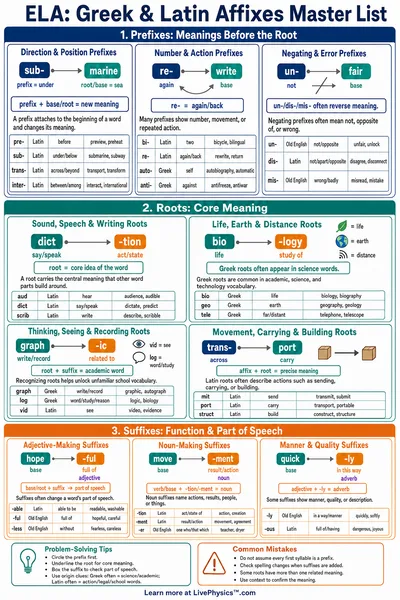
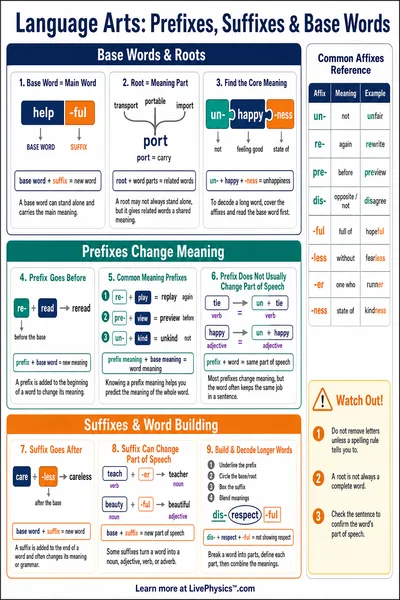
Academic vocabulary words appear across many subjects and text types. Mastering them improves reading comprehension in every class.
The Frayer Model is a useful four-part strategy for learning new words. For each word, write, (1) the definition in your own words, (2) characteristics of the word, (3) examples, and (4) non-examples.
Writing a new sentence forces you to use the word actively, which strengthens memory more than reading or copying a definition alone.
Tip, After finishing a word set, cover the definitions and try to recall each word's meaning from the context sentence alone. Spaced review like this builds lasting vocabulary knowledge.