Practice working with parametric equations by making tables, eliminating parameters, identifying direction, and interpreting motion.
Read each problem carefully. Show your work in the space provided. When graphing, label important points and indicate the direction of motion.
Graphing, interpreting, and converting parametric relationships
Math - Grade 9-12
- 1
For the parametric equations x = t + 1 and y = t^2, find the ordered pairs for t = -2, -1, 0, 1, and 2.
- 2
Eliminate the parameter for x = 3t - 2 and y = 6t + 1. Write the rectangular equation.
- 3
Eliminate the parameter for x = t^2 and y = t + 4. State any restriction on x.
- 4
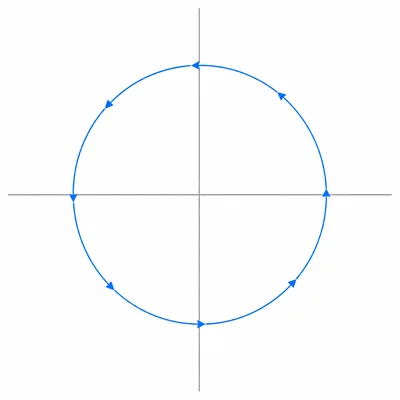
The equations x = 4 cos t and y = 4 sin t are graphed for 0 <= t <= 2π. Describe the graph and its direction.
- 5
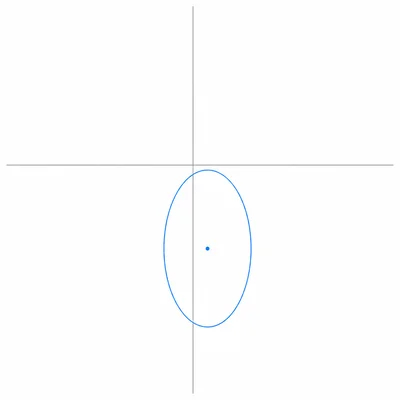
Eliminate the parameter for x = 2 + 3 cos t and y = -1 + 5 sin t. Identify the shape.
- 6
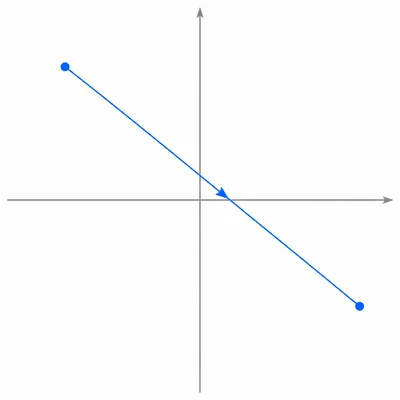
For x = 1 + 2t and y = 5 - t with 0 <= t <= 3, find the endpoints of the graph and describe the direction of motion.
- 7
Determine whether x = 2t, y = 4t^2 traces the same rectangular curve as x = s, y = s^2. Explain your answer.
- 8
Write one possible parametric representation for the rectangular equation y = 3x^2 - 2.
- 9
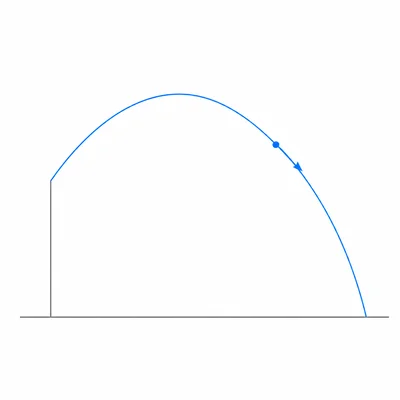
A projectile is modeled by x = 40t and y = 5 + 30t - 16t^2, where t is time in seconds and x and y are measured in feet. Find the projectile's position at t = 1.5 seconds.
- 10
Determine whether the point (5, 12) lies on the parametric curve x = 2t - 1 and y = t^2 + 3.
- 11
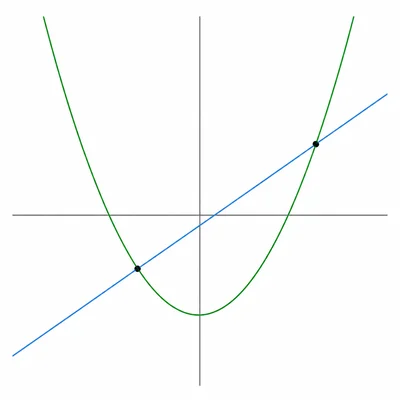
Find the intersection points of the two parametric curves x = t, y = t + 2 and x = s^2, y = 4 - s.
- 12
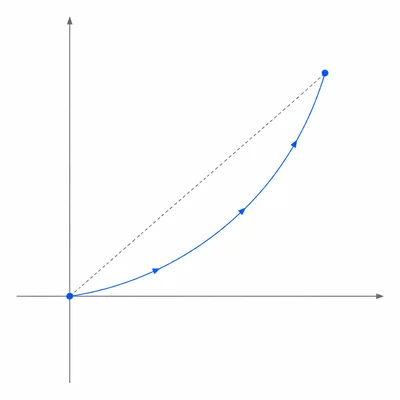
A particle moves according to x = 3t^2 and y = 4t for 0 <= t <= 3. Find its starting point, ending point, and displacement distance from start to end.
- 13
For x = t^2 + 1 and y = t^3, find the slope dy/dx at t = 2.
- 14
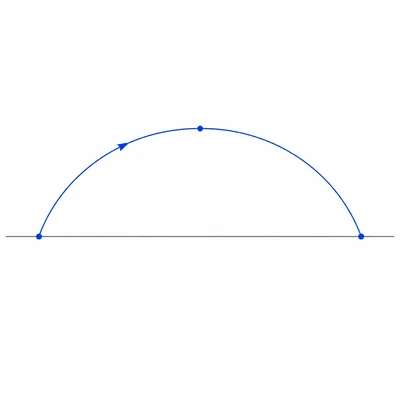
For the parametric curve x = t - sin t and y = 1 - cos t, find the points when t = 0, t = π, and t = 2π.
- 15
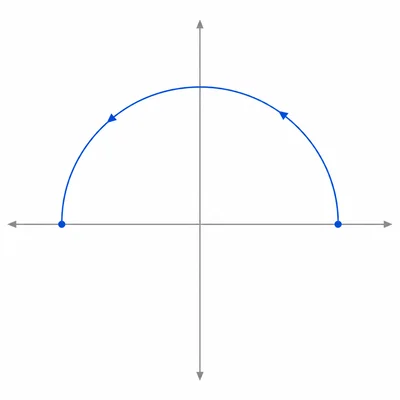
The parametric equations x = 5 cos t and y = 5 sin t trace a circle. What interval of t traces only the upper semicircle from (5, 0) to (-5, 0)?