Light, Shadows & Materials Explorer
Does light pass through wood? What about frosted glass? Classify materials as transparent, translucent, or opaque, and predict how strong the shadow will be.
Level
Score 0
🪟
Clear Glass
Think about how light behaves with this material...
Reference Guide
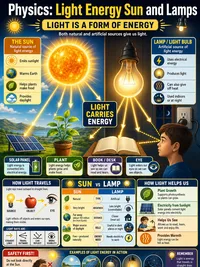
How Materials Interact with Light
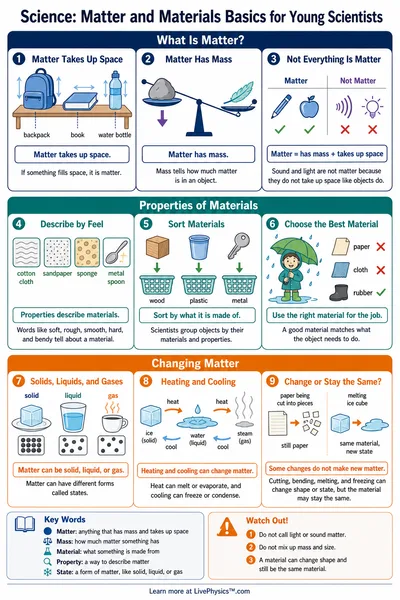
- Transparent. Light passes straight through (clear glass, water).
- Translucent. Some light passes through, rest is scattered (frosted glass, tissue).
- Opaque. No light passes through (wood, rock, cardboard).
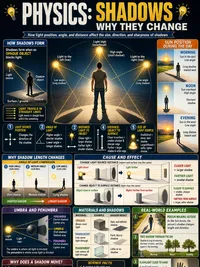
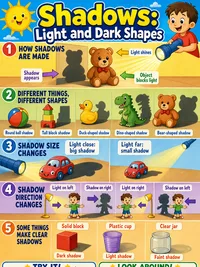
Shadows and Light
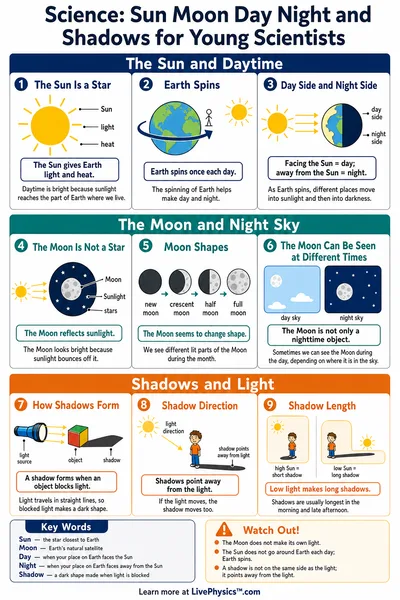
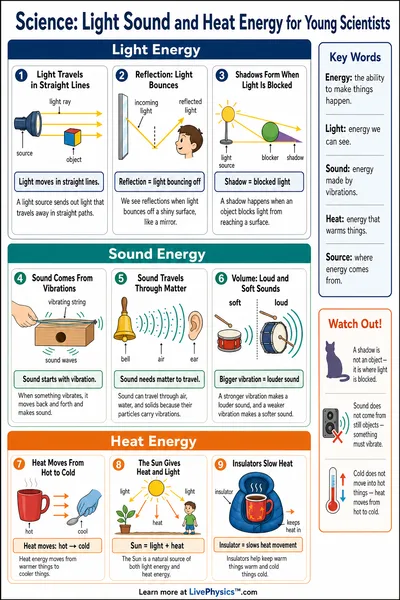
- A shadow forms when an object blocks light.
- Opaque objects make dark, sharp shadows.
- Translucent objects make faint or fuzzy shadows.
- Transparent objects make no shadow at all.
Related Content
Related Tools
Projectile Motion Calculator
Calculate trajectory, range, max height, and time of flight for projectile motion. Visualize the parabolic path with an interactive time slider and velocity vectors.
Circuit Calculator
Calculate voltage, current, resistance, and power with Ohm's law. Build series and parallel resistor networks with step-by-step equivalent resistance.
Lens & Mirror Calculator
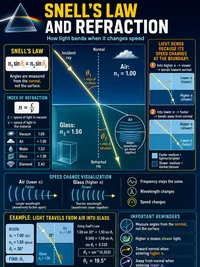
Visualize image formation with interactive ray diagrams for lenses and mirrors.
Kinematics Solver
Solve constant-acceleration problems with step-by-step solutions and motion graphs.
Related Labs
Light, Shadows & Materials Lab
Investigate how transparent, translucent, and opaque materials change the shadows they cast. Record shadow strength for glass, water, wood, fabric, and more. Grades K-1.
Communication Device Lab
Investigate how light patterns, drum beats, and cup-phone vibrations send messages over distance. Record patterns and decode signals across three device types. Grades K-1.
Geometric Optics Lab
Build ray diagrams for converging and diverging lenses and mirrors. Verify the thin lens equation, measure image distance and magnification, and classify images as real or virtual