Waves & Secret Messages Lab
Discover how waves carry information. Explore amplitude and wavelength, test which materials sound and light can pass through, and decode secret messages using flashes of light - just like real signal lamps used at sea.
Guided ExperimentWaves and Information
How do waves carry information from one place to another? Predict whether sound can travel through outer space.
Write your hypothesis in the Lab Report panel, then click Next.
Controls
Wave Visualizer
Wave Vocabulary - click a card to reveal its definition
Quick Check - 3 Questions
1. What part of a wave is the highest point?
2. A wave with BIG amplitude would be...
3. Wavelength measures the distance from one _____ to the next.
Data Table
(0 rows)| # | Wave Type | Travels Through | Cannot Travel Through |
|---|
Reference Guide
What Is a Wave?
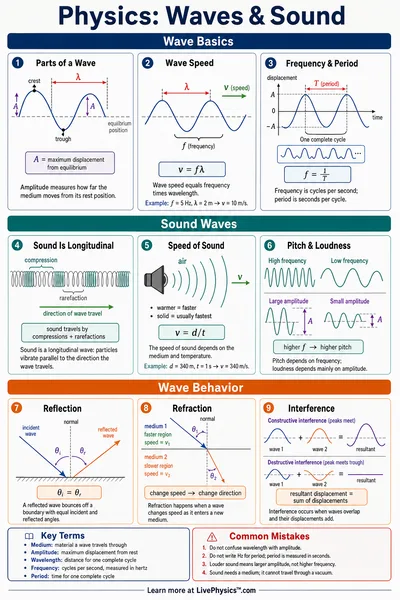
A wave is a disturbance that moves energy from one place to another. When you drop a pebble in a pond, the ripples that spread outward are waves.
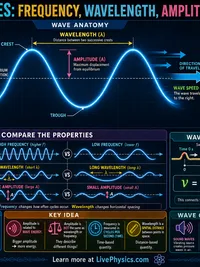
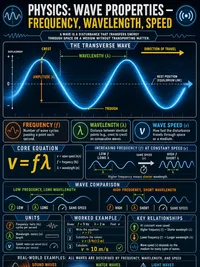
Waves have repeating patterns. The high points are called crests and the low points are called troughs.
Amplitude and Wavelength
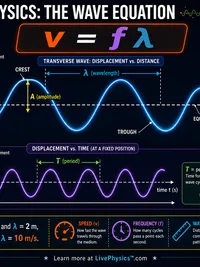
Amplitude is the height of a wave from the center line to the crest. A large amplitude means the wave carries more energy - a sound wave with big amplitude is louder, and a light wave with big amplitude is brighter.
Wavelength is the distance from one crest to the next crest. Short wavelengths mean the wave cycles quickly - like a high-pitched sound or blue light.
Sound Waves vs Light Waves
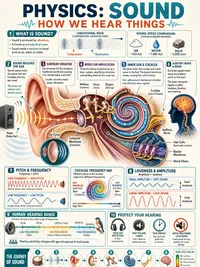
Sound waves are mechanical waves. They need matter - like air, water, or solid objects - to travel. Sound cannot travel through empty space. That is why space is silent.
Light waves are electromagnetic waves. They do not need matter and can travel through empty space at 300,000 km per second. That is how we see light from distant stars.
- Sound. Needs a medium (air, water, solid)
- Light. Travels through vacuum just fine
- Radio waves. Electromagnetic, like light
How Waves Carry Information
Waves carry information by varying their pattern in a meaningful way. A flash of light can represent a letter. A radio wave that changes its frequency carries music. A sound wave carries your voice.
Morse code uses short and long signals (dots and dashes) to encode every letter of the alphabet. The flash code in this lab works the same way - the number of flashes tells you the letter.