Understanding Map Skills Explorer
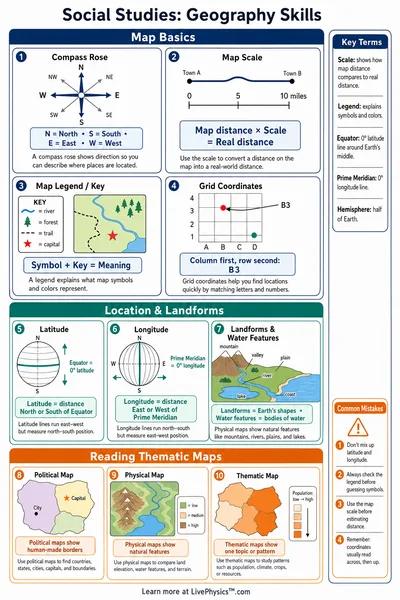
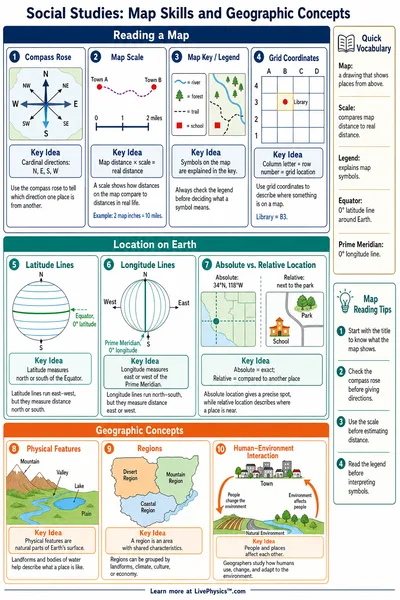
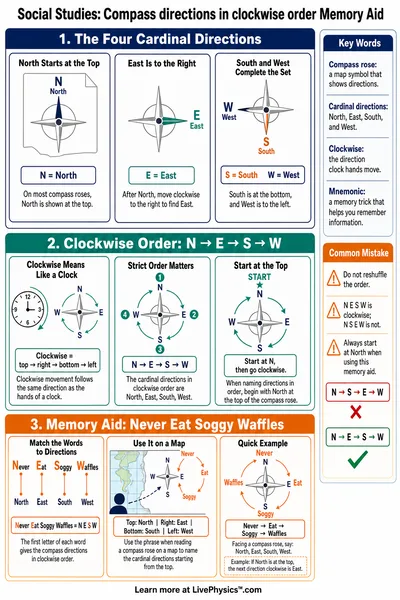
A map is a model, not a photograph of a place. It leaves out most details so that important patterns can be seen quickly. Direction helps readers relate one feature to another, such as knowing that a school lies southeast of a park.
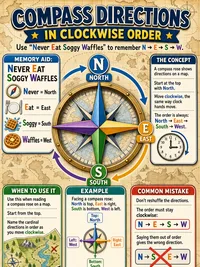
Most classroom maps place north at the top, but this is a convention rather than a rule. Always check the compass rose before assuming the page is oriented in the usual way.
Grid references give locations a shared address. The usual method is to read across first, then up, much like moving along a hallway before going to a higher floor. This order matters because reversing the numbers points to a different square.
Some maps use letters with numbers, while others use two sets of numbers. A grid square identifies an area, so a landmark near an edge may need careful checking against nearby lines.
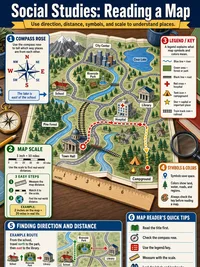
Symbols make crowded information easier to read. A small blue line can represent a stream, but its width on paper does not show the stream's real width. A legend explains the mapmaker's choices, including symbols that may not be familiar or may change between maps.
Colors often carry meaning too. Blue commonly shows water, green may show vegetation, and different road lines can show different types of routes. These patterns are useful clues, but the legend is the final authority.
Scale connects a paper measurement to a real distance. If one centimeter on a map represents one kilometer on the ground, a measured route of three centimeters represents three kilometers. Units must stay consistent during the calculation.
A ruler works well for a straight path, while a string or a strip of paper can follow a curved road or river before being measured. Real travel distance can be longer than map distance because people must follow paths, cross bridges, or avoid barriers.
These skills are used beyond school atlases. People use directions in hiking apps, coordinate systems in emergency services, symbols on transit maps, and scales in building plans. Digital maps can make the work seem automatic, yet they still depend on choices about direction, symbols, location, and zoom level.
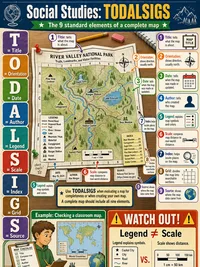
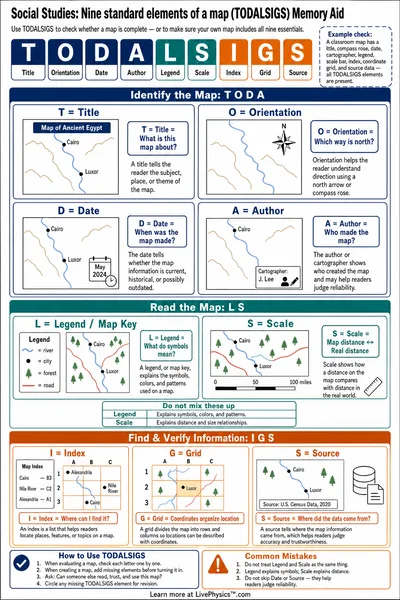
When studying a map, pause to notice its title, date, purpose, and source. A tourist map, weather map, election map, and topographic map each show different evidence, so a good reader considers what the map is designed to communicate.