Historical Timeline Maker
Build and explore interactive timelines of historical events. Add events by year, title, category, and description. Load a preset to study the American Revolution, the Civil Rights Movement, or Ancient Civilizations, then compare two eras side by side.
7 events · 1765 CE to 1789 CE
History Reference Guide
Reading Timelines
A timeline shows historical events arranged in chronological order along a line. Reading a timeline helps you understand the sequence of events, identify cause and effect, and compare the pace of change across eras.
- Chronological order. Events on a timeline run from earliest (left or top) to latest (right or bottom).
- Scale matters. The space between two events on a timeline represents the amount of time between them.
- BCE and CE. BCE (Before Common Era) years count backward from year 1. The higher the BCE number, the older the event.
- Cause and effect. Events earlier on a timeline often caused or influenced events that appear later.
The American Revolution
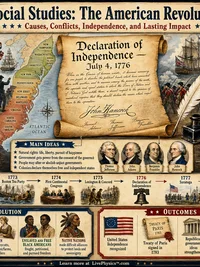
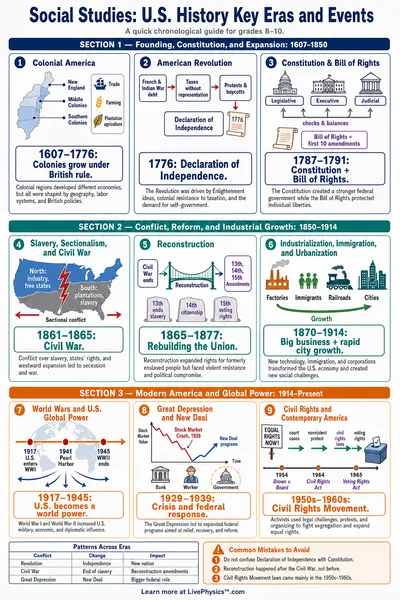
The American Revolution (1765-1789) transformed thirteen British colonies into an independent nation. Tensions over taxation and representation escalated into armed conflict and, ultimately, a new democratic republic.
- Taxation without representation was the colonists' core grievance against British rule after the Stamp Act of 1765.
- The Declaration of Independence (1776) drew on Enlightenment ideas about natural rights and self-governance.
- The Treaty of Paris (1783) ended the war and granted the United States sovereignty over territory east of the Mississippi.
- The Constitution (1789) created a federal government with three branches to prevent any one person or group from holding absolute power.
The Civil Rights Movement
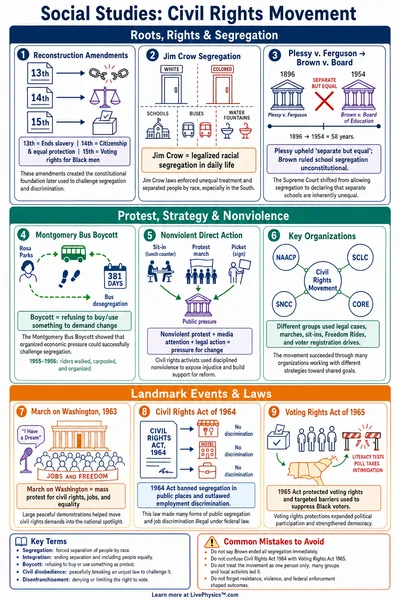
The Civil Rights Movement (1954-1968) was a sustained campaign to end racial segregation and discrimination against African Americans in the United States, using nonviolent protest, legal action, and political organizing.
- Brown v. Board of Education (1954) overturned the "separate but equal" doctrine, ruling school segregation unconstitutional.
- The Montgomery Bus Boycott (1955-56) demonstrated the power of organized, nonviolent economic protest.
- The Civil Rights Act (1964) and the Voting Rights Act (1965) codified legal protections into federal law.
- Key strategies included sit-ins, freedom rides, marches, and coalition building across racial and religious communities.
Ancient Civilizations at a Glance
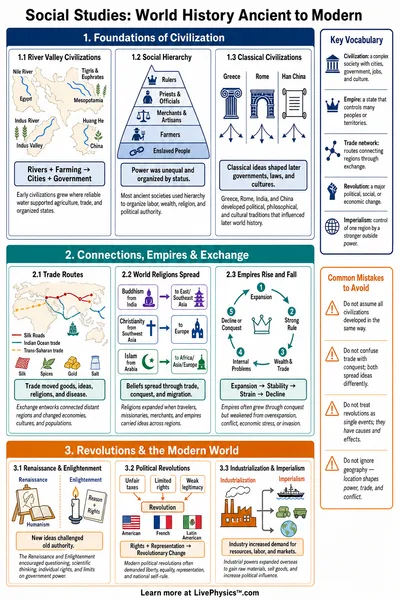
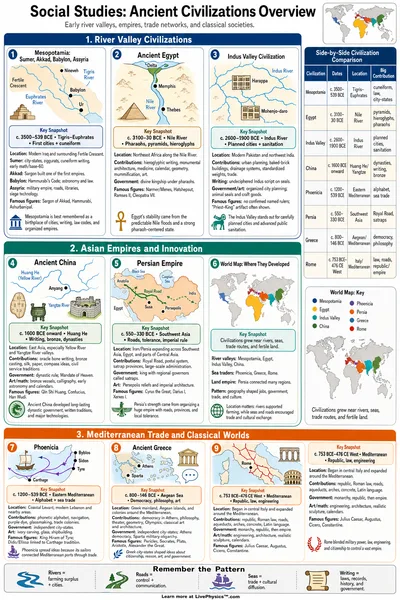
Ancient civilizations from Egypt to Rome laid the foundations of modern government, culture, religion, and science across a span of more than 3,000 years.
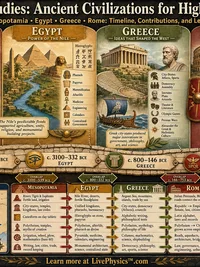
- Egypt (3100-30 BCE) developed writing, monumental architecture, and a centralized state under pharaohs.
- Ancient Greece (800-146 BCE) gave the world democracy, philosophy, the Olympic Games, and foundational works in theater, science, and mathematics.
- The Roman Republic and Empire (509 BCE - 476 CE) spread law, engineering, and Latin throughout Europe and the Mediterranean world.
- The fall of the Western Roman Empire in 476 CE marks the traditional boundary between ancient history and the Middle Ages.