Primary vs Secondary Sources
Learn to identify primary and secondary sources, analyze historical documents with the SOAPST framework, and practice creating MLA citations.
Primary Sources
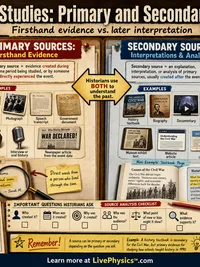
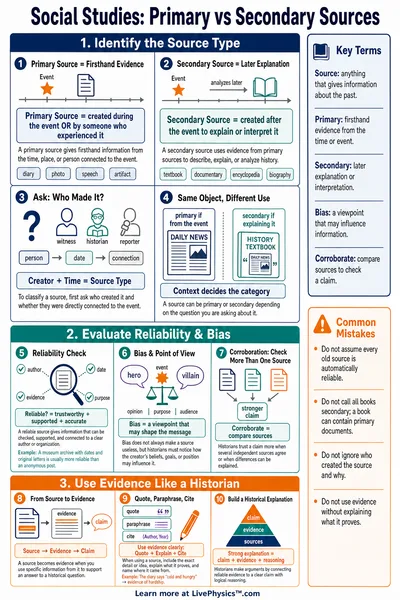
Created at the time of an event, or by someone who directly experienced it.
- Letters and diaries
- Speeches and interviews
- Photographs and films
- Original documents and laws
- Artifacts and physical objects
- Newspaper articles from the time
Secondary Sources
Created after an event, using and interpreting primary sources as evidence.
- Textbooks and encyclopedias
- Biographies and documentaries
- History articles and essays
- Museum exhibit labels
- Academic research papers
- Book reviews and analyses
Key Question to Ask
When identifying a source, ask "Was this created during or immediately after the event, by someone who was there?"
- Yes - it is likely a primary source
- No - it is likely a secondary source
Reference Guide
Primary vs Secondary Sources
A primary source is a document or artifact created at the time of an event, or by a direct participant. Examples include letters, diaries, speeches, photographs, and original laws.
A secondary source is created after the event, using primary sources as evidence. Examples include textbooks, biographies, encyclopedias, and documentary films.
Both types are valuable. Primary sources offer first-hand perspective; secondary sources provide analysis and context.
The SOAPST Framework
SOAPST helps you analyze any document systematically
- S - Source, Who created it and what is their background?
- O - Occasion, What event prompted the document?
- A - Audience, Who was the intended reader?
- P - Purpose, What did the author want to achieve?
- S - Subject, What is the main topic?
- T - Tone, What is the author's attitude?
Evaluating Source Credibility
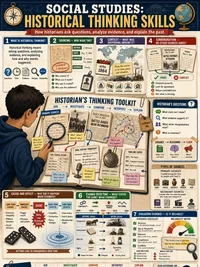
Not all sources are equally reliable. When evaluating any source, consider
- Who created it and what is their perspective?
- When was it created relative to the events?
- What was the author's purpose?
- Does it align with other sources on the same topic?
- Is the author an eyewitness or a later interpreter?
MLA Citation Basics
MLA (Modern Language Association) format is the standard for history and humanities citations.
Basic format for a book, Last, First. Title of Book. Publisher, Year.
Basic format for a website, Last, First. "Title of Page." Site Name, Date. URL.
Always include enough information for a reader to find the original source independently.