Mean Value Theorem & Rolle's Theorem Explorer
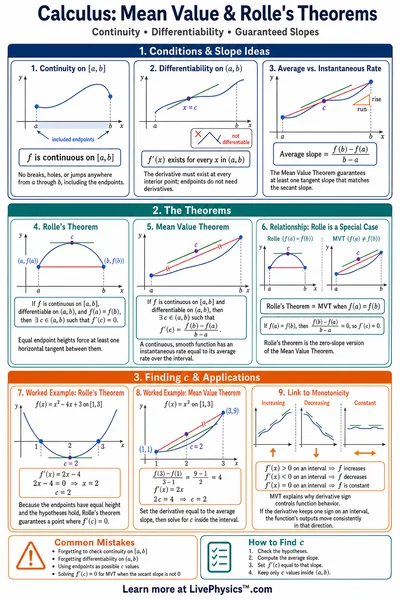
Choose a function and a closed interval [a, b]. The tool draws the secant line and finds every interior point c where , then draws the tangent there parallel to the secant.
Theorem statement
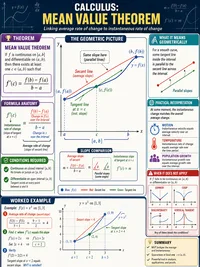
The Mean Value Theorem guarantees at least one interior point c in (a, b) where the tangent slope equals the average rate of change (the secant slope) over [a, b].
Computed values
Points c where f'(c) = secant slope
Hypotheses check
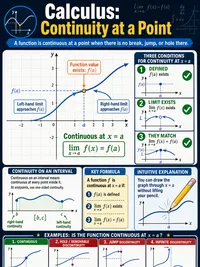
- f is continuous on the closed interval [a, b].
- f is differentiable on the open interval (a, b).
Reference Guide
The Mean Value Theorem
If f is continuous on the closed interval [a, b] and differentiable on the open interval (a, b), then there is at least one point c in (a, b) where
In words, the instantaneous rate of change at c equals the average rate of change across the whole interval.
Rolle's Theorem
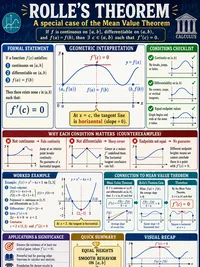
Rolle's Theorem is the special case where the endpoints have the same height, so f(a) = f(b). The secant line is then horizontal and the guaranteed point satisfies
Try f(x) = sin(x) on [0, π] or f(x) = x³ − x on a symmetric interval to see a horizontal tangent appear.
The geometric meaning
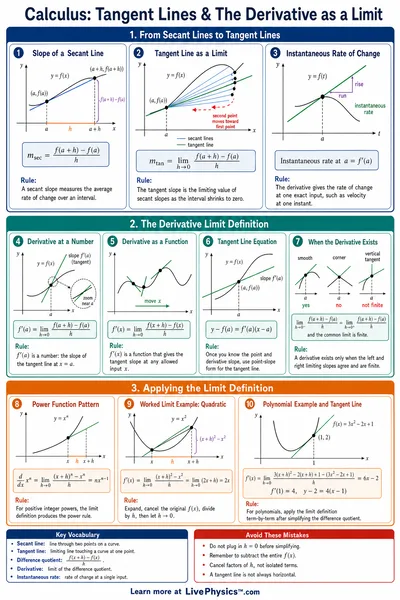
The secant connects the two endpoints (a, f(a)) and (b, f(b)). The theorem says somewhere along the curve the tangent line runs parallel to that secant. Both lines share the same slope, so the tangent at c is just the secant slid until it touches the graph.
Why the hypotheses matter
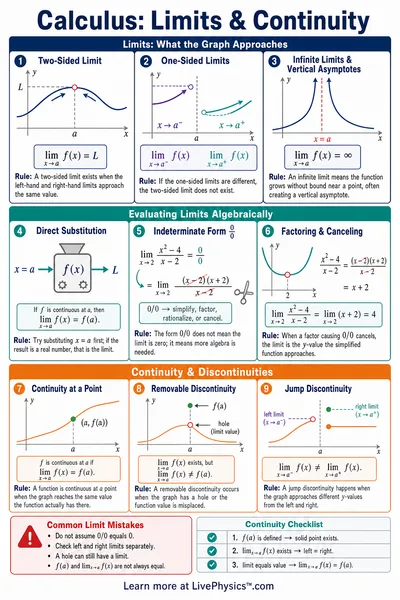
Both conditions are required. Pick f(x) = |x| on an interval such as [−2, 2]. The function is continuous, but it has a sharp corner at x = 0 so it is not differentiable there.
The secant slope is 0, yet no interior tangent line is ever horizontal, so the conclusion fails. A single missing hypothesis is enough to break the guarantee.