Preterite vs Imperfect Explorer
Practice when to use the Spanish pretérito and imperfecto with a guided quiz. Choose the aspect, reveal the conjugated form, and learn the rule behind each answer.
Subject yo | Verb hablar
Ayer ? con mi abuela por dos horas.
Yesterday I talked with my grandmother for two hours.
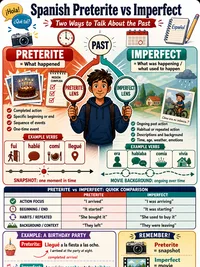
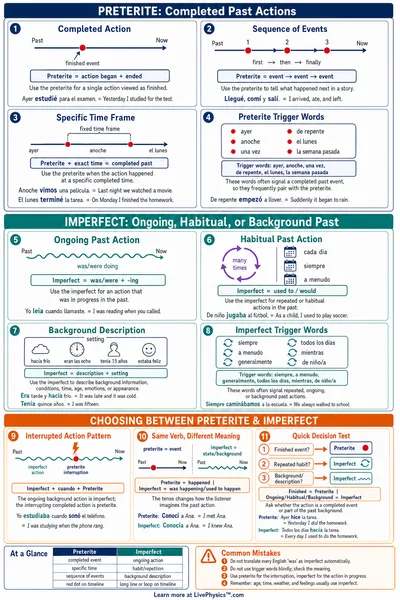
Use the pretérito
The pretérito reports actions the speaker views as completed. The action has a clear beginning, end, or a fixed number of times it happened.
- A single completed action. Ayer comí pizza.
- A sudden event. De repente sonó el teléfono.
- A sequence of finished actions. Llegué, comí y salí.
- An action within a defined time frame. Estudié por dos horas.
Signal words. ayer, anoche, el año pasado, de repente, primero, luego, una vez.
Use the imperfecto
The imperfecto describes ongoing, habitual, or background situations in the past. The action has no clear endpoint and sets the scene.
- A habitual or repeated action. Siempre comíamos juntos.
- Background or description. Era alto y tenía pelo largo.
- An ongoing action interrupted by another. Mientras leía, llamaron.
- Time, age, or weather in the past. Eran las tres y llovía.
Signal words. siempre, mientras, todos los días, generalmente, cuando era niño, de vez en cuando.
The two together
Many past-tense sentences mix both aspects. The imperfecto paints the ongoing background and the pretérito drops in the completed action that interrupts it.
Mientras caminaba a casa, empezó a llover.
Here caminaba is the ongoing action in the imperfecto and empezó is the completed interruption in the pretérito.
Curriculum alignment
This tool supports high school Spanish courses and the ACTFL Intermediate proficiency goals for narrating in the past. The three difficulty modes scaffold learners from recognizing signal words to producing the exact conjugated form.
Learn mode highlights the signal word and offers an aspect hint, Practice mode keeps the highlight only, and Challenge mode removes the cues and asks for the conjugation.