Spanish Gender and Article Practice
Practice Spanish noun gender and the correct definite and indefinite article. Quiz yourself on el, la, los, las, un, una, unos, and unas with gender rules and common exceptions.
0
Correct
0%
Accuracy
0
Best streak
Mode
Regular -o and -a nouns only, singular, with the gender rule shown before you answer.
How it works
Every Spanish noun has a grammatical gender, masculine or feminine, and the article must agree with it. This tool shows you a noun and asks for the correct article. Pick an answer, then read the gender rule that explains why.
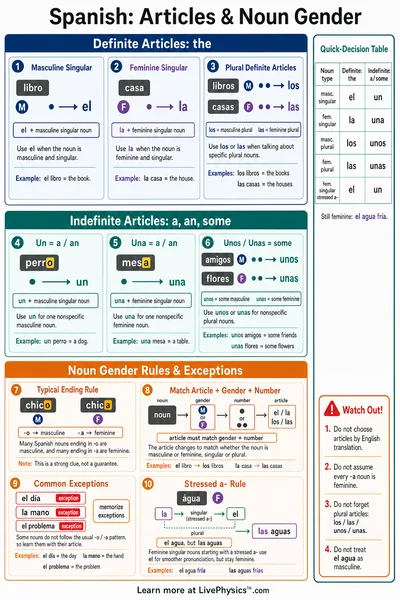
The definite article means "the" and changes with gender and number. Masculine words take el in the singular and los in the plural. Feminine words take la in the singular and las in the plural.
The indefinite article means "a", "an", or "some". Masculine words take un or unos, and feminine words take una or unas. Three presets let you start with regular nouns and a hint, then work up to exceptions and plurals with no help.
Gender rules
- Ends in -o. Usually masculine. el libro, el gato, el plato.
- Ends in -a. Usually feminine. la casa, la mesa, la ventana.
- Ends in -ción, -sión. Feminine. la canción, la televisión.
- Ends in -dad, -tad. Feminine. la ciudad, la libertad, la amistad.
- Other endings. Gender is not predictable, so learn the word with its article. el papel, la flor, la clase.
Common exceptions
Some nouns break the ending rules and must be memorized. These show up in the Challenge preset.
- Masculine despite ending in -a. el día, el mapa, el problema, el programa, el sistema, el planeta. Many words ending in -ma that come from Greek are masculine.
- Feminine despite ending in -o. la mano, la foto (short for la fotografía).
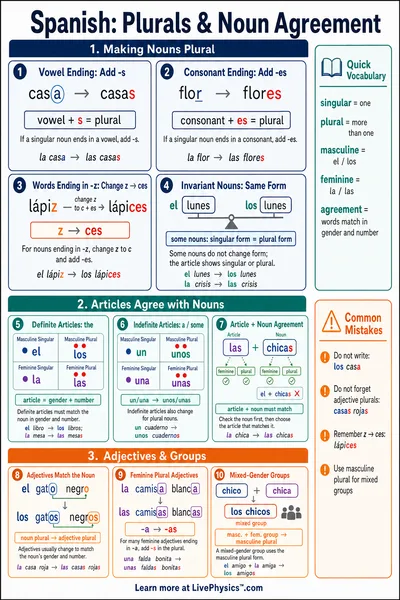
- Plural spelling changes. Words ending in -z change to -ces, so el lápiz becomes los lápices. Words ending in a consonant add -es, so la ciudad becomes las ciudades.
Curriculum alignment
Noun gender and article agreement are core first-year and second-year Spanish skills for middle school and high school. This tool supports ACTFL Novice-Mid through Intermediate-Low learners building accuracy with grammatical gender, definite and indefinite articles, and singular and plural agreement. The presets scaffold the work from guided practice with a visible rule, through mixed regular forms, to open practice with exceptions and plurals.