Spanish Accent Mark Practice
Practice Spanish stress and written accent rules. Classify words as aguda, llana, or esdrújula, click the stressed syllable, and type the correctly accented form.
Click the stressed syllable. The classification and rule are shown to guide you.
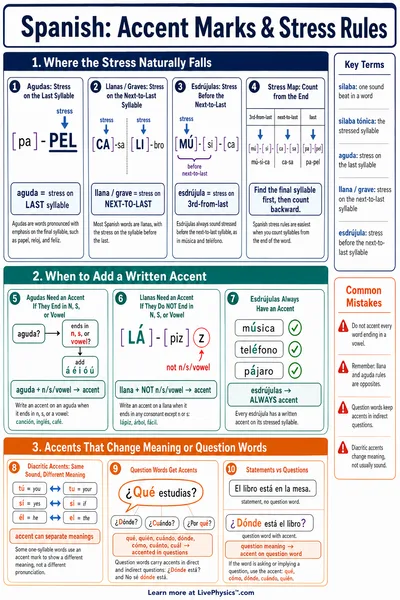
The three stress classes
Every Spanish word with more than one syllable has one stressed syllable. Where that stress falls puts the word into one of three groups.
Aguda
Stress on the last syllable. Examples are canción, café, and jamás. An aguda word takes a written accent when it ends in n, s, or a vowel.
Llana
Stress on the second-to-last syllable, also called grave. Examples are casa, lunes, and árbol. A llana word takes a written accent when it ends in anything except n, s, or a vowel.
Esdrújula
Stress on the third-to-last syllable. Examples are médico, teléfono, and música. An esdrújula word always carries a written accent.
The written accent rule
The tilde (the accent mark over á, é, í, ó, ú) marks the stressed vowel only when the default stress rule would put it somewhere else. Decide the class first, then apply the matching rule.
- Aguda. Tilde if the word ends in n, s, or a vowel.
- Llana. Tilde if the word ends in anything except n, s, or a vowel.
- Esdrújula. Always a tilde.
Curriculum alignment
This tool supports middle school and high school Spanish, where stress patterns (acentuación) and written accents are core spelling and reading skills.
- Learn mode shows the class and the rule while you find the stressed syllable.
- Practice mode asks you to pick the stress and decide on the tilde.
- Challenge mode has you type the fully accented word from a bare form.