Ser vs Estar Visualizer
Practice when to use ser and estar in Spanish. Fill in the blank, pick the correct verb, and reveal the rule category with the DOCTOR and PLACE mnemonics.
Score
0 / 0
The rule category hint shows before you answer.
Vosotros estudiantes de la universidad.
You all are university students.
The two mnemonics
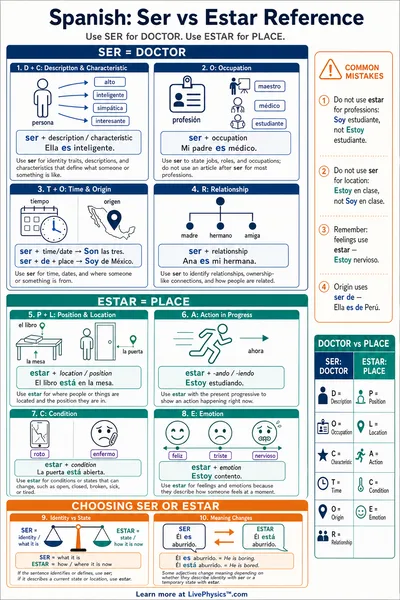
Spanish has two verbs for to be. Use the color coded cards to remember which situations call for ser and which call for estar. The matching card highlights after you answer.
DOCTOR
Permanent and defining traits
- DDescription. Physical traits and inherent descriptions.
- OOccupation. Jobs, roles, and professions.
- CCharacteristic. Personality and lasting qualities.
- TTime. Dates, days, hours, and events.
- OOrigin. Where someone or something is from, and material.
- RRelationship. Family ties and personal relationships.
PLACE
Temporary states and location
- PPosition. Body or object posture, like seated or standing.
- LLocation. Where someone or something is right now.
- AAction. Ongoing actions with the present progressive.
- CCondition. Temporary states like sick, tired, or open.
- EEmotion. Feelings and moods that can change.
SER is DOCTOR
Use ser for things that stay the same. The DOCTOR letters cover the main uses.
- Description. Tall, short, blue, made of wood.
- Occupation. Teacher, student, doctor, engineer.
- Characteristic. Kind, patient, funny, smart.
- Time. Days, dates, hours, and when events happen.
- Origin. Where someone is from and what something is made of.
- Relationship. Family ties and personal connections.
ESTAR is PLACE
Use estar for location and for states that can change. The PLACE letters cover the main uses.
- Position. Seated, standing, lying down.
- Location. Where someone or something is right now.
- Action. The present progressive, like estoy comiendo.
- Condition. Sick, tired, open, cold, broken.
- Emotion. Happy, sad, nervous, excited.
How it works
Each round shows a Spanish sentence with a missing verb. Choose ser or estar, then check your answer. The tool reveals the correct conjugated form, names the rule category, and highlights the matching mnemonic card. Learn mode shows the category hint first, Practice mode hides it, and Challenge mode also asks you to pick the exact form such as soy, eres, está, or estamos.
Curriculum alignment
This tool supports middle school and high school Spanish courses that introduce the present tense of ser and estar. It maps to novice and intermediate proficiency goals from world language standards, where students learn to describe people, express feelings, and tell location. The color coded mnemonics give learners a quick reference they can carry into writing and speaking practice.