Practice making decisions like a space mission planner by comparing budgets, payload mass, power limits, and scientific value.
Read each mission planning problem carefully. Show your calculations and explain your choices using evidence from the problem.
Planning a mission by balancing cost, mass, power, and science goals
Astronomy - Grade 6-8
- 1
A small Moon orbiter has a total mission budget of $120 million. The rocket launch costs $55 million, spacecraft construction costs $38 million, and mission operations cost $12 million. How much money is left for science instruments?
- 2
A mission can carry at most 80 kg of science payload. The team wants to bring a camera that is 18 kg, a magnetometer that is 12 kg, a dust detector that is 9 kg, an infrared spectrometer that is 22 kg, and a drill that is 25 kg. Can all five instruments fit within the payload mass limit? Explain.
- 3
The table shows four possible instruments for an asteroid mission. Choose a set of instruments that stays within both the $30 million instrument budget and the 60 kg payload limit. Instrument A costs $8 million and has a mass of 12 kg. Instrument B costs $14 million and has a mass of 25 kg. Instrument C costs $11 million and has a mass of 18 kg. Instrument D costs $9 million and has a mass of 20 kg. Give one valid set and show that it works.
- 4
A Mars lander has 200 watts available for instruments during the daytime. Its camera uses 35 watts, weather station uses 25 watts, drill uses 90 watts, and chemical analyzer uses 70 watts. If all four run at the same time, will the lander stay within the power limit?
- 5
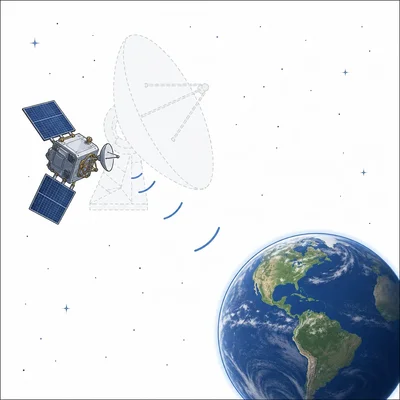
A spacecraft team can save $6 million by using a smaller antenna, but the spacecraft will send data back to Earth 25% more slowly. Describe one possible benefit and one possible drawback of this choice.
- 6
A mission designer gives each instrument a science score from 1 to 10. A visible camera costs $6 million and has a science score of 6. A radar mapper costs $18 million and has a science score of 9. A particle detector costs $5 million and has a science score of 4. Which instrument gives the greatest science score per million dollars? Show your work.
- 7
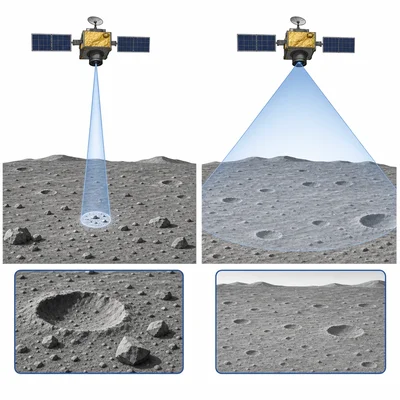
A spacecraft can carry either a high resolution camera or a wide angle camera, but not both. The high resolution camera sees small details on a narrow area of a moon's surface. The wide angle camera sees a large area but with less detail. If the mission goal is to map the entire surface quickly, which camera is the better choice and why?
- 8
A probe has room for 40 kg more payload. The team is choosing between adding extra batteries with a mass of 16 kg, a backup computer with a mass of 10 kg, and a small telescope with a mass of 18 kg. Can the team add all three? If yes, how much payload mass remains?
- 9
A Europa flyby mission has two possible instrument packages. Package 1 costs $42 million, has a mass of 55 kg, and can study the surface ice. Package 2 costs $48 million, has a mass of 50 kg, and can study the surface ice plus measure magnetic fields that may give clues about an ocean. The mission can spend up to $50 million and carry up to 60 kg. Which package would you choose for the best science return, and why?
- 10

A mission's total budget is shown as a circle graph: launch 40%, spacecraft 30%, operations 15%, and science instruments 15%. If the total budget is $200 million, how much money is assigned to science instruments?
- 11
A rover must be kept under 500 kg. The basic rover body is 410 kg. The team wants to add a 35 kg camera mast, a 28 kg scoop, and a 40 kg mini-lab. Which one item must be removed so the rover is within the mass limit while keeping the other two items?
- 12
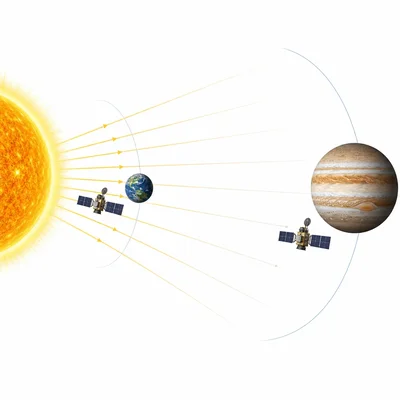
A spacecraft's solar panels produce 300 watts near Earth but only 75 watts near Jupiter because sunlight is weaker there. Explain how this lower power could affect payload choices for a Jupiter mission.
- 13
A mission has $20 million left. The team can buy a spectrometer for $12 million, a dust sensor for $6 million, a radiation detector for $5 million, or a thermal camera for $9 million. Choose the combination with the highest total cost that does not go over $20 million, and show your work.
- 14
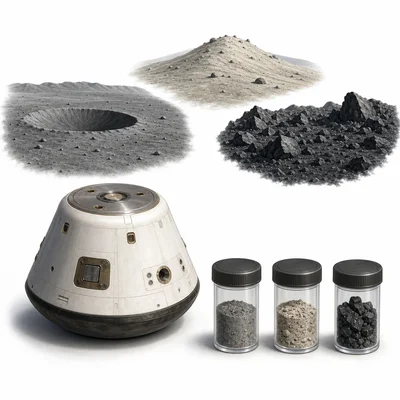
A sample return mission can bring back 120 grams of material. Scientists want samples from three locations: crater floor, hilltop, and dark rock field. If each location needs at least 30 grams to be useful, is it possible to collect useful samples from all three locations? How many grams would remain if exactly 30 grams were collected from each?
- 15
Two teams disagree about a spacecraft design. Team A wants to add one expensive instrument that could make a major discovery but would use most of the budget. Team B wants to add three smaller instruments that answer different questions but may not make one large discovery. Write a short recommendation that explains which plan you would choose and what trade-off your choice makes.