Measurement Conversion Lab
Estimate conversions before you reveal the answer. Work through 14 challenges spanning length, mass, volume, and temperature. See step-by-step unit factor calculations, track your accuracy, and record data for your lab report.
Guided ExperimentLength Conversions
Which do you think will be easier to estimate, metric length conversions (cm to m) or imperial length conversions (ft to in, mi to km)? Why?
Write your hypothesis in the Lab Report panel, then click Next.
Progress
Controls
Write your best guess, then click Reveal to see the real answer.
Enter your estimate and click Reveal to see the step-by-step conversion.
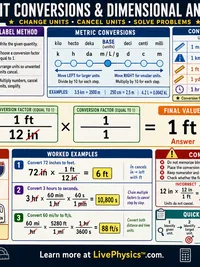
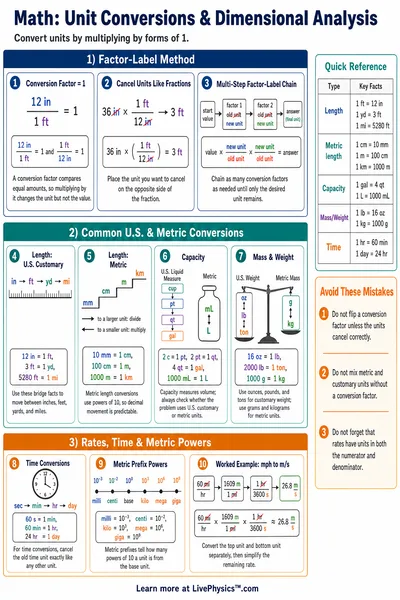
- Length (metric) cm to m divides by 100. m to km divides by 1000.
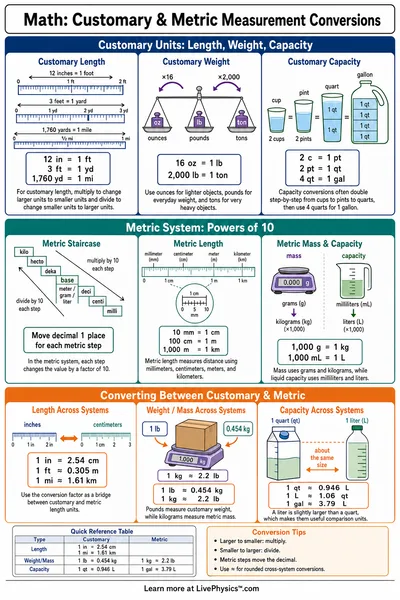
- Length (imperial) 1 ft = 12 in, 1 yd = 3 ft, 1 mi ≈ 1.6 km.
- Mass 1 kg ≈ 2.2 lb, 1 oz ≈ 28 g, 1 lb ≈ 454 g.
- Volume 1 L = 1000 mL, 1 gal = 4 qt, 1 cup = 8 fl oz.
- Temperature Water freezes at 0°C / 32°F, boils at 100°C / 212°F.
Data Table
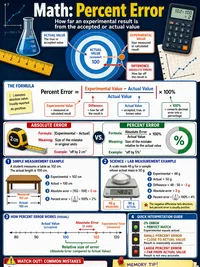
(0 rows)| # | Challenge | Category | Your Estimate | Actual Value | % Error | Accuracy |
|---|
Reference Guide
Length Conversions
Metric units use powers of 10, making mental conversion straightforward.
- 1 km = 1000 m = 100 000 cm
- 1 m = 100 cm = 1000 mm
- 1 cm = 10 mm = 0.01 m
- 1 ft = 12 in, 1 yd = 3 ft = 36 in
- 1 mi = 5280 ft ≈ 1.609 km
- 1 in = 2.54 cm
Mass Conversions
Metric mass is based on grams (g), kilograms (kg), and milligrams (mg).
- 1 kg = 1000 g ≈ 2.205 lb
- 1 lb = 16 oz ≈ 453.6 g
- 1 oz ≈ 28.35 g
- 1 metric ton = 1000 kg ≈ 2205 lb
A liter of water weighs exactly 1 kg - a useful anchor for estimation.
Volume Conversions
Both metric and US customary units are common in cooking and science.
- 1 L = 1000 mL ≈ 0.264 gal
- 1 gal = 4 qt = 8 pt = 16 cups = 128 fl oz
- 1 cup = 8 fl oz = 16 tbsp
- 1 qt ≈ 0.946 L
Temperature Conversions
Temperature requires a formula, not a simple multiplication factor.
- °C to °F, multiply by 9/5, then add 32
- °F to °C, subtract 32, then multiply by 5/9
- °C to K, add 273.15