Practice explaining the roles of xylem, phloem, and transpiration while interpreting simple plant transport data.
Read each problem carefully. Use complete sentences when explaining your thinking. Show calculations when a problem includes data.
How plants move water, minerals, and sugars
Biology - Grade 6-8
- 1
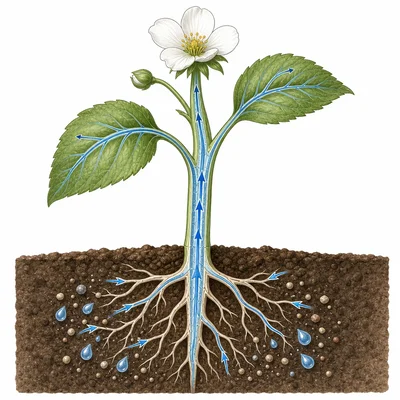
A plant needs to move water from its roots to its leaves. Which plant tissue does this job, and what else does it usually carry?
- 2
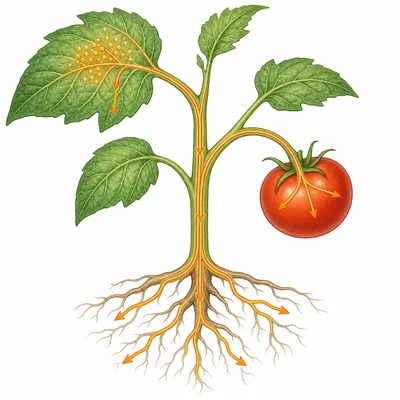
A plant makes sugar in its leaves during photosynthesis. Which plant tissue moves the sugar to other parts of the plant, such as roots and fruits?
- 3
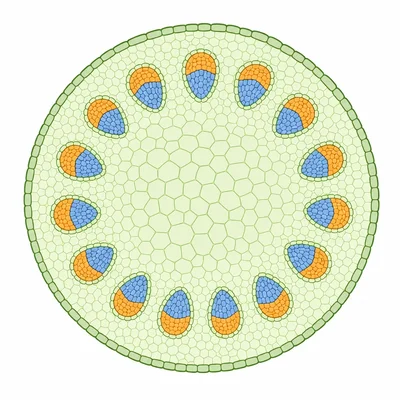
Label the two transport tissues in a stem cross section. Tissue A is closer to the inside of the stem and tissue B is closer to the outside. In many stems, xylem is inside and phloem is outside. Identify A and B.
- 4
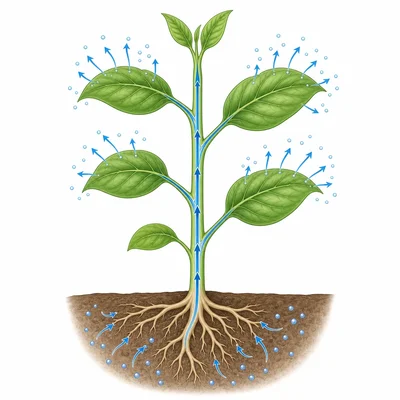
Explain how transpiration helps pull water upward through a plant.
- 5
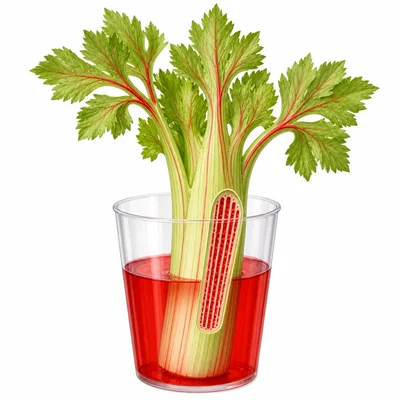
A student places a leafy celery stalk in red-colored water overnight. The next day, red lines appear in the celery stalk and leaves. Which tissue became colored, and what does this show?
- 6
Study the data: Plant A lost 6 mL of water in 1 hour, Plant B lost 3 mL of water in 1 hour, and Plant C lost 9 mL of water in 1 hour. Which plant had the greatest transpiration rate?
- 7
A plant loses 12 mL of water over 4 hours. Calculate its transpiration rate in mL per hour.
- 8
A class compares transpiration under two conditions. Plant 1 is kept in still air and loses 4 mL of water in 2 hours. Plant 2 is placed near a fan and loses 10 mL of water in 2 hours. What does the data suggest about wind and transpiration?
- 9
Use the table: Low light, 2 mL lost per hour; medium light, 5 mL lost per hour; bright light, 8 mL lost per hour. Describe the pattern in the data.
- 10
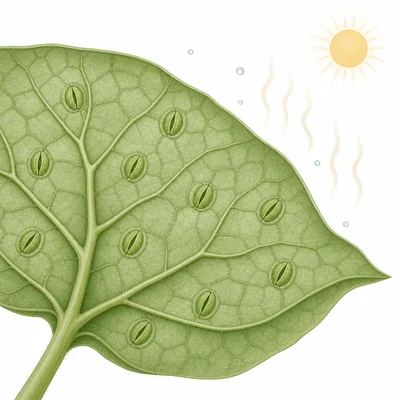
A plant's stomata close during very dry conditions. Explain how this helps the plant survive.
- 11
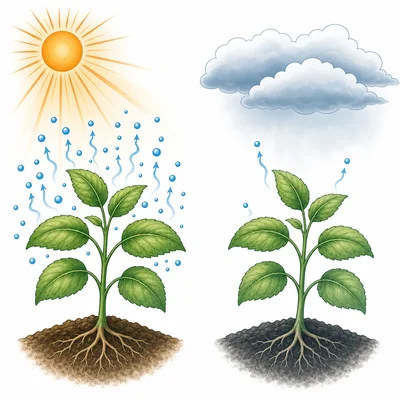
Why can a hot, sunny day cause a plant to lose water faster than a cool, cloudy day?
- 12
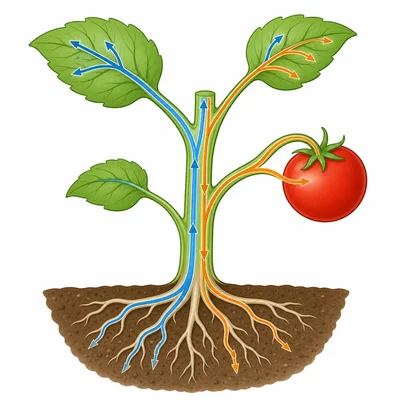
A student says, "Xylem and phloem both move materials, so they do the same job." Explain why this statement is not correct.
- 13
The graph shows water loss from a plant over time: 0 hours, 0 mL; 1 hour, 2 mL; 2 hours, 4 mL; 3 hours, 6 mL; 4 hours, 8 mL. What is the plant's transpiration rate?
- 14
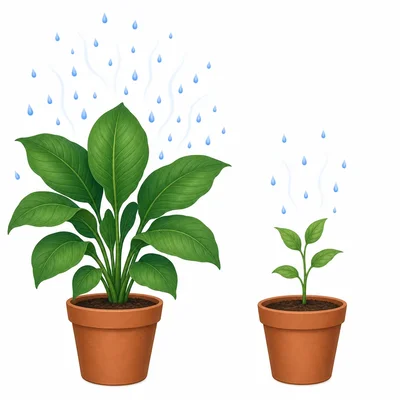
A plant with many large leaves usually loses more water than a plant with a few small leaves. Explain why leaf size and number can affect transpiration.
- 15
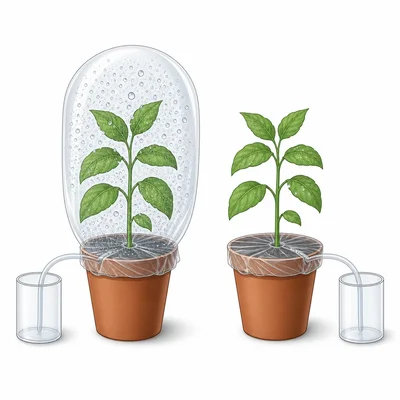
Design a simple investigation to test how humidity affects transpiration. Include the variable you would change, what you would measure, and one thing you would keep the same.