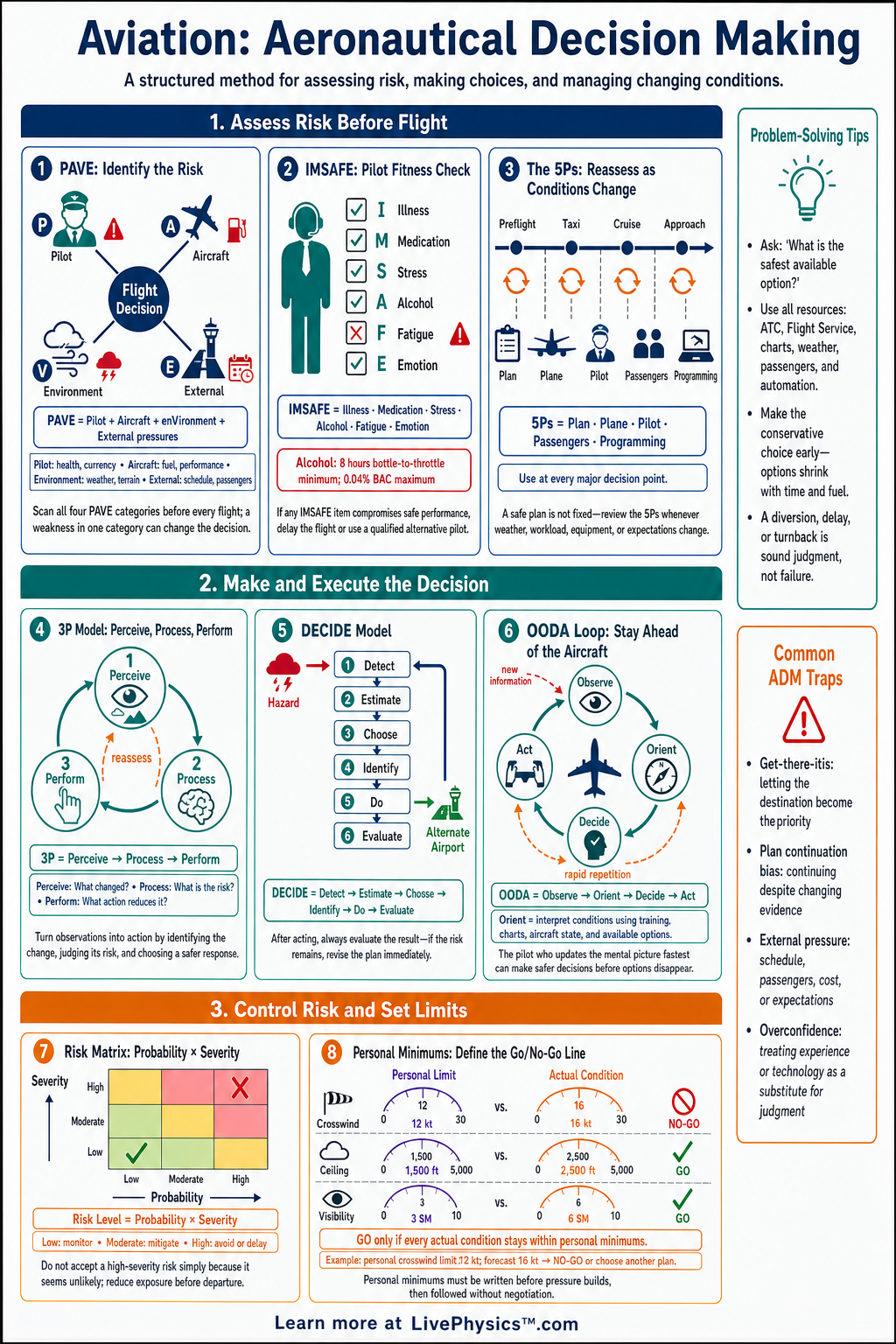
Aeronautical decision making, often called ADM, is the structured process pilots use to make safe choices before and during flight. This cheat sheet organizes the most important risk tools into a clear reference for training, planning, and cockpit use. Pilots need ADM because weather, aircraft condition, fatigue, time pressure, and passenger expectations can all affect a flight.
Good decisions reduce risk before it becomes an emergency.
The core tools include the PAVE checklist for identifying hazards, the 3P model for managing risk, and the DECIDE model for responding to a changing situation. Pilots also use personal minimums to set clear limits before a flight begins. Risk management depends on recognizing hazards, assessing their seriousness, and choosing practical actions.
The safest decision is often to delay, divert, turn around, or cancel when conditions exceed safe limits.
Key Facts
- The PAVE checklist evaluates Pilot, Aircraft, enVironment, and External pressures before and during a flight.
- The 3P model is Perceive hazards, Process their risk, and Perform a safe action.
- The DECIDE model is Detect, Estimate, Choose, Identify, Do, and Evaluate.
- Risk equals the probability of an unwanted event multiplied by the severity of its consequences.
- The IMSAFE checklist is Illness, Medication, Stress, Alcohol, Fatigue, and Emotion.
- Personal minimums should be more conservative than legal limits when pilot experience or conditions require it.
- The 5P check reviews Plan, Plane, Pilot, Passengers, and Programming at regular points in a flight.
- A safe go or no-go decision requires that all critical risks remain within the pilot's personal minimums.
Vocabulary
- Aeronautical decision making
- Aeronautical decision making is a systematic method pilots use to identify risks and choose safe actions.
- Hazard
- A hazard is any condition, event, or object that could contribute to an unsafe outcome.
- Risk
- Risk is the chance that a hazard will cause harm combined with the seriousness of that harm.
- Personal minimums
- Personal minimums are a pilot's written limits for weather, experience, aircraft, and operating conditions.
- External pressure
- External pressure is an outside influence, such as a schedule or passenger expectation, that can push a pilot toward an unsafe choice.
- Diversion
- A diversion is a planned change from the original route or destination to improve safety.
Common Mistakes to Avoid
- Using legal weather minimums as personal minimums is wrong because legal limits may exceed a pilot's current skill, recency, or comfort level.
- Completing PAVE only before departure is wrong because hazards such as weather, fatigue, and fuel status can change during flight.
- Treating each risk separately is wrong because several moderate hazards can combine into a high-risk situation.
- Continuing because of a schedule or passenger expectation is wrong because external pressure can cause plan continuation bias and delay a safer decision.
- Waiting too long to divert is wrong because fuel, daylight, weather options, and pilot workload usually become worse with time.
Practice Questions
- 1 A pilot has slept poorly, feels stressed, and plans a two-hour flight after taking an unfamiliar cold medicine. Which IMSAFE factors indicate risk, and what is the safest initial decision?
- 2 Forecast visibility is 4 statute miles, but a pilot's written personal minimum for this route is 6 statute miles. State the go or no-go decision and explain it using personal minimums.
- 3 During flight, the destination weather drops below the pilot's personal minimums while an alternate airport has good weather 25 nautical miles away. Apply the DECIDE model to describe the pilot's next actions.
- 4 Explain why cancelling or diverting a flight can demonstrate strong aeronautical decision making rather than poor piloting.
Understanding Aeronautical Decision Making
Aeronautical decision making is a learned skill, not simply good judgment or confidence. A pilot gathers information, notices hazards, compares choices, and acts before the situation worsens. This process begins well before engine start.
A careful preflight decision includes weather, fuel, aircraft performance, airport conditions, pilot readiness, and the purpose of the trip. Conditions can change after departure, so the pilot must continue making decisions throughout the flight.
The PAVE checklist helps organize common hazards into four groups. Pilot includes health, fatigue, stress, recent experience, medication, and proficiency. Aircraft includes airworthiness, fuel, performance limits, equipment, and known defects. enVironment includes weather, terrain, runway conditions, airspace, daylight, and airport services.
External pressures include schedules, passengers, money, personal goals, and the urge to finish a trip. Identifying a hazard does not automatically mean cancelling. It means the pilot must understand the hazard and manage its risk.
The 3P model gives a simple cycle for handling risk. Perceive means noticing the facts and hazards. Process means deciding how serious those hazards are and how they could combine.
Perform means choosing and carrying out a safe action. For example, lowering visibility, increasing fatigue, and unfamiliar terrain may create more risk together than any one factor alone. A pilot may perform by delaying departure, adding fuel, choosing a different route, taking another pilot, or cancelling the flight.
The DECIDE model is especially useful when something changes in flight. Detect the change, estimate its effect, choose a safe outcome, identify actions, do the actions, and evaluate the result. A rough-running engine, unexpected cloud layer, or worsening headwind requires a prompt response.
Waiting for perfect information can remove useful options. Early decisions usually provide more airports, more fuel, more daylight, and less stress.
Personal minimums turn general safety advice into specific limits. A student or new private pilot might set higher visibility, ceiling, wind, and crosswind limits than the legal minimums. These limits should match training, recency, aircraft capability, and the planned operation.
They should be written down before the flight, when pressure is low. During study, focus on recognizing hazardous attitudes and replacing them with safer actions. A disciplined pilot treats a diversion or cancellation as evidence of sound judgment.