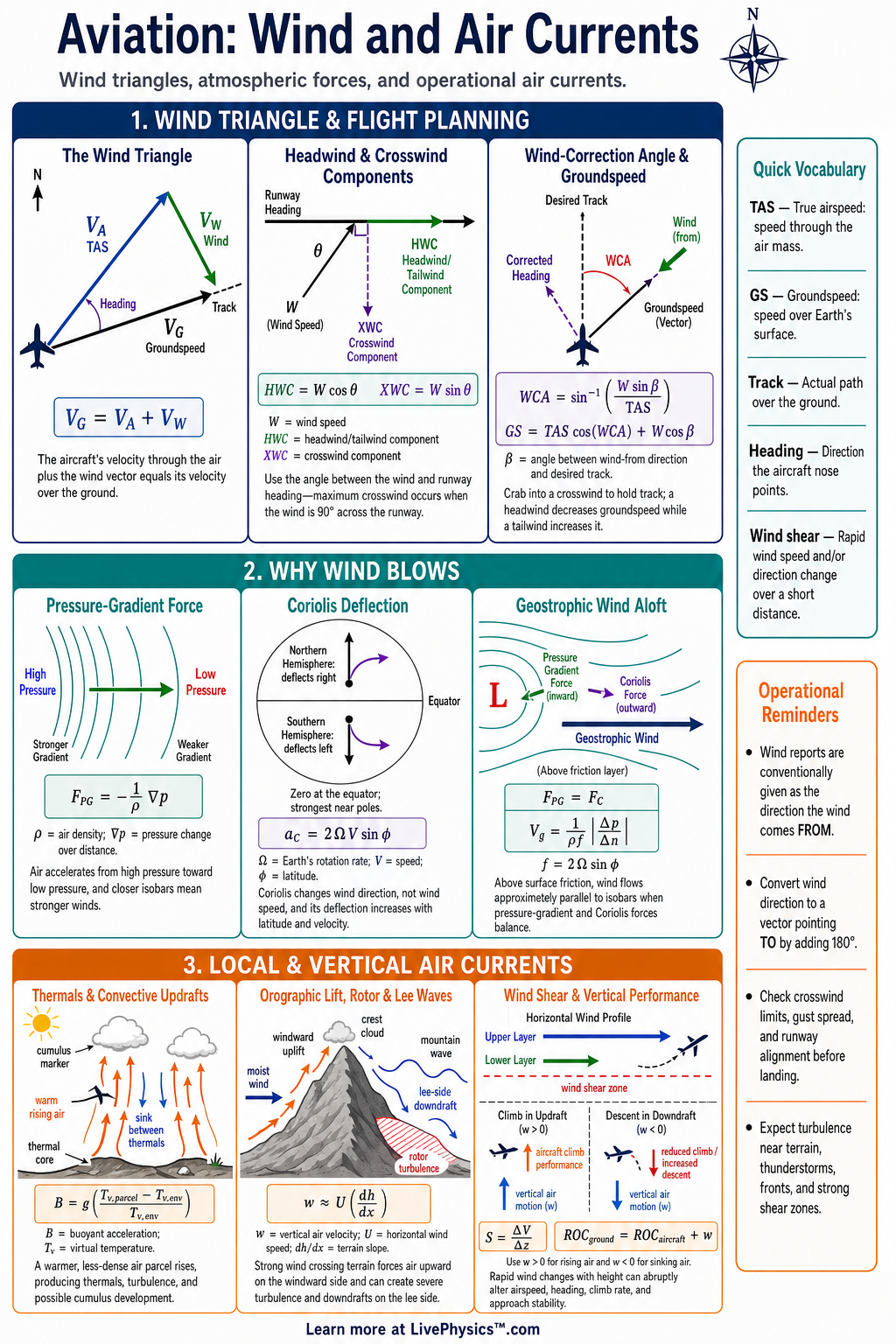
Wind changes an aircraft's path over the ground even when the pilot holds a steady heading and airspeed. This cheat sheet helps aviation students separate air movement from ground movement. It supports flight planning, navigation exercises, and practical understanding of weather effects.
Pilots need these skills to fly accurate tracks, estimate times, and choose safe runways.
The central tool is the wind triangle, which combines the aircraft airspeed vector with the wind vector to find the groundspeed and track. Wind can act as a headwind, tailwind, crosswind, or any combination of these components. A wind correction angle changes the heading so the aircraft follows its planned course.
Air currents such as thermals, ridge lift, turbulence, and jet streams also affect aircraft performance and ride quality.
Key Facts
- True airspeed is the aircraft's speed through the surrounding air, while groundspeed is its speed over the Earth's surface.
- A reported wind of 270 degrees at 20 knots comes from 270 degrees and blows toward 090 degrees at 20 knots.
- Groundspeed equals the along-track component of true airspeed plus the tailwind component or minus the headwind component.
- Crosswind component equals wind speed times the sine of the angle between the wind direction and the runway or track.
- Headwind component equals wind speed times the cosine of the angle between the wind direction and the runway or track.
- Wind correction angle is the angle added toward the wind so that the aircraft maintains the desired ground track.
- A headwind reduces groundspeed and increases travel time, while a tailwind increases groundspeed and reduces travel time.
- The wind triangle combines the true airspeed vector and wind vector to determine aircraft heading, groundspeed, and ground track.
Vocabulary
- True airspeed
- True airspeed is the aircraft's actual speed through the air mass after accounting for air density.
- Groundspeed
- Groundspeed is the rate at which an aircraft moves over the ground.
- Wind correction angle
- Wind correction angle is the angle a pilot flies into the wind to prevent drift from the planned track.
- Crosswind
- A crosswind is the sideways component of wind that acts across an aircraft's track or runway.
- Wind triangle
- A wind triangle is a vector diagram or calculation used to combine aircraft airspeed, wind, and groundspeed.
- Wind shear
- Wind shear is a rapid change in wind speed or direction over a short distance.
Common Mistakes to Avoid
- Treating wind direction as the direction the wind travels is wrong because aviation wind reports state the direction from which the wind comes. Reverse the reported direction by 180 degrees when drawing the wind's movement vector.
- Using heading and track as the same value is wrong because heading is where the nose points while track is the path over the ground. Apply a wind correction angle when crosswind is present.
- Adding the full wind speed to groundspeed is wrong because only the wind component parallel to the track changes groundspeed. Resolve an angled wind into headwind or tailwind and crosswind components.
- Using sine for the headwind component and cosine for the crosswind component is wrong when the angle is measured from the runway or track. Use cosine for the parallel component and sine for the sideways component.
- Ignoring altitude when planning for wind is wrong because wind speed and direction can change greatly between the surface and cruising altitude. Use winds forecast for the planned altitude and update the plan when conditions change.
Practice Questions
- 1 An aircraft has a true airspeed of 120 knots and flies due east with a direct 20-knot tailwind. Calculate its groundspeed.
- 2 Runway 270 is in use, and the wind is 230 degrees at 18 knots. Calculate the approximate headwind component and crosswind component.
- 3 An aircraft has a true airspeed of 150 knots and needs to track due north. The wind is from 090 degrees at 20 knots. Calculate the approximate wind correction angle and groundspeed.
- 4 Explain why a pilot must point the aircraft into a crosswind even though the desired ground track remains straight ahead.
Understanding Wind and Air Currents
An aircraft moves through the air mass, not directly across the ground. Its true airspeed describes its speed through the surrounding air. The wind is the movement of that air mass over the ground.
Groundspeed is the aircraft speed over the ground after wind effects are included. A pilot can maintain the correct heading and still drift away from the intended track if crosswind is not corrected. Navigation therefore requires attention to both the aircraft vector and the wind vector.
Winds are reported by the direction they come from. A wind reported as 270 degrees at 20 knots comes from the west and blows toward the east. This wording is important because the wind arrow used in a vector diagram points in the direction the wind travels.
A headwind acts against the aircraft's forward motion and reduces groundspeed. A tailwind acts with the aircraft's motion and increases groundspeed. A crosswind acts sideways and causes drift, requiring a crab angle into the wind.
The wind triangle is a scaled drawing or calculation that links true airspeed, wind, and groundspeed. The pilot begins with the desired track, then applies a wind correction angle toward the wind. The result is a heading that allows the airplane to move along the planned ground track.
Groundspeed equals the along-track part of true airspeed plus or minus the along-track wind component. Crosswind component equals wind speed times the sine of the angle between the runway or track and the wind direction.
Headwind component equals wind speed times the cosine of that angle. These relationships are especially useful for takeoff and landing performance calculations.
Air currents are organized movements within the atmosphere that can change an aircraft's altitude, speed, and handling. Thermals are rising columns of warm air and are useful to glider pilots, but they can make powered aircraft feel bumpy. Ridge lift forms when wind is forced up a slope or mountain range.
Mountain waves can create strong lift, sink, and severe turbulence far downwind of high terrain. Jet streams are narrow bands of very fast upper-level winds. Airline crews use favorable jet streams to save time and fuel, while avoiding strong wind shear and turbulence where needed.
When studying wind problems, draw a clear diagram before using numbers. Label the intended track, the wind direction, and the aircraft heading separately. Check whether the reported wind direction is the direction from which the wind comes.
Keep units consistent, usually knots for speed and degrees for direction. In real flight, pilots compare forecasts with observed winds and update their navigation plan because winds vary with altitude, time, terrain, and weather systems.