Vector Addition & Components Explorer
Enter each vector as a magnitude and direction or as x and y components, then watch the tool draw them head to tail, resolve each one into components, and compute the resultant magnitude and direction. Works for forces, displacements, and velocities.
Head-to-tail diagram
Vectors
Components table
| Vector | Magnitude | Angle θ | x | y |
|---|---|---|---|---|
| A | 3.00 m | 0.00° | 3.00 | 0.00 |
| B | 4.00 m | 90.00° | 0.00 | 4.00 |
| R (resultant) | 5.00 m | 53.13° | 3.00 | 4.00 |
Resultant
Resolve each vector into components
Add components
Magnitude and direction of the resultant
Working with Vectors
A Vector Is Not Just a Number
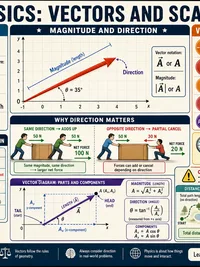
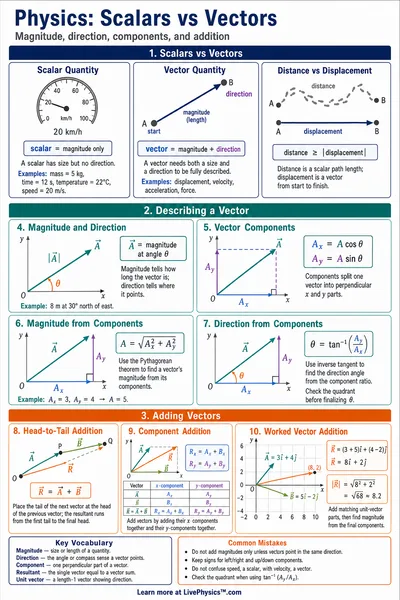
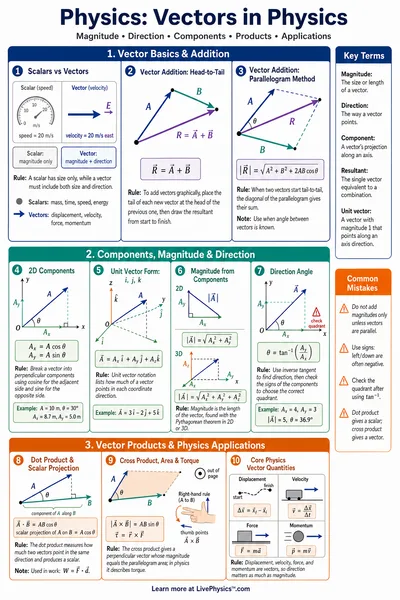
A scalar has only size, such as a mass of 5 kg or a temperature of 20 °C. A vector has both size and direction, such as a force of 5 N pointing east or a velocity of 20 m/s heading north.
Because direction matters, you cannot add vectors the way you add ordinary numbers. Two 5 N forces can combine into anything from 0 N to 10 N depending on the angle between them.
In this tool the direction angle θ is measured counterclockwise from the positive x axis, so 0° points right (east), 90° points up (north), 180° points left, and 270° points down.
Resolving into Components
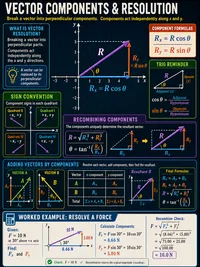
Any vector can be split into an x part and a y part using a right triangle. The magnitude is the hypotenuse and the angle sets how much falls along each axis.
Vy = V sin θ
A 10 N force at 53° has Vx = 10 cos 53° ≈ 6 N and Vy = 10 sin 53° ≈ 8 N. Once a vector is in component form, the two axes can be handled separately, which is what makes addition easy.
Adding by Components
To add several vectors, resolve each one into x and y parts, then sum the x parts and the y parts separately. The two sums are the components of the resultant.
Ry = Vy1 + Vy2 + ...
This method always works, no matter how many vectors you have or what angles they point. It replaces awkward triangle geometry with simple addition along each axis.
Resultant Magnitude and Direction
Once you have Rx and Ry, the magnitude of the resultant comes from the Pythagorean theorem and the direction comes from the inverse tangent.
θ = atan2(Ry, Rx)
Using atan2 rather than a plain arctangent keeps the angle in the correct quadrant. A resultant with Rx negative and Ry positive lands in the second quadrant near 135°, not in the first quadrant.
Head-to-Tail and Parallelogram Methods
The head-to-tail method draws the first vector, then starts the second vector at the tip of the first, and continues for every vector. The resultant runs from the very first tail to the very last head. The diagram above uses this method.
The parallelogram method handles two vectors drawn from the same starting point. Complete the parallelogram and the diagonal from that shared point is the resultant. Both methods give the same answer as adding by components.
Equilibrium and the Zero Resultant
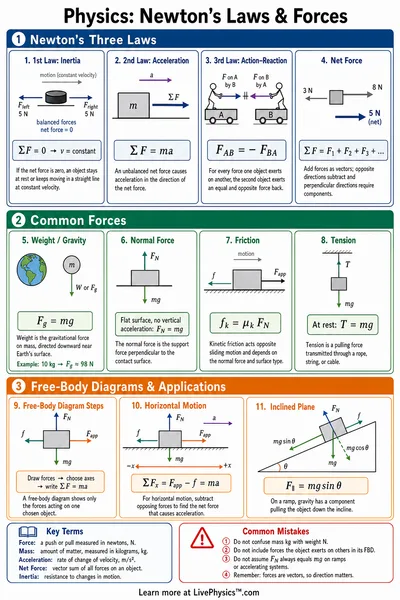
When several forces act on an object and their resultant is zero, the object is in equilibrium. In the head-to-tail diagram this shows up as a closed shape that ends back at the origin.
Three equal forces 120° apart cancel exactly, which is why the equilibrium preset returns a resultant of 0 N. Whenever both Rx and Ry come out to zero, the vectors balance.