Sign in to save

Bookmark this page so you can find it later.

Sign in to save

Bookmark this page so you can find it later.

Astronomy high-school February 14, 2025

What Would Happen If You Fell Into a Black Hole?

A trip past the point of no return
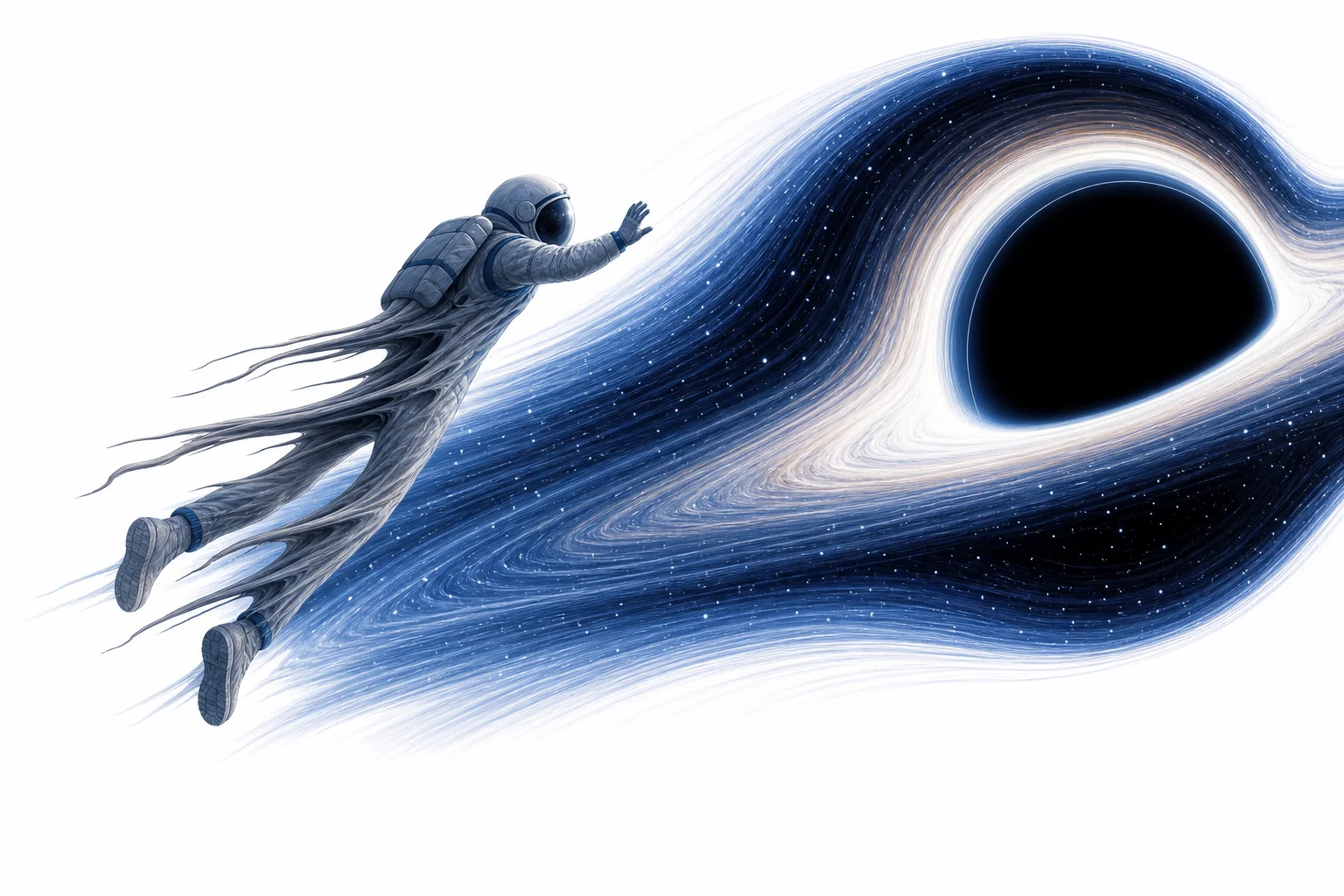
A diagram of a person falling toward a black hole, with the event horizon marked and distant starlight bent around the black hole

If you fell into a black hole, gravity would pull much harder on the parts of you closer to it. Near a small black hole, that stretching could tear you apart before you crossed the edge. Near a huge black hole, you might cross that edge without noticing it at first, but you could never get back out.

Big Idea. NGSS HS-ESS1-3 connects this question to how stars can end their lives as compact objects whose gravity shapes matter, light, and space.

A black hole is not a cosmic vacuum cleaner. It is a place where a lot of mass is packed into a small region, so gravity becomes extreme. If you fell toward one, the result would depend on the black hole's mass and on where you are during the fall. Far away, the trip would feel like falling toward any massive object. Closer in, gravity would stretch you because your feet and head would not feel the same pull. Near the event horizon, time and light would behave in ways that seem strange from a distance. This question brings together gravity, stellar life cycles, and relativity, which makes it a strong fit for NGSS HS-ESS1. For a fast review of the objects involved, see the Black Holes & Neutron Stars cheat sheet.

What a black hole is
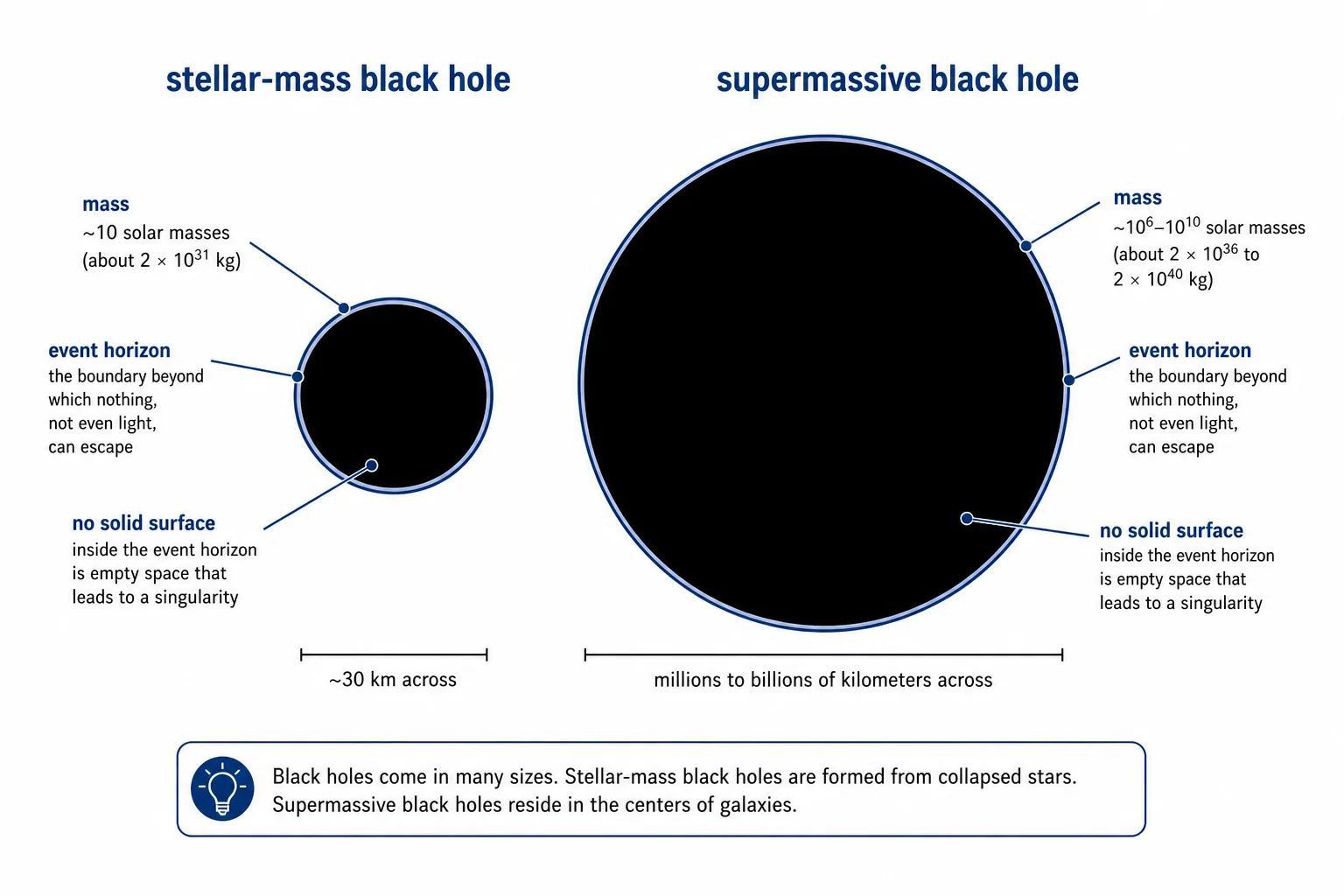
A labeled diagram comparing a small black hole and a supermassive black hole, each with its event horizon shown as a boundary
The event horizon is a boundary, not a surface
A black hole forms when matter becomes packed so tightly that escape requires a speed greater than the speed of light. The boundary around that region is called the event horizon. It is not a solid surface. You would not bump into it like a wall. It marks the place where every possible path forward leads inward. Black holes can form when massive stars collapse at the end of their lives. They can also grow when they merge with other black holes or pull in nearby gas. The size of the event horizon depends on mass. A black hole with more mass has a larger event horizon. That matters for falling in. Around a small black hole, gravity changes sharply over short distances. Around a supermassive black hole, the same boundary can be much wider, so the change across a human body can be gentler at the horizon.

The event horizon marks where escape becomes impossible.

The stretching force
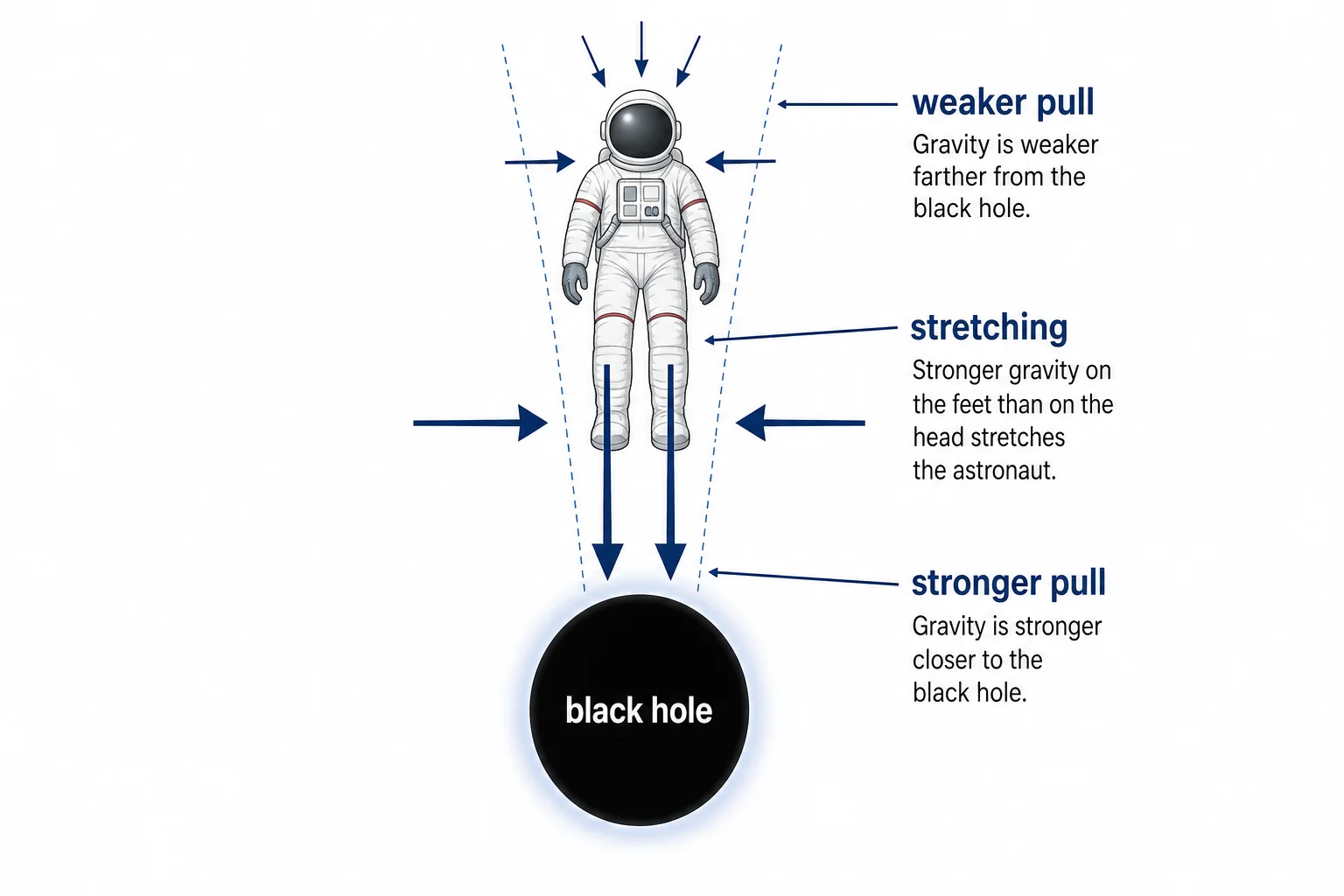
A falling astronaut near a black hole with arrows showing stronger gravity on the feet than on the head
Tidal forces stretch falling objects
As you fall inward, gravity grows stronger. It also changes with distance. If your feet are closer to the black hole than your head, your feet feel a stronger pull. At the same time, the sides of your body are squeezed inward. This difference in force is called a tidal force. Near a black hole, it can become extreme enough to stretch matter into a long, thin shape. Scientists often call that spaghettification. The effect is stronger near smaller black holes because the pull changes more sharply over a short distance. Near a stellar-mass black hole, a falling astronaut could be torn apart before reaching the event horizon. Near a supermassive black hole, the tidal force at the horizon could be weak enough that the astronaut crosses first and is stretched later. The outcome depends on size, mass, and distance from the center.

Spaghettification happens because gravity is not equally strong across your body.

Crossing the horizon
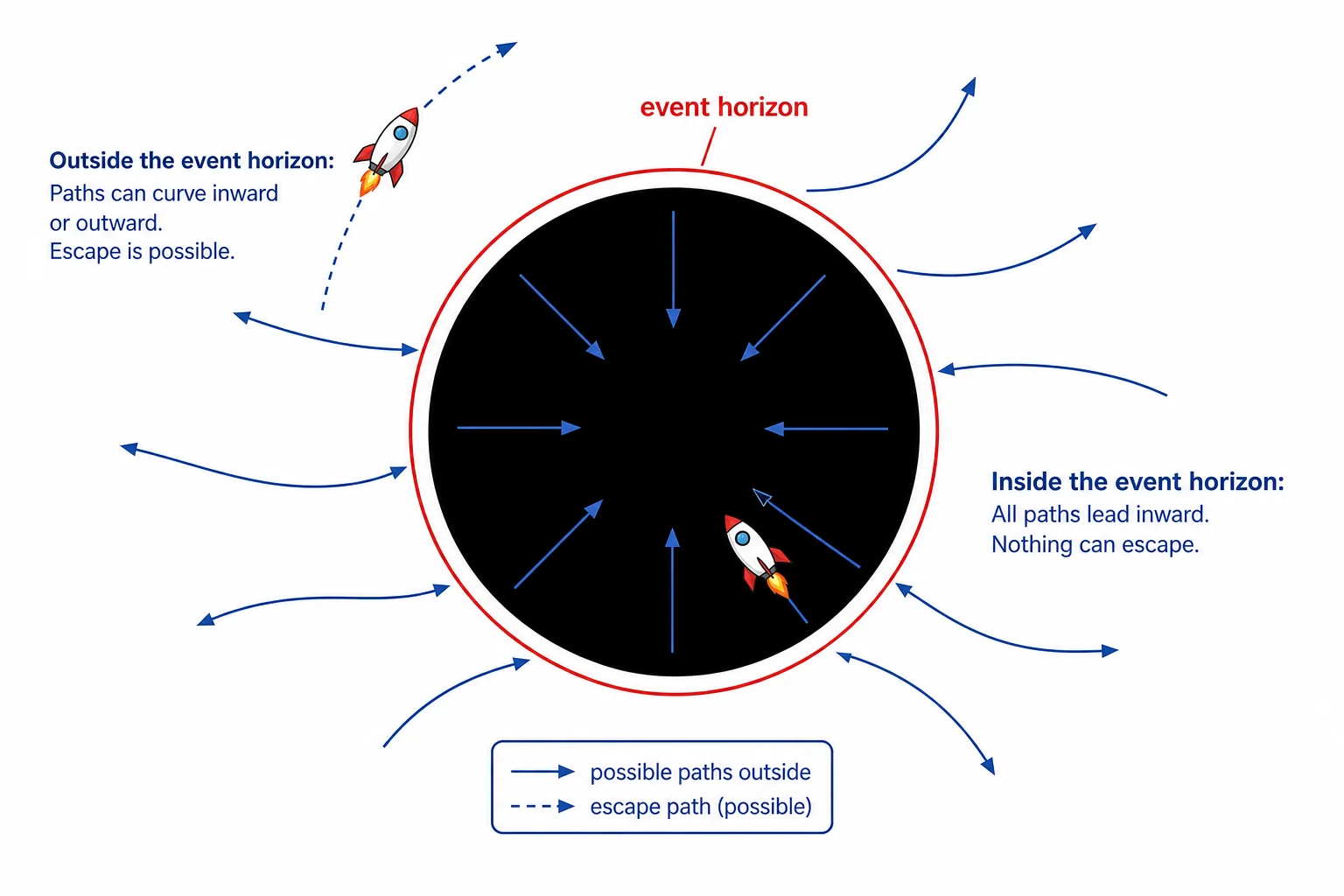
A path diagram showing possible escape paths outside a black hole event horizon and only inward paths inside it
Inside the horizon, every path leads inward
If the black hole is large enough, crossing the event horizon might not feel special at that exact moment. There is no local sign that says the boundary has been crossed. You would still see your surroundings, and your watch would still tick normally for you. The difference is in what paths are possible after crossing. Outside the event horizon, a fast enough rocket could still move away. Inside it, all future paths lead closer to the center. This does not mean you fall faster than light. It means space and time are arranged so that moving outward cannot take you outside again. A useful idea is the escape speed. On Earth, escape speed is high but possible for rockets. At the event horizon, the needed escape speed reaches light speed, and nothing with mass or information can leave.

You could cross a large black hole's horizon without a sudden bump, but you could not return.

What you would see
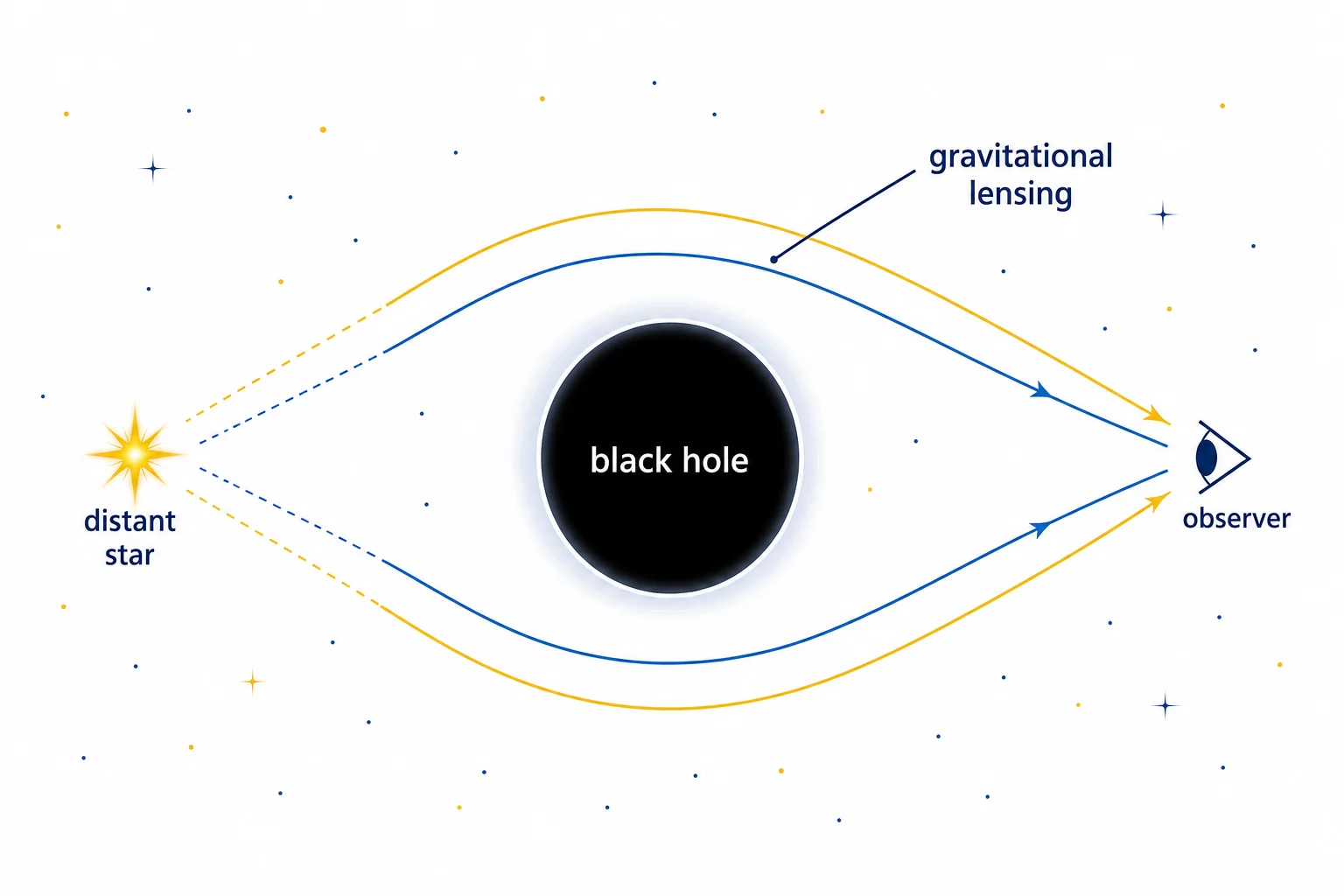
A simplified view of distorted starlight around a black hole, with arcs of light caused by gravitational bending
Gravity bends the paths of light
Light near a black hole follows curved paths because gravity changes the shape of space and time. As you fall, the outside universe would appear distorted. Starlight could bend into rings and arcs around the dark center. Light from behind the black hole could curve into view. You might see some regions brighten and shift in color as light gains or loses energy. If hot gas is orbiting the black hole, that gas can glow in X-rays and visible light, depending on its temperature. The view would not be a simple black disk in the sky. It would be a warped map of the surrounding universe. Still, your eyes and brain would have little time to study it near a small black hole. The tidal forces would become dangerous quickly. Near a supermassive black hole, the visual distortions could be more gradual at the horizon.

A black hole can bend light from objects behind it into your view.

What others would see
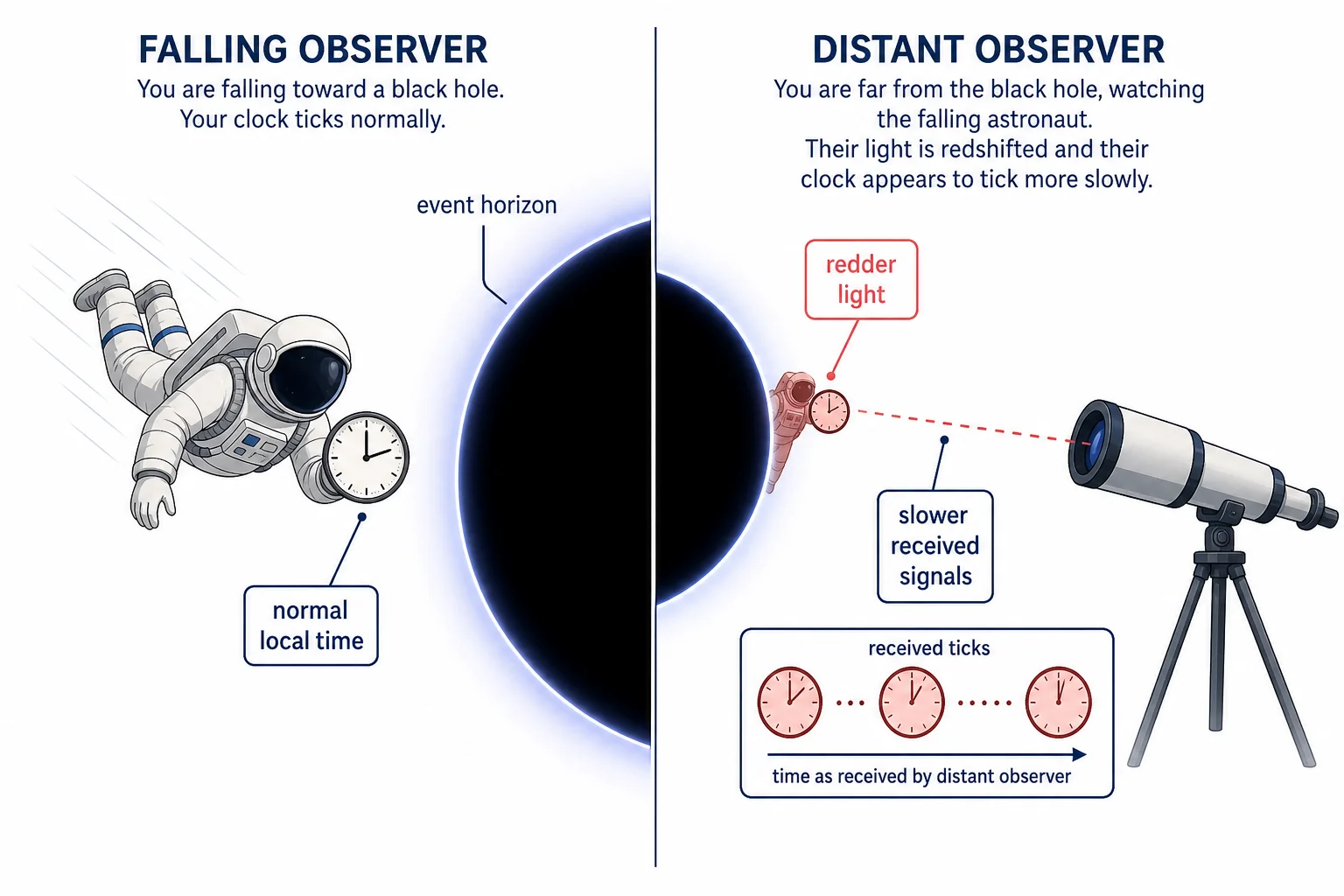
A split diagram comparing the falling person's clock with a distant observer's view of the person fading near the event horizon
Time looks different from far away
Your experience and an outside observer's view would not match. From your own point of view, your clock runs normally as you fall. You cross the event horizon, if tidal forces have not already destroyed you, after a finite amount of time. A distant observer sees something different. Light from you has to climb out of a strong gravitational field. That light loses energy and arrives more slowly. To the observer, you appear to slow down near the event horizon and fade. Your image becomes redder and dimmer because each light wave is stretched. The observer never sees you clearly cross the horizon. This does not mean you are frozen in place from your own point of view. It means the information reaching the outside observer becomes delayed and weakened until it effectively disappears.

Time dilation changes what distant observers receive, not what the falling person feels locally.

Vocabulary

Black hole
A region where gravity is so strong that nothing can escape once it crosses the event horizon.
Event horizon
The boundary around a black hole beyond which light, matter, and information cannot return to the outside universe.
Tidal force
A difference in gravitational pull across an object that can stretch or squeeze it.
Spaghettification
The extreme stretching of an object by strong tidal forces near a compact massive object.
Time dilation
A difference in the rate at which time is measured by observers in different gravitational fields or states of motion.
Gravitational lensing
The bending of light paths by gravity, which can make background objects appear warped, repeated, or brightened.

In the Classroom

Tidal force model

20 minutes | Grades 9-12

Students draw arrows on a stick figure at several distances from a black hole. They compare how the difference between head and feet changes as the figure moves inward.

Outside observer timeline

30 minutes | Grades 9-12

Students make two timelines for the same fall. One timeline shows the falling person's clock, and the other shows the delayed, redshifted signals received far away.

Escape speed comparison

25 minutes | Grades 9-12

Students compare escape speed on Earth, near a dense star, and at a black hole event horizon using proportional reasoning. The goal is to connect a familiar rocket idea to the meaning of the event horizon.

Key Takeaways

  • A black hole's event horizon is a boundary where escape becomes impossible, not a solid surface.
  • Tidal forces stretch a falling object because gravity is stronger on the side closer to the black hole.
  • Small black holes can cause deadly spaghettification before the event horizon is reached.
  • A supermassive black hole can have gentler tidal forces at its event horizon, so crossing it might not feel sudden.
  • A distant observer would see the falling person slow, fade, and redden near the horizon because of time dilation and light stretching.