Full Projectile Motion Experimental Lab
A full-workflow projectile motion investigation. Choose an investigation, state your hypothesis, identify the independent and dependent variables, collect replicated trials, fit a regression line, and analyze residuals and percent error.
Choose an Investigation
Investigation A. Optimal Angle for Maximum Range
How does launch angle affect the horizontal range of a projectile, and which angle maximizes it?
Launch angle θ (vary from 15° to 75° in 5° steps)
Range R (averaged from 3 measurement replicates)
- Initial speed v (constant)
- Local gravity g (constant)
- Launch height h₀ (0 m, ground level)
Predict which launch angle gives the longest range when launching from ground level. Will the range vs angle curve be symmetric? State a clear, testable hypothesis.
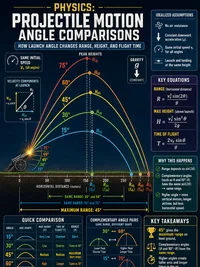
Range peaks at θ = 45° and the curve is symmetric about 45°. Trials at complementary angles (e.g. 30° and 60°) should produce nearly identical ranges within measurement scatter.
- Fix speed and height. Record trials at 15°, 25°, 35°, 45°, 55°, 65°, 75°
- Plot range R vs launch angle θ
- Identify the angle that produced the maximum measured range
- Compare the data-derived optimal angle to the theoretical value of 45°
- Check whether complementary-angle pairs gave similar ranges
Setup
Each "Record Trial" simulates 3 measurements of the landing point with realistic ±0.15 m scatter. The recorded R is the average of those three replicates.
Trajectory Preview
Range R (m) vs Launch angle θ (°)
Record at least 2 trials (or load sample data) to see the regression line.
Regression & Error Analysis
Record at least 2 trials to compute the regression. For a defensible fit you should collect 6 or more trials across the full range of the IV.
Data Table
(0 rows)| # | Trial | Speed v(m/s) | Angle θ(°) | Launch height h₀(m) | Range R (avg of 3)(m) | Range std dev(m) | v²(m²/s²) | Theoretical R(m) |
|---|
Reference Guide
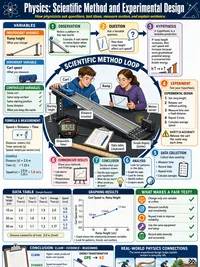
Investigation Workflow
A scientific investigation needs more than a single measurement. It needs a hypothesis, a clear independent and dependent variable, repeated trials, a fit line, and an honest error analysis.
- State a testable hypothesis
- Identify IV, DV, and controlled variables
- Record at least 6 replicated trials across the range of the IV
- Fit a regression line and inspect residuals
- Quote a final value with uncertainty and percent error
Kinematic Equations
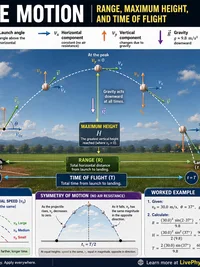
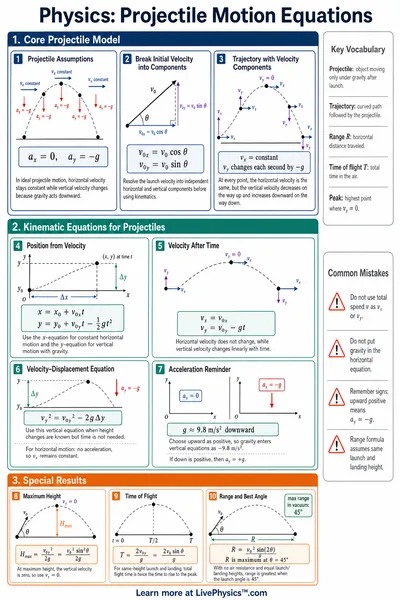
Horizontal and vertical motion are independent. With launch speed v and angle θ
The landing point is where y returns to 0. Solving the quadratic in t and substituting back into x gives the full range.
Range Formula
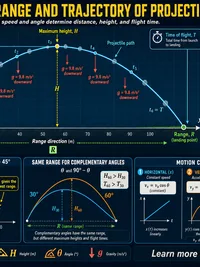
For a ground-launched projectile (h₀ = 0), the range simplifies to
Range is maximized at θ = 45° since sin(2θ) is maximum there. Complementary angles (e.g. 30° and 60°) give equal ranges. At 45° the formula reduces to R = v²/g, so the slope of R vs v² equals 1/g and gives an experimental derivation of gravity.
Error Analysis
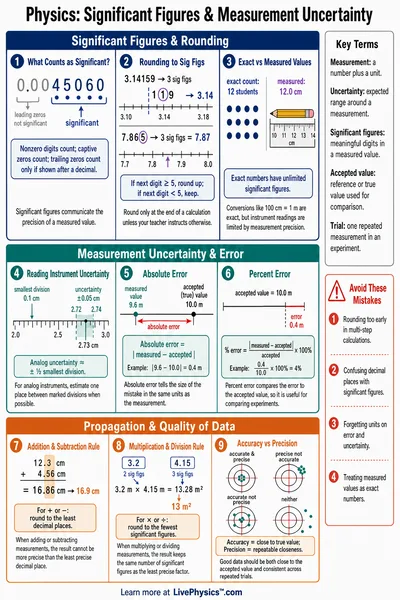
Quote the derived value with both uncertainty and percent error
Slope uncertainty propagates to g via the relative-error rule δg/g = δslope/slope. Inspect residuals for systematic patterns. Curvature indicates that a linear fit is inappropriate (e.g. range vs angle, which is sinusoidal, not linear).
When launching from a raised platform, the simple R = v²sin(2θ)/g formula breaks down. The full range formula includes a square-root correction from the quadratic time-of-flight equation.