Black Hole Geometry Explorer
Explore the spacetime geometry of Schwarzschild black holes. Adjust the mass from a stellar remnant to the largest known quasars and watch the event horizon, photon sphere, and ISCO scale in real time. Includes gravitational light bending.
Black Hole Mass
Schwarzschild Geometry
Computed Values
Gravitational Light Bending
Adjust the impact parameter b (how closely the light ray passes) to see how the Schwarzschild geometry deflects its path.
Key Concepts
The Schwarzschild Metric
The Schwarzschild solution describes curved spacetime outside a non-rotating, uncharged mass. The line element (metric) in Schwarzschild coordinates is
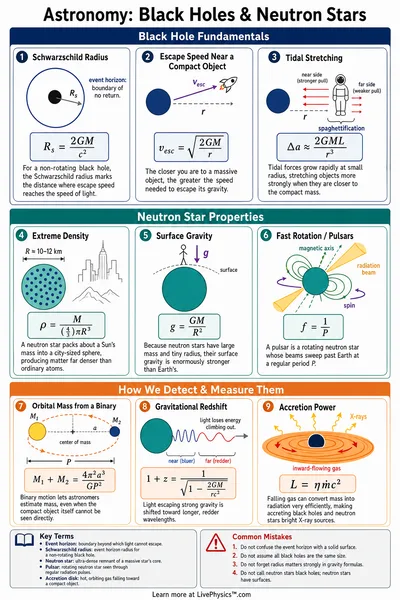
At , the metric coefficient vanishes, marking the event horizon. No causal signal can escape from inside this radius.
Photon Sphere
At , massless photons can orbit the black hole in unstable circular trajectories. Photons approaching closer spiral inward; those farther out escape. This sphere creates the bright ring seen in black hole images.
ISCO
The Innermost Stable Circular Orbit at is the smallest orbit where matter can stably revolve. Inside ISCO, orbits are unstable and matter plunges toward the singularity. It sets the inner edge of the accretion disk.
Gravitational Lensing
Einstein predicted that light is deflected near massive objects. The weak-field deflection angle is , where is the impact parameter. The Sun deflects starlight by about 1.75 arcseconds at its limb.
Tidal Forces
Tidal forces arise from the gradient of gravity across an extended body. Near stellar black holes (small ), tidal forces are extreme and would "spaghettify" any object. Near supermassive black holes, the tidal force at the horizon can be surprisingly mild.
Reference Guide
The Schwarzschild Radius
The Schwarzschild radius is the critical radius below which an object of a given mass must be compressed to form a black hole. Once matter crosses inside r_s, no force can prevent collapse and no signal can escape.
For a one solar mass object, r_s is about 3 km. Earth compressed to a marble (about 9 mm) would form a black hole.
Photon Sphere and ISCO
At 1.5 r_s, photons can orbit in unstable circles. This sphere determines the apparent shadow of a black hole as observed from far away. The bright ring in Event Horizon Telescope images of M87* traces this region.
The Innermost Stable Circular Orbit at 3 r_s is the inner edge of the accretion disk. Gas spiraling inward releases enormous energy just before crossing the ISCO.
General Relativity Background
Karl Schwarzschild derived the exact solution to Einstein's field equations for a spherically symmetric vacuum in 1916, just weeks after Einstein published general relativity and while Schwarzschild was serving in World War I.
The Schwarzschild solution assumes a non-rotating, uncharged mass. Real black holes spin (described by the Kerr metric), which moves the event horizon and ISCO inward for prograde orbits.
Curriculum Alignment
Useful for AP Physics 1 and AP Physics C gravity extensions, introductory astronomy, and first-semester general relativity courses. The Schwarzschild radius formula is accessible at the high-school level using only dimensional analysis and energy arguments.
The light-bending visualization bridges Newtonian gravity intuition with the geodesic concept central to general relativity. Einstein's prediction of 1.75 arcseconds of deflection by the Sun was confirmed in 1919 by Arthur Eddington.