Why Does a Mirror Flip Left and Right but Not Up and Down?
A reflection reverses depth, not direction
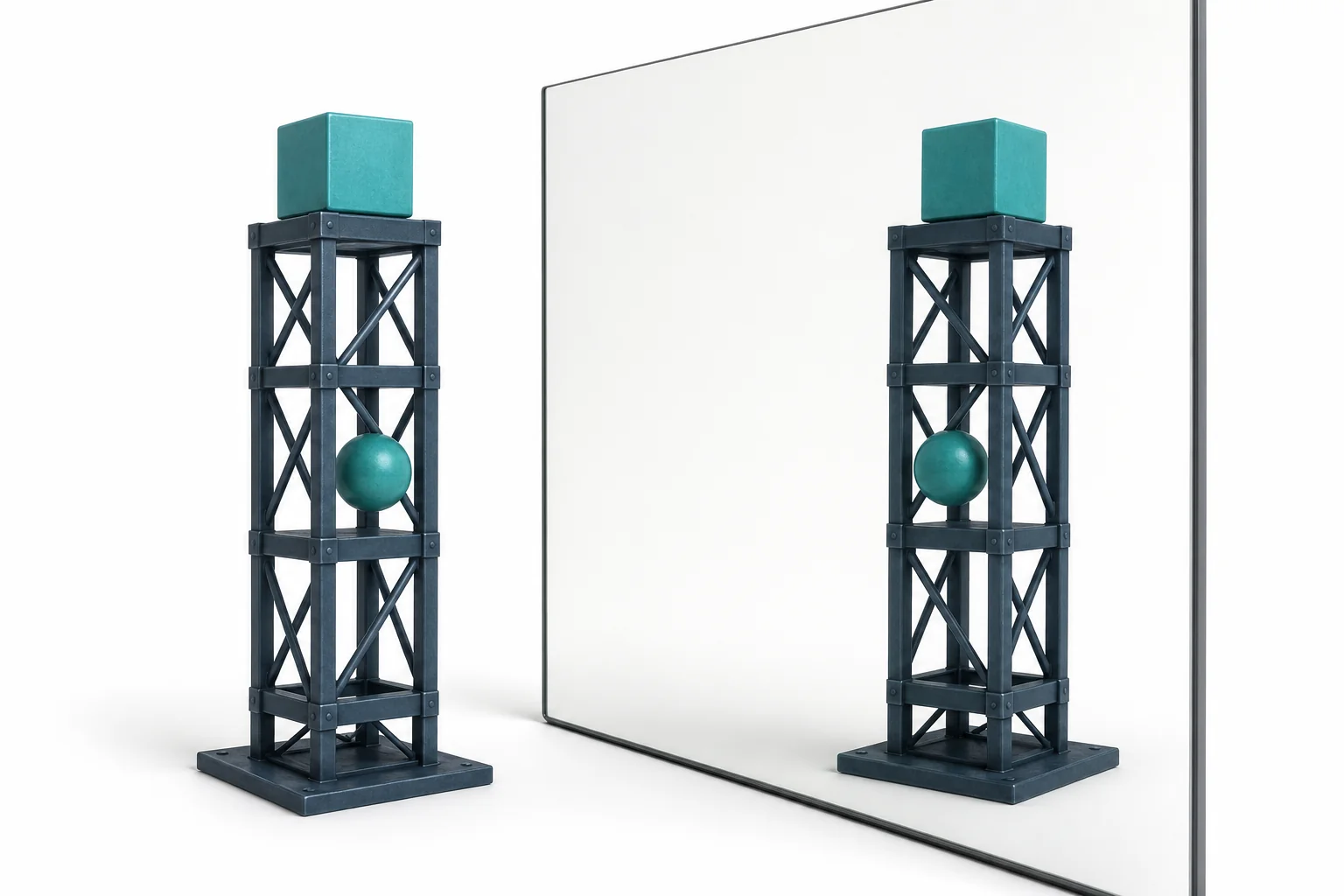
A mirror does not truly flip left and right. It sends the part of you closest to the mirror back to the same point in the image, so front and back are reversed. Your brain calls that left and right because you imagine turning around to stand where the image is.
A bathroom mirror seems to do something strange. Raise your right hand, and the person in the mirror seems to raise a left hand. Tilt your head, and the head in the mirror does not move to the floor. The common explanation says that mirrors flip left and right, but that is not what the geometry says. A flat mirror reverses the direction perpendicular to its surface. That is the front to back direction for a person standing in front of it. The directions across the mirror, such as up, down, left, and right, stay in place. The left-right flip is an interpretation made by your brain. You compare the mirror image to another person facing you, and that comparison includes a mental half-turn. This question sits inside high-school wave physics because reflection follows a simple rule about light rays and surfaces.
The mirror changes depth
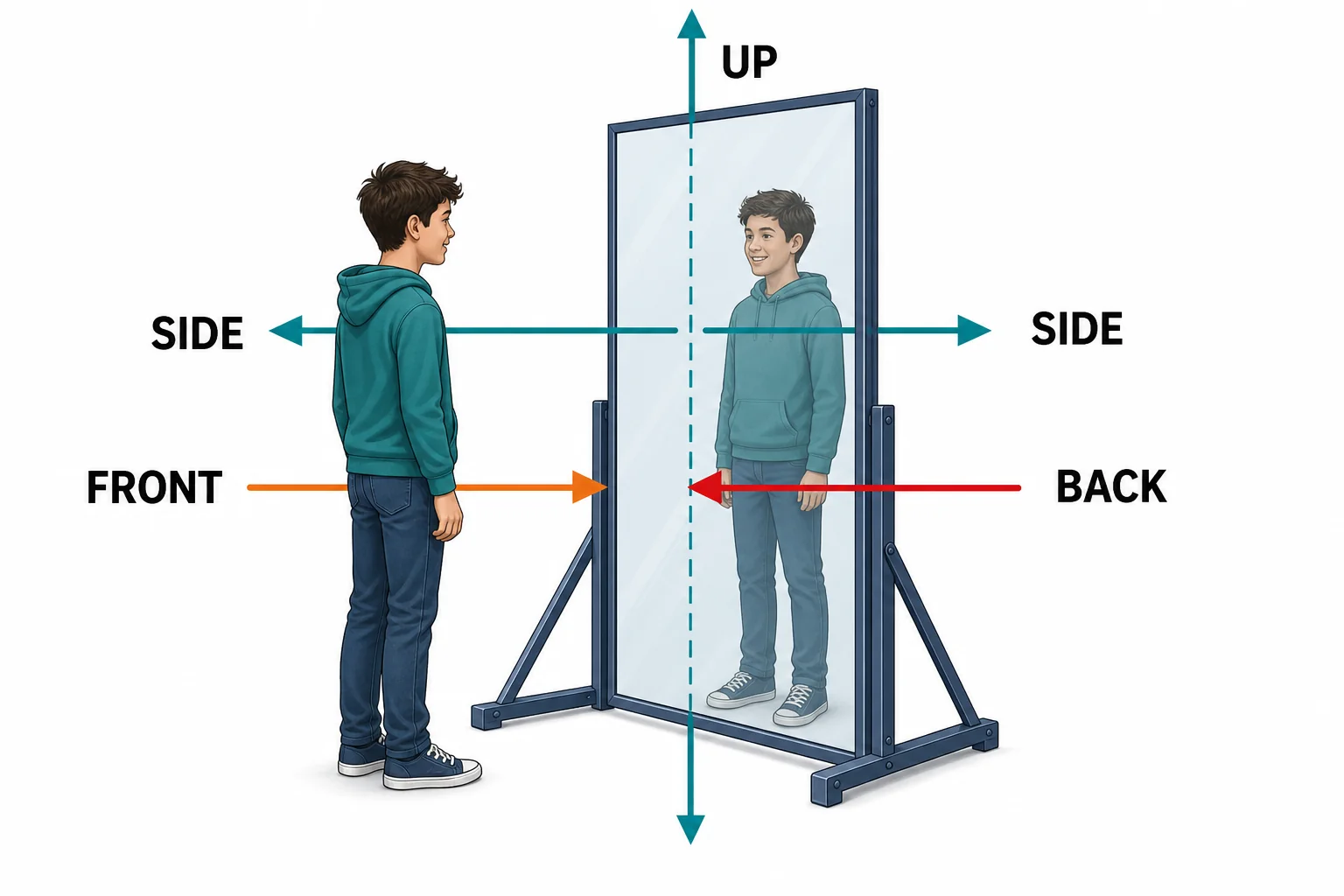
The changed direction is depth, not left or right.
Each point maps straight back
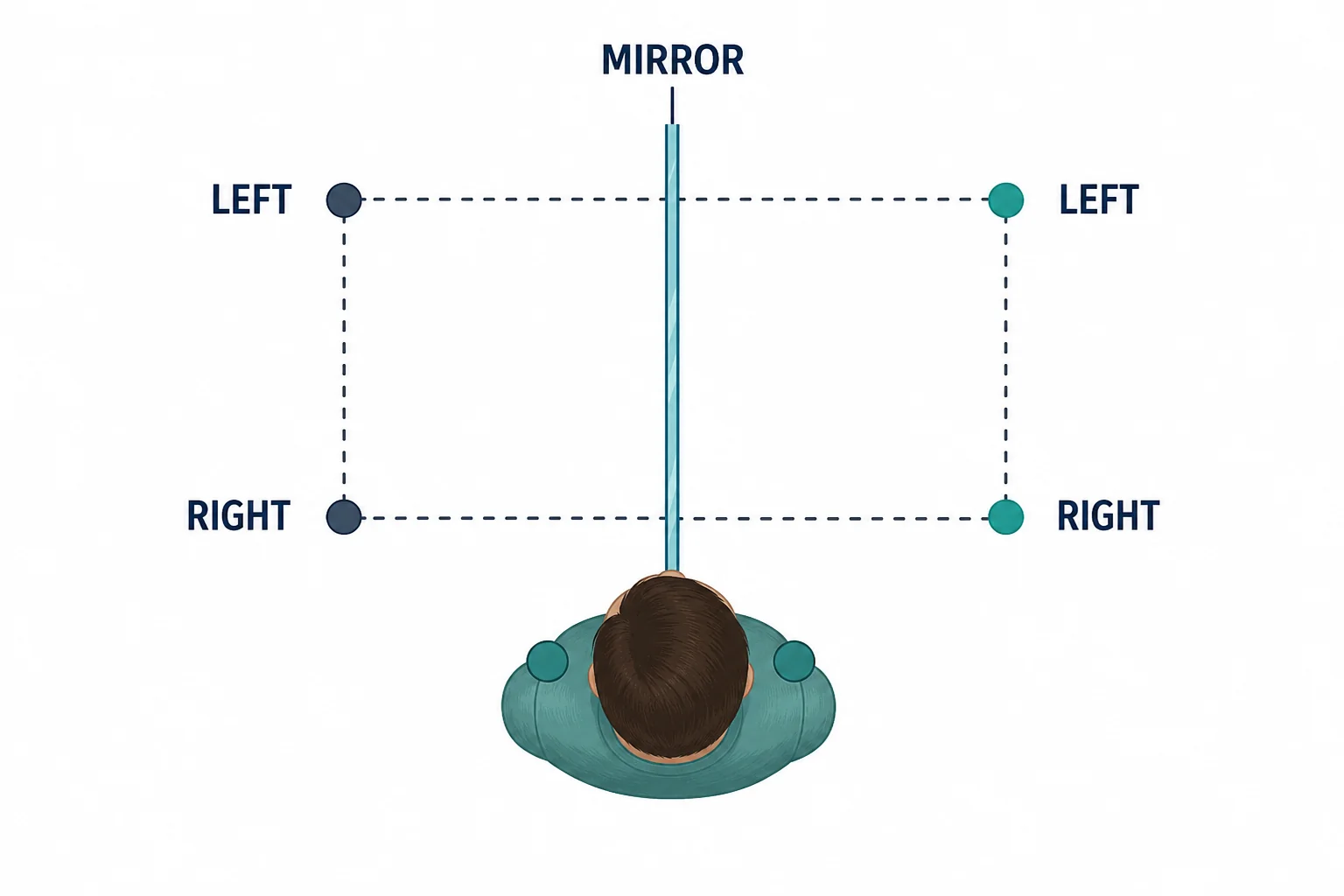
Left and right points keep their order along the mirror.
Why writing looks backward
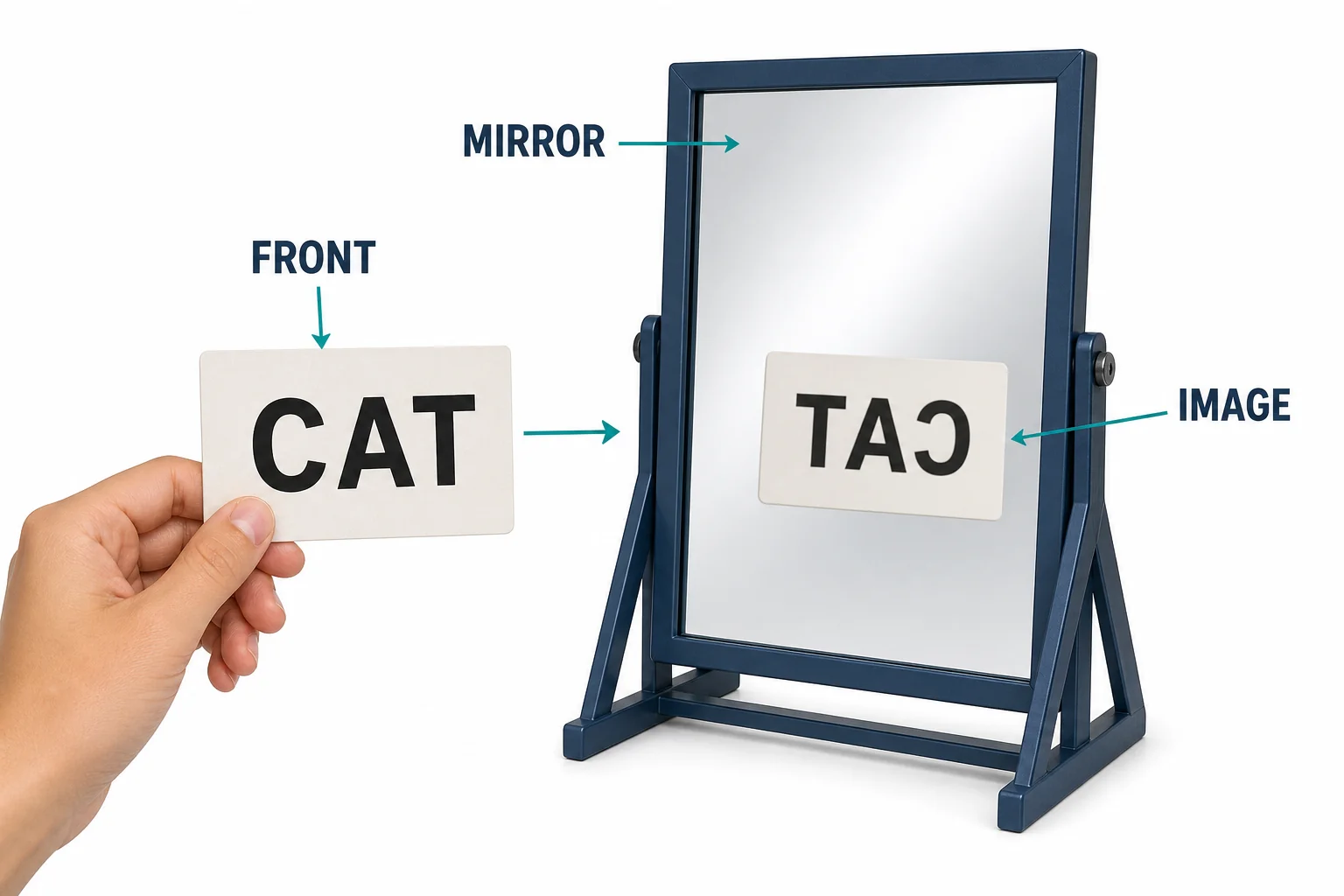
Letters look reversed because their front face is reflected in depth.
Your brain imagines a turn
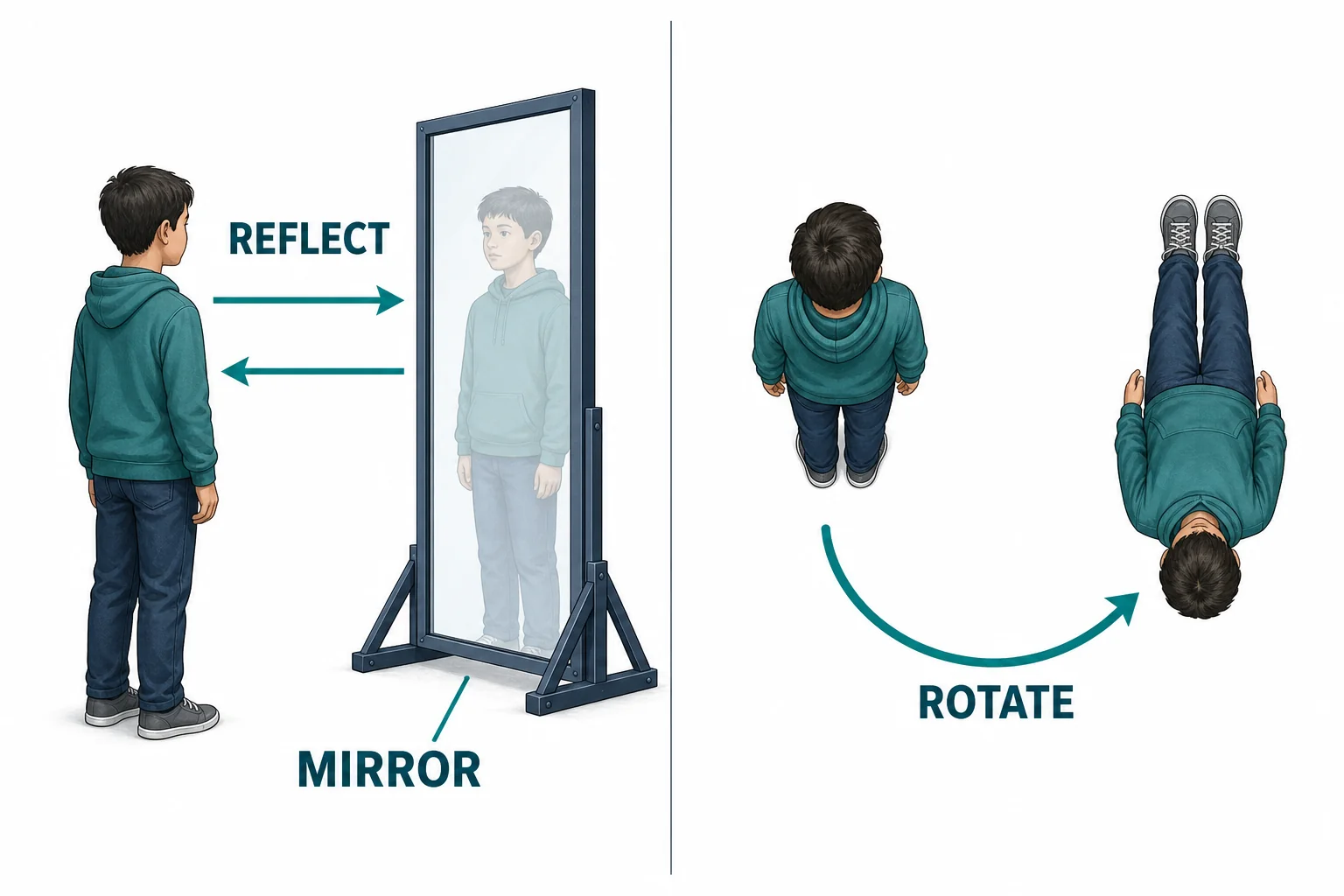
The mind compares the image to a turned person.
Why up and down stay put
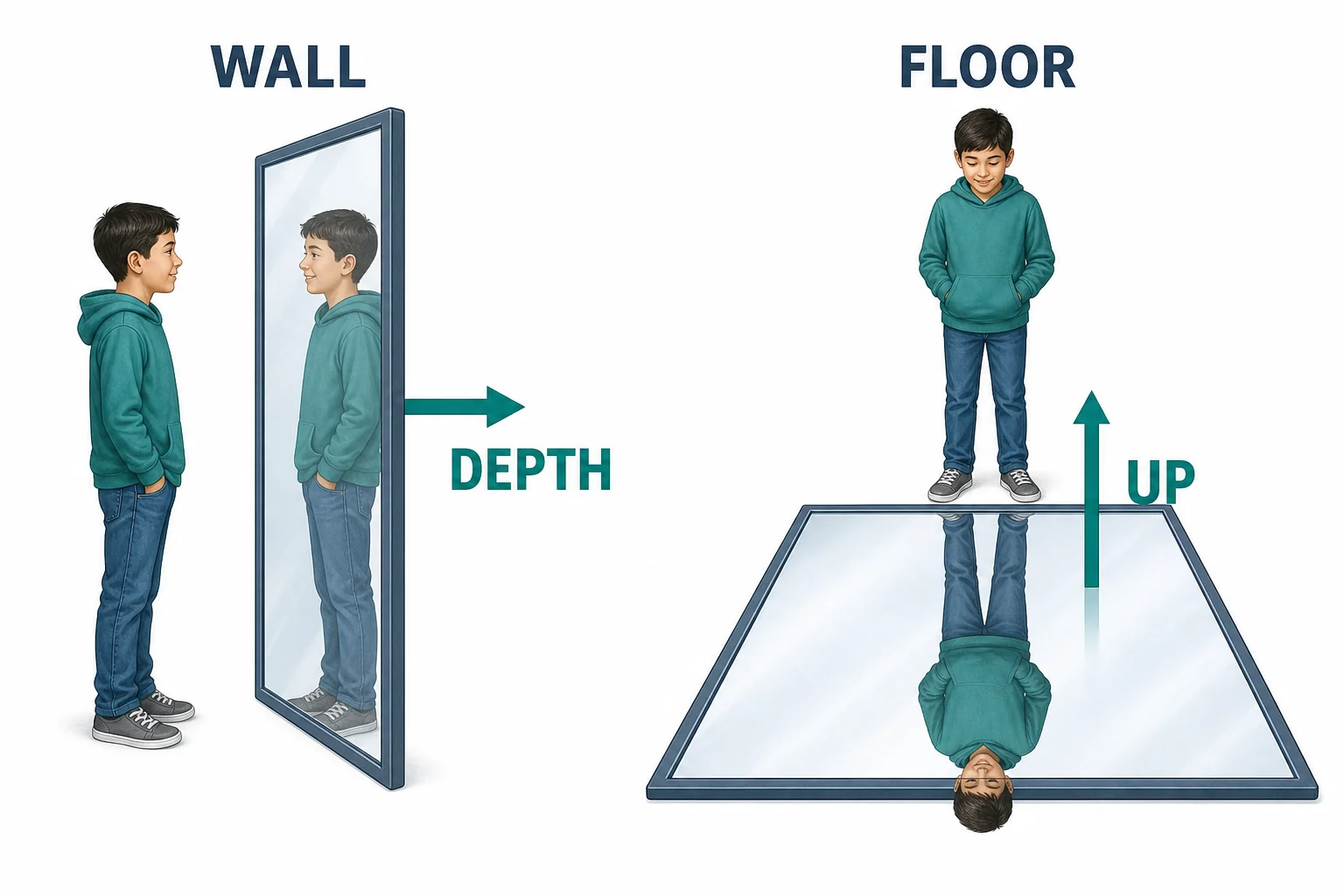
Change the mirror plane, and the reversed direction changes too.
Vocabulary
- Reflection
- The change in direction when light bounces off a surface.
- Plane mirror
- A flat mirror that forms an upright virtual image the same size as the object.
- Virtual image
- An image that appears to be behind a mirror because reflected light rays seem to come from that location.
- Perpendicular
- Meeting a surface at a right angle.
- Coordinate axis
- A reference direction used to describe position, such as side-to-side, up-down, or front-back.
- Rotation
- A turn around an axis, which is different from a reflection across a plane.
In the Classroom
Map a reflection with string
20 minutes | Grades 9-12
Tape a line on a table to represent a mirror. Students place dots for object points, then use string and a ruler to place matching image points the same distance on the other side.
Compare reflection and rotation
25 minutes | Grades 9-12
Students draw a simple person icon on grid paper, then make one copy by reflecting it across a line and another by rotating it 180 degrees. They identify which coordinates changed in each case.
Mirror writing test
15 minutes | Grades 8-12
Students write a short word on paper and on clear plastic, then compare how each looks in a mirror. The class explains the result using front-back inversion and the position of the writing surface.
Key Takeaways
- • A flat mirror reverses the direction perpendicular to its surface.
- • For a wall mirror, that reversed direction is front-back.
- • Left and right do not physically swap positions along the mirror surface.
- • The apparent left-right flip comes from comparing the image to a person who turned around.
- • Up and down stay aligned in a wall mirror because they lie along the mirror plane.