Understanding Optical Bench Lab
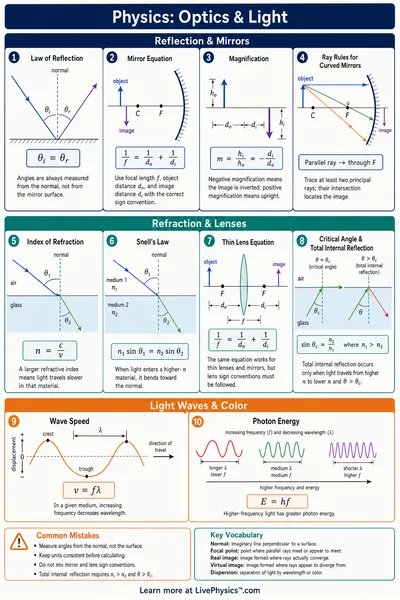
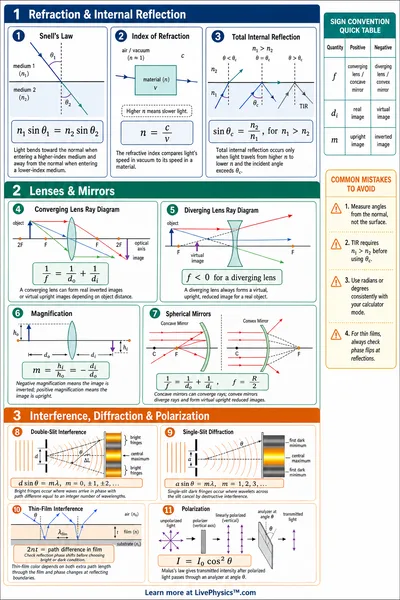
An optical system redirects light because the direction of light changes when it enters a new material or reflects from a surface. The amount of bending depends on the surface shape and on how strongly the material slows light.
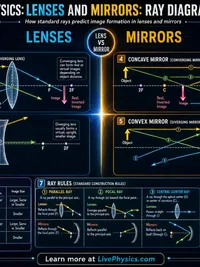
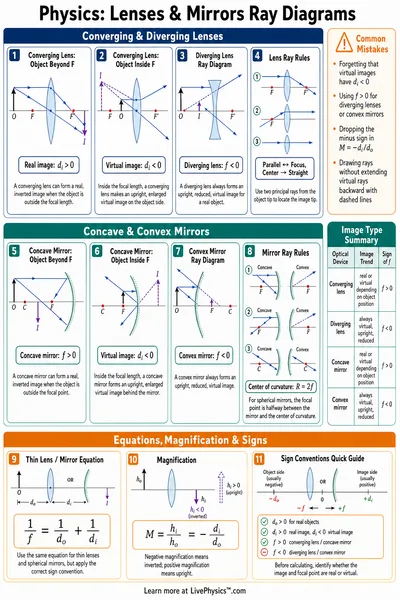
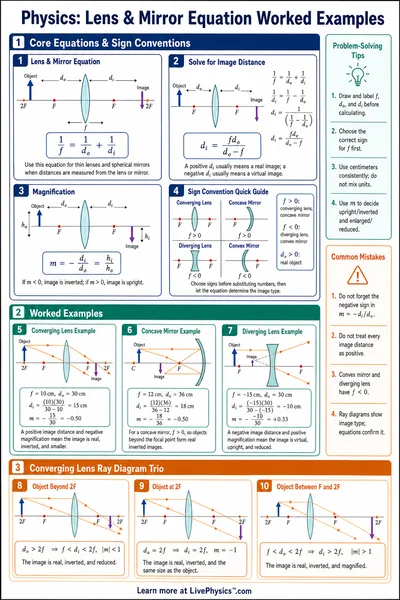
Convex lenses are thicker at the center, so rays from one object point can meet after passing through them. Concave lenses spread rays apart, making the rays seem to come from a point on the object side.
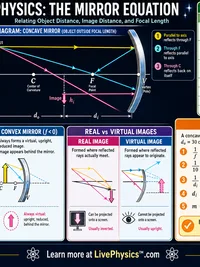
Curved mirrors produce similar effects without light travelling through glass. A concave mirror can bring incoming parallel rays together, whereas a convex mirror sends them outward and gives a broad field of view.
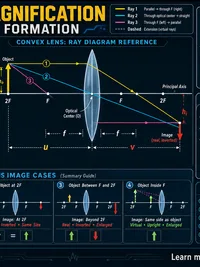
Every visible point on an object sends light in many directions. The optical element sorts those rays into a new pattern, and the eye interprets the pattern as an image located where the rays meet or appear to meet.
A real image is formed by light reaching the same physical location, so it can be captured on paper, a screen, or a camera sensor. A virtual image cannot be projected because its rays are still separated when they reach the observer.
Image orientation is not a label to memorise separately. When rays from the top and bottom of an object cross before reaching the image, their positions exchange, producing an inverted image.
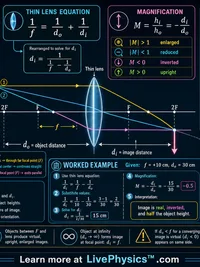
Magnification compares image height with object height, but size alone does not tell the whole story. A large image may be virtual or real, while a small image may be upright or inverted depending on the arrangement.
The focal length sets the scale of an optical device. A short focal length bends rays strongly and makes image position change quickly as the object moves, while a long focal length produces gentler changes.
Near the focal position, the outgoing rays can become nearly parallel. In that condition, the image is effectively extremely far away, which explains why small placement errors can cause large shifts in calculated image distance.
Principal rays are useful because they represent paths whose behavior is easy to predict from the geometry. They are a construction tool rather than the only rays present, since countless rays from each point actually pass through the system.
Careful measurement matters on a bench because distances are taken from a reference point of the element, not from its edge or mount. Keeping a consistent direction for positions prevents an image on one side from being confused with one on the other.
These ideas appear in phone cameras, projectors, microscopes, glasses, door viewers, and rear view mirrors. When studying them, draw rays neatly, check whether they truly intersect, and connect the geometry to what a screen or an eye can receive.