
The Moon is Earth's only natural satellite and the brightest object in our night sky after the Sun. Studying its structure and surface features helps scientists understand how rocky worlds form, cool, and change over time. Because the Moon has almost no atmosphere and very little active geology today, it preserves evidence from the early solar system.
Its craters, maria, and internal layers act like a long-term record of planetary history.
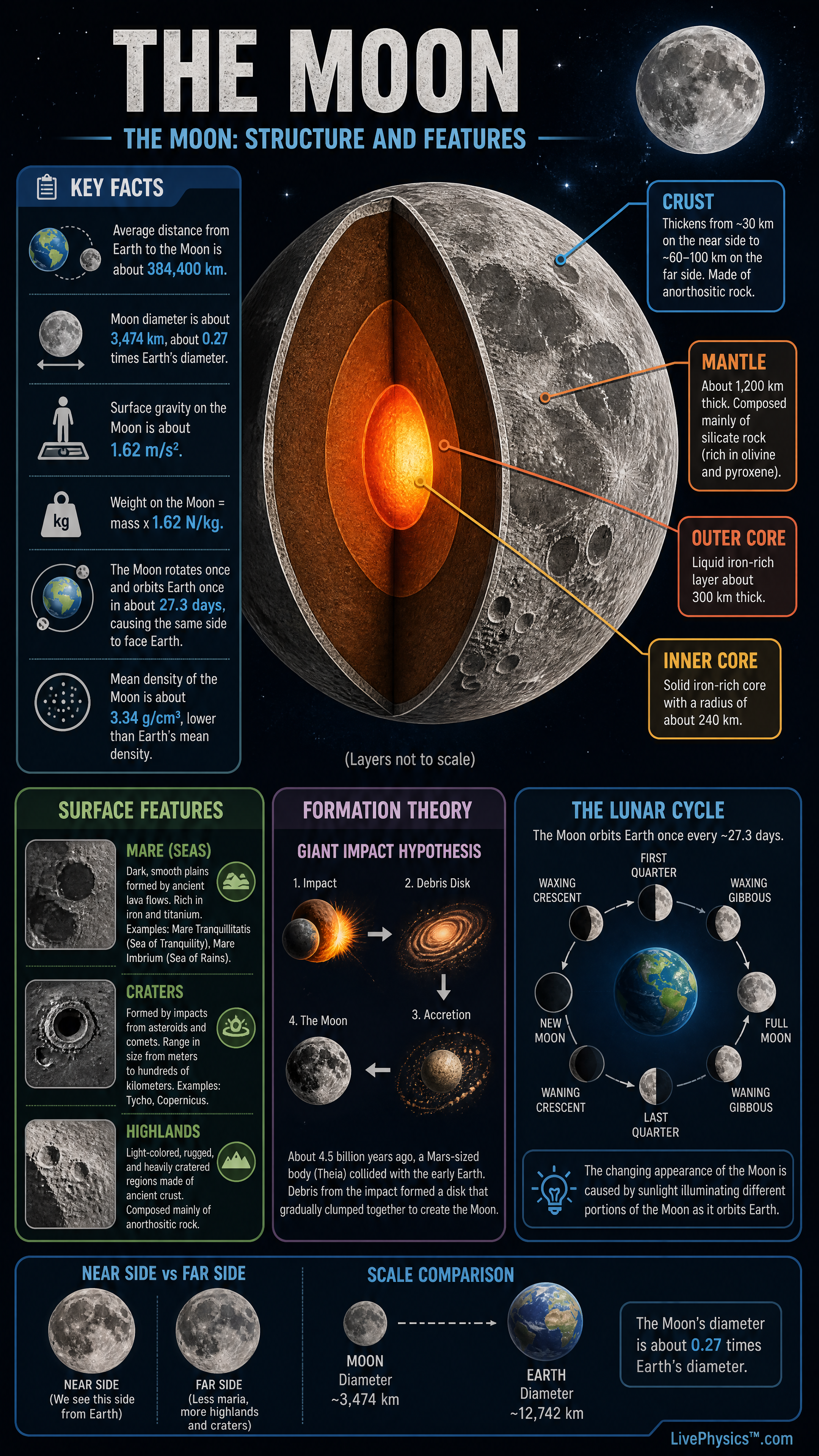
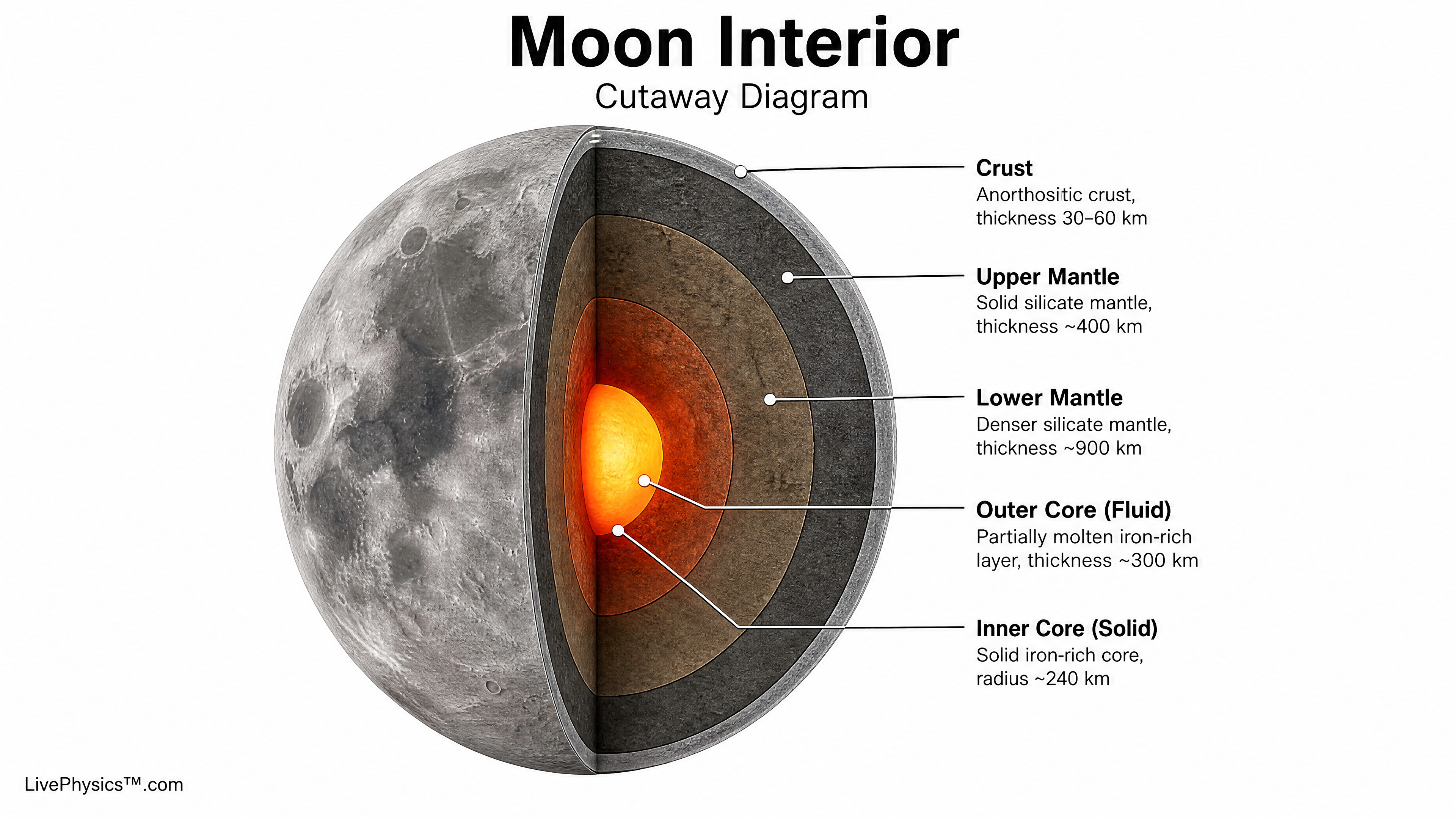
The Moon has a layered interior made of crust, mantle, and a small core, much like Earth but on a smaller scale. Its surface shows dark basalt plains called maria, bright highlands, impact craters, mountains, and long cracks called rilles. Most of these features formed through impacts, volcanic activity, and slow cooling over billions of years.
By mapping these structures and measuring the Moon's size, density, and motion, scientists can test ideas about its origin and evolution.
Understanding The Moon, Structure and Features
Scientists learn about the Moon's hidden interior without drilling very far into it. Instruments left by Apollo astronauts recorded moonquakes. The paths and speeds of seismic waves changed as they moved through different materials.
This gave evidence for a rigid outer shell, a warmer mantle below it, and a small metallic core. Gravity measurements from orbit add more clues. Some regions pull spacecraft slightly more strongly because dense rock lies beneath them.
These buried dense areas are called mass concentrations, or mascons. Many occur below large ancient impact basins.
The crust is not equally thick everywhere. The far side has more highland crust and fewer large lava plains than the near side. This difference may be linked to early heating inside the Moon.
Radioactive elements that produced heat were unevenly distributed, so magma reached the surface more easily in some places. When large impacts broke through the crust, molten rock could rise and flood the basin floor.
The cooled lava is rich in iron, which makes it darker than many highland rocks. Samples brought to Earth show that lunar rocks can be dated, giving scientists actual ages for parts of the surface.
Impact craters provide a useful way to estimate age where no samples exist. A surface exposed for a long time collects more craters. Fresh craters often have sharp rims, bright streaks of ejected material, and rough walls.
Over time, later impacts grind these features down. Small impacts matter because there is almost no wind or rain to erase their marks. Crater counting is not perfect.
Scientists must separate craters from volcanic pits and must consider that impact rates changed in the early solar system. Still, comparing crater numbers across different regions helps build a timeline of lunar events.
The leading explanation for the Moon's origin is the giant impact idea. Very early in Earth's history, a Mars-sized body probably struck the young Earth. Hot debris from both objects entered orbit and gradually joined together.
This idea explains why Moon rocks resemble Earth rocks in several chemical ways, while the Moon has relatively little iron compared with Earth. The impact was violent enough to melt much of the new body.
As it cooled, lighter minerals floated upward to form early crust, while denser minerals sank. Scientists continue to test this model because details such as the exact mix of material remain uncertain.
Moon phases come from the changing angle between the Sun, Earth, and Moon. Half of the Moon is always lit by the Sun, but people on Earth see different portions of that lit half. The full sequence of phases takes about twenty nine and a half days, slightly longer than one orbit because Earth moves around the Sun during that time.
Eclipses do not happen every month because the Moon's orbit is tilted relative to Earth's path around the Sun. When studying diagrams, pay close attention to light direction and viewing position.
A phase is not caused by Earth's shadow except during a lunar eclipse. Lunar gravity also raises tides on Earth, showing that gravity acts across very large distances.
Key Facts
- Average distance from Earth to the Moon is about 384,400 km.
- Moon diameter is about 3,474 km, which is about 0.27 times Earth's diameter.
- Surface gravity on the Moon is g_moon about 1.62 m/s^2.
- Weight on the Moon = mass x 1.62 N/kg.
- The Moon rotates once and orbits Earth once in about 27.3 days, causing the same side to face Earth.
- Mean density of the Moon is about 3.34 g/cm^3, which is lower than Earth's mean density.
Vocabulary
- Crust
- The crust is the Moon's thin outer rocky layer above the mantle.
- Mantle
- The mantle is the thick middle layer of hot rock beneath the crust.
- Core
- The core is the dense central region of the Moon, made partly of metallic material.
- Maria
- Maria are large dark plains formed when ancient lava filled low areas on the Moon.
- Highlands
- Highlands are the older, brighter, heavily cratered regions that cover much of the Moon's surface.
Common Mistakes to Avoid
- Thinking the dark areas are oceans, which is wrong because maria are solid basalt plains left by ancient volcanic eruptions. They only looked like seas to early observers.
- Assuming the Moon does not rotate, which is wrong because it rotates once in the same time it orbits Earth. This synchronous rotation is why we keep seeing nearly the same face.
- Confusing craters with volcanoes, which is wrong because most lunar craters were made by impacts from meteoroids and asteroids. Only some surface features are volcanic in origin.
- Believing the Moon has no internal structure, which is wrong because measurements show it has a crust, mantle, and core. Its interior is simpler and smaller than Earth's, but it is still layered.
Practice Questions
- 1 An astronaut has a mass of 75 kg. What is the astronaut's weight on the Moon? Use weight = mass x 1.62 N/kg.
- 2 The Moon's diameter is about 3,474 km and Earth's diameter is about 12,742 km. Calculate the ratio Moon diameter divided by Earth diameter and round to two decimal places.
- 3 The Moon has many preserved impact craters, while Earth has fewer visible ancient craters. Explain how the lack of a thick atmosphere, liquid water, and active plate tectonics helps the Moon preserve old surface features.