Mirror Reflection Maze
Place plane mirrors on the grid and redirect the laser beam to hit the target. Each level challenges you to use the law of reflection to solve the puzzle.
Level 1: Straight Shot
The laser goes straight. Watch how it travels in a straight line.
Observe the laser beam traveling in a straight line.
Level
Place Mirrors
This level has no movable mirrors. Watch the laser travel straight.
Angle Panel
Place a mirror to see the angles of incidence and reflection.
Reference Guide
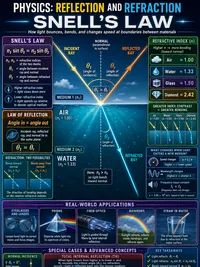
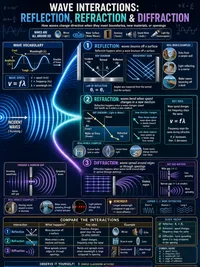
Law of Reflection
The Rule
When light reflects off a smooth surface, the angle it arrives at (angle of incidence) always equals the angle it leaves at (angle of reflection). Both angles are measured from an imaginary line called the normal, which stands perpendicular to the surface.
The Normal Line
The normal is an invisible reference line drawn at 90 degrees to the mirror surface at the point where the light hits. Angles of incidence and reflection are both measured from this normal, not from the mirror surface itself.
Why It Matters
This law applies to all mirrors and smooth surfaces. It explains how telescopes, periscopes, laser systems, and even your bathroom mirror all work.
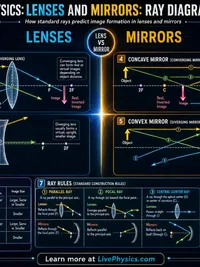
Plane Mirrors
What Is a Plane Mirror?
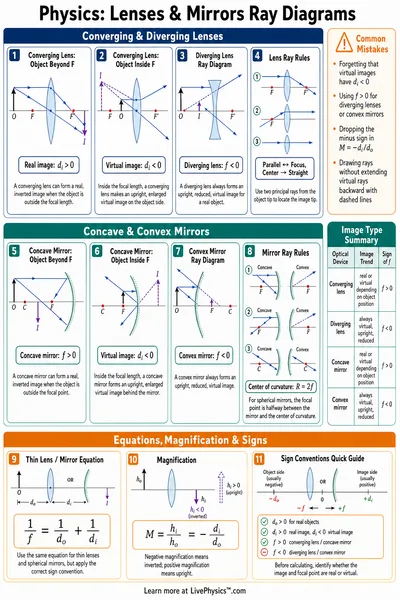
A plane mirror is a flat, reflective surface. Unlike curved mirrors, a plane mirror reflects each incoming ray at the same angle it arrived from, producing a clear, undistorted image.
Mirror Angle and Beam Direction
Rotating a mirror by one degree redirects the reflected beam by two degrees. This is because both the angle of incidence and the angle of reflection shift when the mirror tilts. This property makes mirrors powerful for precisely steering light.
Real-World Uses
- Periscopes in submarines
- Laser targeting systems
- Optical fiber alignment
- Kaleidoscopes and art installations
Angle of Incidence
The angle of incidence is the angle between the incoming (incident) ray and the normal line at the point of reflection. It is always measured on the same side as the incoming ray.
A ray hitting a mirror straight on (perpendicular) has an angle of incidence of 0 degrees and bounces straight back. A ray hitting at 45 degrees to the normal reflects at 45 degrees on the other side.
Key angles to know
- 0 deg Ray reflects straight back
- 45 deg Ray turns 90 degrees
- 90 deg Ray grazes the surface
Placing a mirror at 45 degrees to an incoming horizontal beam will redirect it perfectly vertically, either upward or downward depending on which side of the beam the mirror sits.