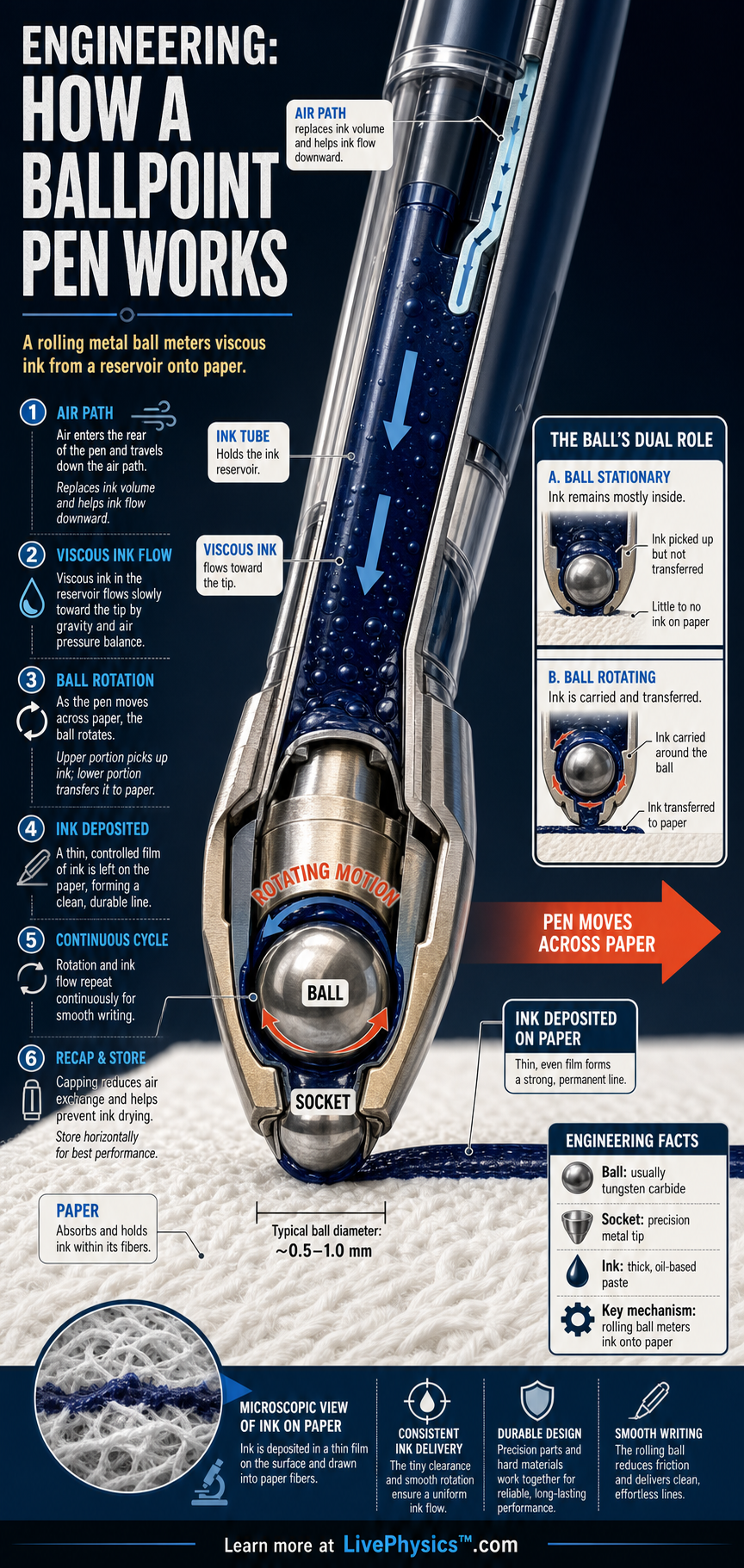
A ballpoint pen is a compact rolling ink-delivery system that turns hand motion into a controlled written line. Its tiny metal ball rotates inside a precisely shaped socket at the pen tip. This design delivers ink without the dripping and smearing associated with many liquid-ink pens.
The pen works because mechanical contact, fluid flow, and air pressure are carefully balanced.
As the tip moves across paper, friction makes the exposed part of the ball roll. The rear of the rotating ball contacts viscous ink in the reservoir, while the front carries a thin ink film onto the paper fibers. An air path into the ink tube replaces the volume of ink used, preventing a damaging vacuum from forming.
The socket holds the ball tightly enough to seal and guide it, yet loosely enough to let it rotate smoothly.
Understanding Engineering, How a Ballpoint Pen Works
The pen tip is made to very small tolerances. The ball is often tungsten carbide, a very hard material that resists wear. The tip body may be brass, stainless steel, or another metal that can be shaped accurately.
During manufacture, the ball is pressed into its socket so it cannot fall out, yet it still has a tiny clearance for rotation. If this clearance is too large, ink can leak or collect around the tip.
If it is too small, the ball can stick. Engineers must control dimensions much smaller than the width of a written line.
Ballpoint ink is much thicker than water. Its high viscosity helps it stay inside the refill when the pen is carried in a pocket or held point upward. This thickness creates a tradeoff.
Thick ink is less likely to drip, but it needs enough force at the tip to form a smooth mark. Warm ink flows more easily than cold ink.
This is one reason a pen may write poorly after being left in a cold car, then work again when warmed in a hand. Ink makers choose pigments, oils, resins, and additives so the ink flows under writing pressure, wets the paper, then dries without spreading too far.
The angle and pressure of writing affect the result. A ballpoint works best when enough of the ball touches the paper to turn it. Very light pressure can give a faint line because little ink is transferred.
Excessive pressure can dig into soft paper, flatten the paper fibers, or make the line look wider. Rough paper increases resistance and may wear the tip faster.
Smooth coated paper can make the line feel slippery and can slow drying. Students see these effects when writing in different notebooks, filling in forms, or making notes on glossy pages.
Many common pen faults come from interrupted ink flow. A dried layer of ink at the exposed tip can stop the ball from picking up fresh ink. Scribbling on scrap paper may remove this layer and restart the flow.
A small air bubble in the refill can break the continuous path between ink and tip, causing skips. Dropping a pen can damage the tip or shift the ball slightly in its socket. Keeping the cap on a capped pen limits evaporation and dirt.
When studying this device, pay attention to the balance between sealing, flow, friction, and manufacturing accuracy. A pen succeeds because each part has a narrow acceptable range, not because any one part works alone.
Key Facts
- The ball rotates rather than slides across the paper, reducing drag at the tip.
- The rear of the ball picks up viscous ink from the ink tube; the front transfers it to paper.
- A typical ballpoint ball diameter is about 0.5 mm to 1.2 mm.
- The socket is a precision metal cup that retains the ball while leaving part of it exposed.
- Friction creates the turning effect, τ = rF, where τ is torque, r is ball radius, and F is friction force.
- Air entering the reservoir replaces used ink volume, ΔV_air ≈ ΔV_ink.
Vocabulary
- Ball
- The small polished metal sphere at the pen tip that rolls and transfers ink to paper.
- Socket
- The precision-shaped metal holder that captures the ball while allowing it to rotate.
- Ink reservoir
- The tube inside the pen body that stores ink and supplies it to the tip.
- Viscosity
- A fluid's resistance to flowing, which helps ballpoint ink stay in the pen until the ball transfers it.
- Air path
- A route for air to enter the ink reservoir as ink leaves, helping maintain pressure balance.
Common Mistakes to Avoid
- Thinking the ball is fixed in place is incorrect because the ball must rotate to pick up ink at its rear and deposit ink at its front.
- Assuming ink flows freely out of the pen like water is incorrect because ballpoint ink is viscous and is metered mainly by the rotating ball and narrow tip gap.
- Ignoring the air path is incorrect because ink leaving a sealed reservoir would lower the internal pressure and eventually oppose further ink flow.
- Believing that pressing harder always makes a pen write better is incorrect because excessive force can damage the tip, dig into paper, or prevent smooth rolling.
Practice Questions
- 1 A pen has a ball diameter of 0.80 mm. Calculate the ball's radius in meters.
- 2 The friction force on a 0.50 mm radius ball is 0.20 N. Calculate the torque on the ball using τ = rF.
- 3 A pen writes normally for a short distance and then stops even though ink remains in the tube. Explain how a blocked air path could cause this result.