States of Matter Sorter
Drag each substance card into the correct Solid, Liquid, or Gas zone. Watch how particle diagrams show you the difference between tightly packed, loosely packed, and spread-out particles.
Choose difficulty
6 substances, hints always shown
Progress
0 / 6
Drag each substance into the correct category
Ice
Ice is frozen water - particles are locked in place!
Water
Water flows and takes the shape of its container!
Steam
Steam fills all available space like any gas!
Rock
Rocks have a fixed shape - particles are packed together!
Milk
Milk pours and flows - it's a liquid!
Oxygen
The air we breathe is a gas - particles zoom around freely!
Fixed shape, tightly packed particles
Takes container shape, particles slide
Fills all space, particles spread out
Reference Guide
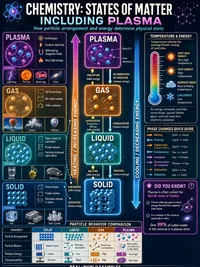
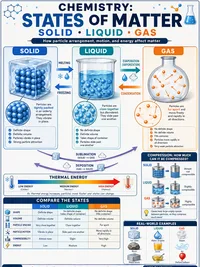
Three States of Matter
Solid
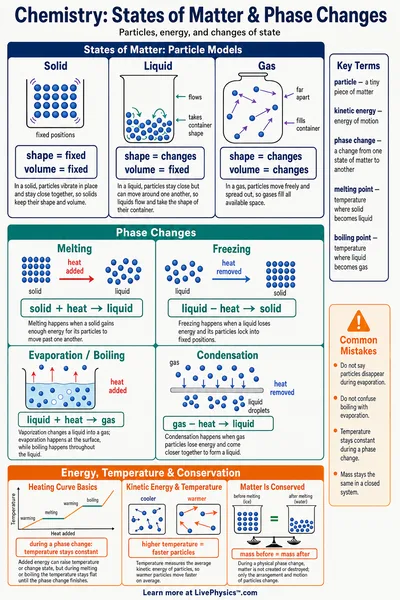
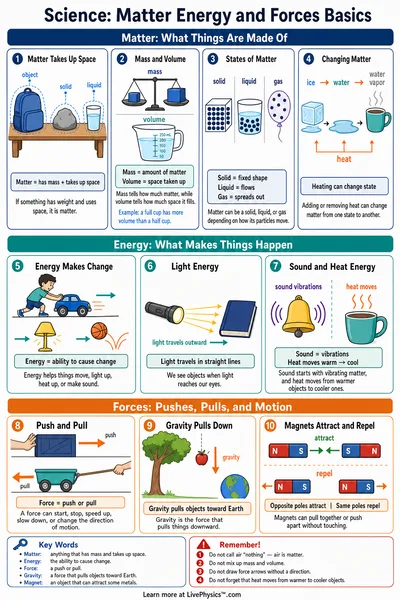
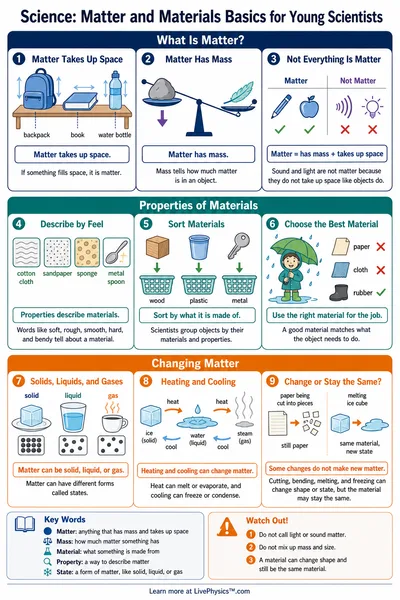
Has a definite shape and a definite volume. Particles are packed tightly together and can only vibrate in place. Solids do not flow and cannot be compressed easily.
Liquid
Has a definite volume but no definite shape. Particles are close together but can slide past one another, so a liquid takes the shape of its container. Liquids flow.
Gas
Has no definite shape or volume. Particles move very fast and spread out to fill any container. Gases can be compressed much more easily than solids or liquids.
Particle Theory
All Matter is Made of Particles
Every substance is made of tiny particles (atoms or molecules) too small to see with the naked eye. The arrangement and movement of these particles determines the state of matter.
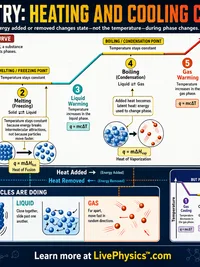
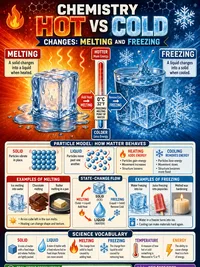
Energy Controls State
Adding heat gives particles more energy so they move faster. When enough energy is added, a solid melts into a liquid and a liquid evaporates into a gas. Removing heat reverses the process.
Particle Spacing
Solid particles are closest together; gas particles are farthest apart. That is why solids are usually denser than liquids, which are denser than gases.
Everyday Examples
Solids Around You
- Ice cubes in a glass
- A wooden chair
- Rocks and sand grains
- Books, pencils, and coins
Liquids Around You
- Water, milk, and juice
- Honey and syrup
- Cooking oil
- Mercury in a thermometer
Gases Around You
- Oxygen we breathe
- Steam from boiling water
- Helium inside a balloon
- Smoke rising from a fire