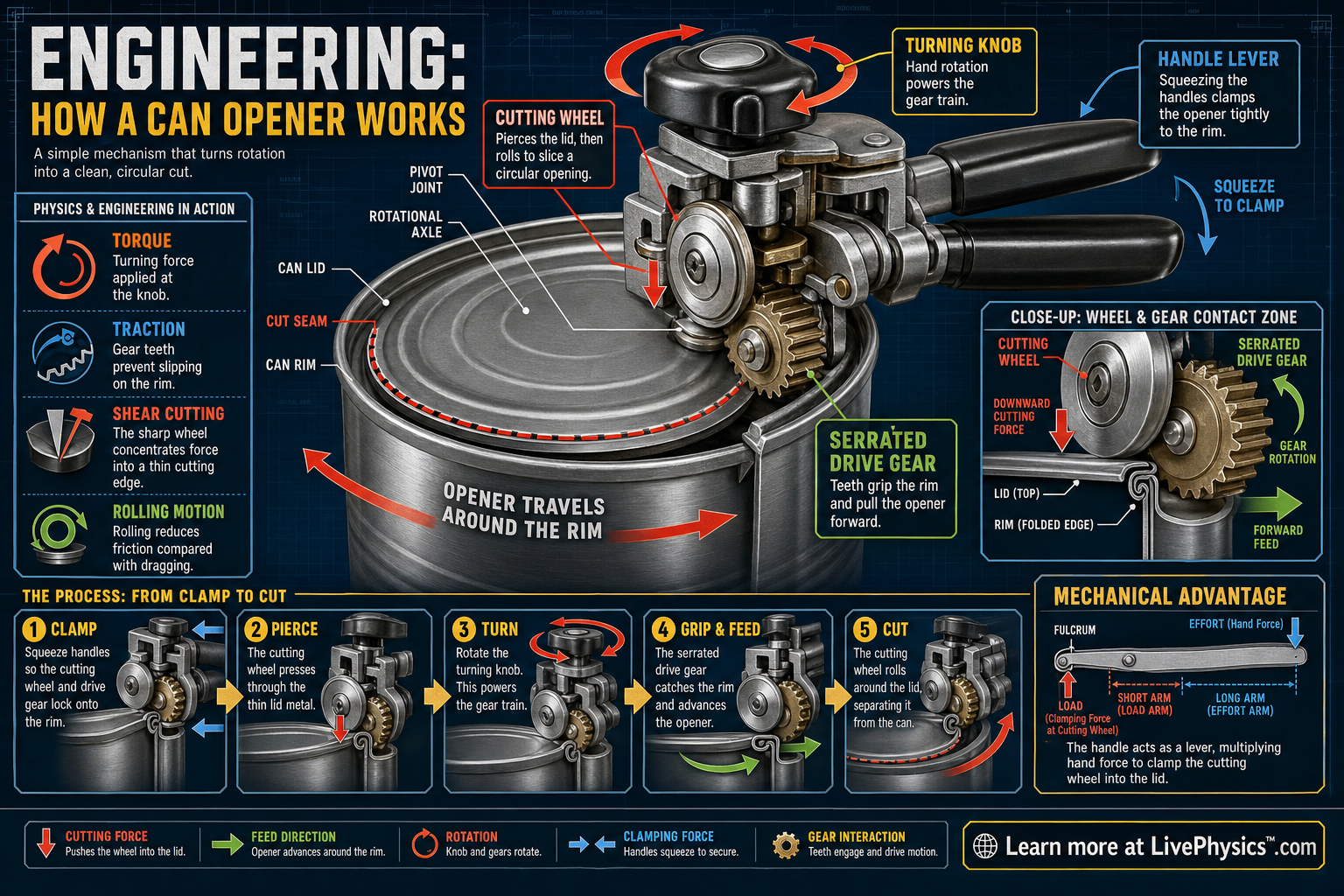
A manual can opener is a compact machine that uses rotating wheels, gears, and leverage to separate a can lid from its sidewall. It converts the small force from a person's hand into a controlled cutting and feeding action. The sharp cutting wheel pierces the thin metal lid, while a serrated drive gear grips the can's rim.
Understanding this device connects everyday tools to engineering ideas such as force, torque, friction, and motion transfer.
Squeezing the handles clamps the opener onto the can and positions the cutting wheel just inside the raised rim. Turning the knob applies torque to the drive gear, whose teeth grip the rim and pull the opener around the circular can. The drive gear also makes the cutting wheel roll and shear the lid metal along a nearly circular path.
The handle acts as a lever, allowing the user to create enough clamping force to keep the wheels engaged without crushing the can.
Understanding Engineering, How a Can Opener Works
The important cutting process is shearing, not simply slicing. The cutting wheel pushes the lid metal against a supporting edge near the rim. Pressure becomes concentrated in a very narrow strip, so the metal first bends, then develops a small crack.
As the opener moves, that crack extends around the lid. This is similar to cutting paper with scissors, where two nearby edges force material to fail along a line. The wheel must be hard enough to keep its shape.
It must still have a carefully rounded form, since a point that is too sharp can jam or tear the lid unevenly. The raised rim gives the tool a strong track to follow.
The teeth on the drive gear solve a motion problem. A smooth wheel could slide on the painted metal rim, especially if the can is wet or greasy. Serrations make many small contact points that press into the rim surface.
Friction and tooth shape resist slipping as the knob turns. The gear and cutting wheel are held at a fixed spacing by the opener frame. This spacing matters because the tool needs to stay aligned while it travels around a curved edge.
If the wheels separate slightly, the gear loses its grip. If they squeeze too tightly, turning becomes difficult because friction rises.
Can lids are usually thin steel or aluminium, while the rim is folded into several layers to make it stiff. This difference explains why the lid can be cut without the whole can collapsing. The folded rim acts like a structural beam around the edge.
It resists bending much better than a flat sheet of the same metal. A damaged rim can cause trouble because dents change the path of the wheels. Rust can make the metal weaker in some places, while sticky food residue can increase drag.
A worn cutting wheel may leave a partial cut. A worn drive gear may skip, causing the opener to stop or move in jerks.
This tool is a useful example of engineering tradeoffs. A larger knob gives the hand more turning leverage, but it makes the opener bulkier. Stronger clamping reduces slipping, but too much clamping makes the device tiring to use.
Engineers choose the tooth size, wheel diameter, handle length, and frame stiffness together. Students can observe these choices in bottle openers, hand drills, bicycle gears, pliers, and pencil sharpeners.
When studying the mechanism, pay attention to where force enters through the hand, where it changes into rotation, and where contact forces act on the metal. Drawing arrows for these forces often makes the motion easier to understand.
Key Facts
- The cutting wheel pierces the lid just inside the raised rim, leaving the rim attached to the can wall.
- The serrated drive gear grips the outside of the can rim and advances the opener around the can.
- Torque is the turning effect of a force, τ = rF when the force is perpendicular to the handle.
- A longer turning knob or handle radius produces more torque for the same applied force, τ = rF.
- For rolling without slipping, the distance traveled along the rim is s = rθ, where θ is in radians.
- One trip around a circular lid has circumference C = 2πR, where R is the lid radius.
Vocabulary
- Cutting wheel
- The sharp circular blade that pierces and cuts the can lid as it rolls.
- Drive gear
- The serrated wheel that grips the can rim and moves the opener around the can.
- Torque
- Torque is the turning effect produced by a force applied at a distance from a rotation axis.
- Lever
- A lever is a rigid bar that helps multiply or redirect an applied force about a pivot.
- Shearing
- Shearing is cutting caused by forces that make adjacent parts of a material slide past each other.
Common Mistakes to Avoid
- Thinking the cutting wheel cuts through the thick raised rim is incorrect because the wheel normally cuts the thinner lid metal just inside the rim.
- Assuming the smooth cutting wheel alone pulls the opener forward is incorrect because the serrated drive gear provides the grip that advances the tool.
- Turning the knob without squeezing the handles firmly is a mistake because insufficient clamping force lets the gear slip off the rim or prevents the wheel from piercing the lid.
- Treating the handle as a source of energy is incorrect because the user's hand supplies the energy, while the handle and knob provide mechanical advantage and control.
Practice Questions
- 1 A student applies a perpendicular force of 18 N to a can opener knob located 0.040 m from its axle. Calculate the torque on the axle.
- 2 A can lid has a radius of 4.5 cm. Calculate the approximate distance the opener travels while cutting once around the lid. Use C = 2πR and give your answer in centimeters.
- 3 A can opener's drive gear slips on a wet, damaged rim while the cutting wheel remains sharp. Explain why the opener stops moving effectively around the can and describe one design change that could reduce slipping.