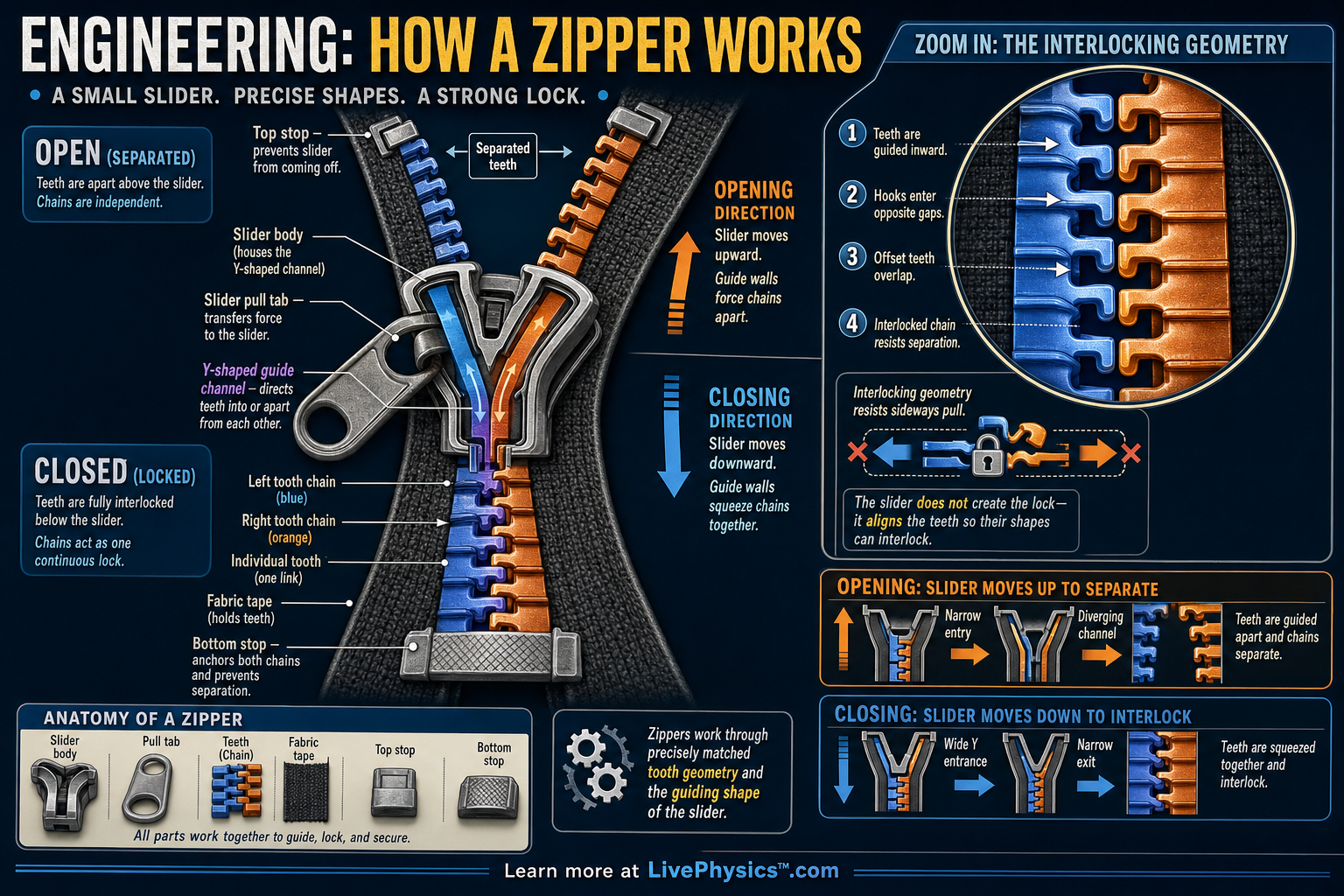
A zipper is a mechanical fastener that joins two flexible fabric edges quickly and repeatedly. It appears in clothing, bags, tents, protective equipment, and many engineered products because it can create a long, controllable closure. Its strength does not come from a single tooth, but from many small teeth sharing the load along the closed length.
Understanding a zipper shows how carefully shaped parts can convert a simple pulling motion into reliable locking and unlocking.
Understanding Engineering, How a Zipper Works
Each zipper tooth has a shape that can catch the tooth opposite it. On many zippers, the teeth have a small hook and a matching hollow space. The slider guides two rows of teeth into a narrow channel.
As the slider moves upward, its wedge-shaped interior pushes the rows together at the correct angle. Each tooth enters the gap in its partner and becomes locked behind it. Moving the slider in the other direction gives the teeth room to separate.
This is a useful engineering idea. The slider does not create the lock by squeezing every tooth with great force. It positions parts so their shapes hold each other.
The tape beside the teeth is just as important as the teeth themselves. It must be flexible enough to follow cloth, yet strong enough to transfer pulling forces into the zipper chain. Manufacturers often weave the tape from tough synthetic fibers.
The teeth may be metal, molded plastic, or a continuous plastic coil. Metal teeth can resist wear and high loads, but they may bend or corrode. Molded plastic teeth are common on jackets and bags because they are light and inexpensive.
Coil zippers bend easily around curves, so they work well on luggage, tents, and outdoor gear. Engineers choose the material by considering strength, flexibility, weight, cost, and exposure to water or dirt.
A closed zipper can fail when forces pull the two fabric sides apart too strongly. The load should pass through many connected teeth, but damage to one section can concentrate stress nearby. A tooth that is bent, missing, or poorly aligned may stop the slider or allow the chain to open behind it.
Dirt and loose threads can block the narrow spaces inside the slider. For this reason, zipper care is practical engineering maintenance. Students can notice that forcing a stuck zipper often makes the problem worse.
Gently removing trapped fabric, aligning the two sides, and keeping the slider straight usually reduces damage. Lubricants made for zippers can lower friction, though the wrong substance may collect dust or harm fabric.
The parts at the ends control how the zipper is used. A bottom stop prevents the slider from coming off a closed-end zipper, such as one on a pocket. A separating zipper has a box and pin at the bottom.
The pin enters the box first, making sure both tooth rows begin in the right position before the slider closes them. This design is used on coats that need to open completely. Zippers show up in engineering lessons about tolerances.
Tolerance means the small allowed difference in part size. Teeth must be made consistently enough to interlock, while the slider must have just enough clearance to move without wobbling. When examining a zipper, pay attention to shape, alignment, friction, material choice, and how force travels through the whole assembly.
Key Facts
Vocabulary
- Zipper chain
- A zipper chain is one complete row of teeth attached along a fabric tape.
- Slider
- A slider is the movable Y-shaped part that guides two tooth chains together or apart.
- Interlocking teeth
- Interlocking teeth are shaped fastener elements that engage opposite teeth to form a continuous closure.
- Fabric tape
- Fabric tape is the woven strip that supports the teeth and is sewn or attached to the product.
- Stop
- A stop is a small end component that prevents the slider from moving beyond the usable tooth chain.
Common Mistakes to Avoid
- Thinking that zipper teeth simply touch edge to edge is incorrect because each tooth must engage with the gap or feature of the opposing row to resist separation.
- Pulling the slider sideways is a mistake because the slider is designed to guide teeth along the zipper direction, and side loading can bend teeth or jam the mechanism.
- Assuming one tooth carries all the force is wrong because the load is distributed among many interlocked teeth along the closed portion of the zipper.
- Forcing a jammed slider is a mistake because trapped fabric, misaligned teeth, or damaged teeth can become worse when excessive pulling force is applied.
Practice Questions
- 1 A closed zipper has 80 interlocked tooth pairs, and an outward load of 160 N is shared equally by all pairs. What average load is carried by each tooth pair?
- 2 A zipper has teeth spaced 4 mm apart. How many tooth positions are present along a 24 cm length of zipper chain?
- 3 Explain why the Y-shaped channel in a slider can close a zipper when moved in one direction and open it when moved in the opposite direction.