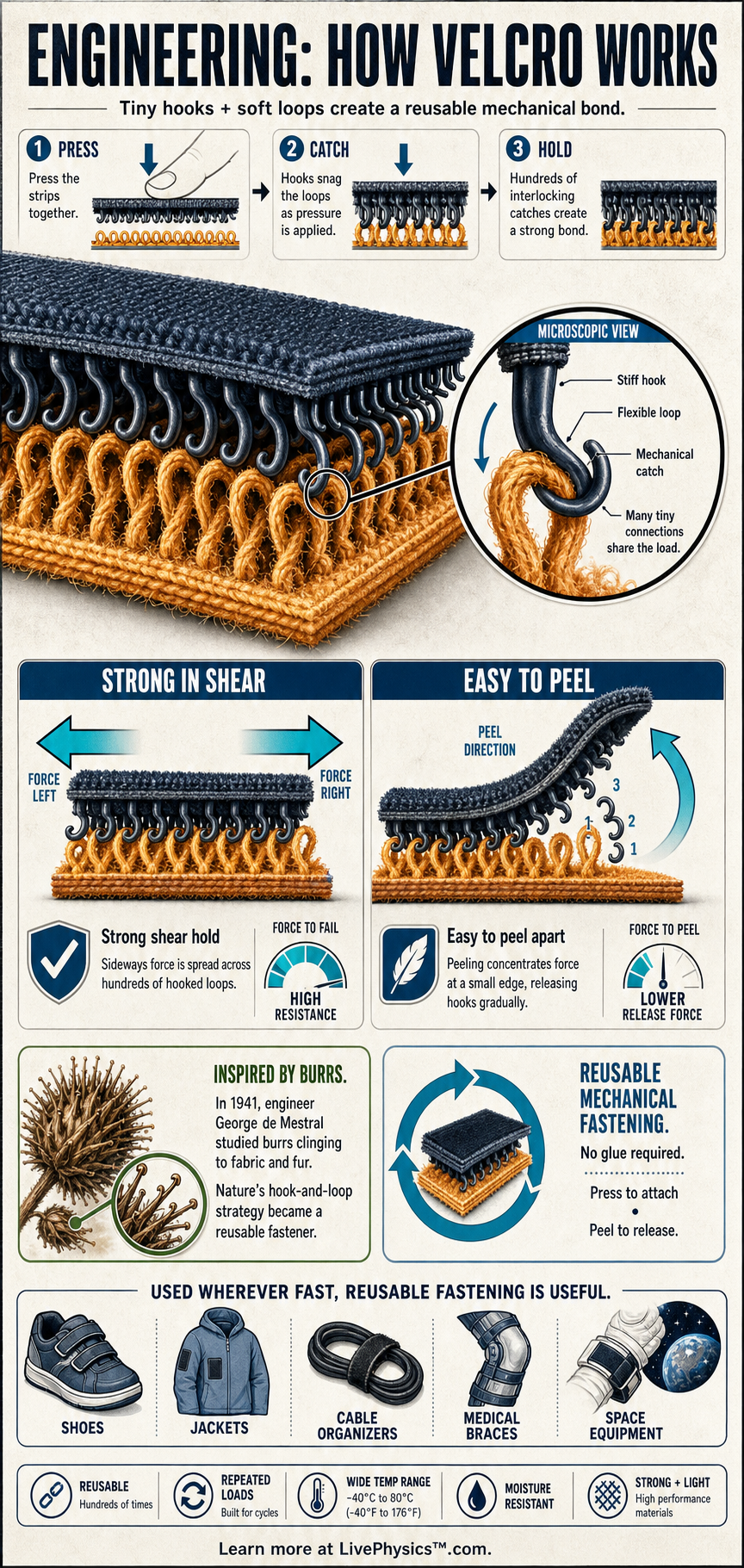
The fastening principle was inspired by burrs that cling to animal fur using small hooks. A single hook-loop connection is weak, but thousands of connections share the load and produce a strong hold, especially when the strips are pulled sideways in shear. The strips separate more easily when peeled apart because peeling releases hooks one small region at a time.
Engineers tune hook shape, loop density, material stiffness, and strip area to balance holding force, ease of opening, durability, and noise.
Understanding Engineering, How Velcro Works
At the microscopic scale, a hook fastener works by bending fibres into useful shapes. The hook side is usually made from nylon or polyester. Its fibres are heated, cut, or moulded so that their tips curve outward.
The loop side has softer fibres that form open arches. When the surfaces meet, some hooks slide past the loop fibres before catching beneath them. The fibres flex during this process.
That flexibility matters because rigid hooks would break or fail to find loops. A good design has enough stiffness to resist a pull, yet enough springiness to connect without needing excessive pressing force.
The load does not spread perfectly across every connection. Some hooks catch deeply, while others only touch lightly. The first few connections may carry more force than the rest.
As the material stretches slightly, nearby connections begin to take part. This is called load sharing. Engineers try to make this sharing more even because overloaded hooks can straighten, snap, or pull free.
A wider strip usually carries a larger load because it contains more possible contact points. The backing fabric matters too. If it is too stretchy, the fastener can distort and concentrate the force near one edge.
Opening a fastener produces a moving separation front. Near that front, fibres bend, release stored elastic energy, then spring back into shape. This is why the familiar ripping sound occurs.
The sound comes from many quick releases and vibrations in the fabric and air. A slow pull can be quieter than a sharp pull, though it still separates the same kind of contacts.
Fasteners used in clothing, medical supports, or quiet equipment may use softer loops and smaller hooks to reduce noise. Those choices can make the closure less strong or less durable, so every design involves compromise.
Students meet this engineering idea in shoes, bags, sports pads, cable wraps, blood pressure cuffs, and protective clothing. Each use needs different properties. A shoe strap must survive dirt, repeated opening, and sideways forces during movement.
A cable wrap may need easy adjustment more than maximum strength. Dust, hair, lint, and loose fibres can fill the loops or block the hooks. Washing, heat, sunlight, and repeated bending can weaken plastic fibres over time.
When studying a hook fastener, pay attention to the direction of the pull, the size of the contact area, the condition of the fibres, and the stiffness of both strips. These details explain why the same fastener can feel very secure in one situation and easy to open in another.
Key Facts
- Hook-and-loop fastening is a mechanical bond, not a glue-based chemical bond.
- Hooks catch loops when the strips are pressed together, creating many small attachment points.
- Total holding force is approximately F_total = N × F_avg, where N is the number of engaged hook-loop contacts.
- Shear force acts parallel to the strip surfaces, so many hooks can share the load at once.
- Peel force acts by lifting one edge, so contacts detach progressively rather than all at once.
- Pressure is P = F/A, so pressing the strips together over a larger contact area can engage more hooks and loops.
Vocabulary
- Hook-and-loop fastener
- A reusable fastening system made of one strip with tiny hooks and another strip with tiny loops.
- Micro-hook
- A very small stiff curved feature that catches and holds a fiber loop.
- Loop
- A soft, flexible fiber ring that can be caught by a hook.
- Shear
- A force that pushes or pulls parallel to a surface.
- Peel
- A separating action that lifts one layer away from another starting at an edge.
Common Mistakes to Avoid
- Thinking hook-and-loop strips work like glue. They hold because hooks physically catch loops, so dirt, crushed loops, or damaged hooks can reduce the mechanical connection.
- Assuming every hook must connect for the fastener to work. Only a fraction may engage, but a large number of successful contacts can still produce a useful holding force.
- Treating shear strength and peel strength as the same. A strip usually resists sideways shear strongly but can be opened more easily by peeling from one edge.
- Pulling the strips apart straight outward when testing their strongest direction. This mainly creates peel separation, which releases contacts progressively instead of loading all contacts together.
Practice Questions
- 1 A fastener patch has 800 engaged hook-loop contacts. If each contact resists an average shear force of 0.015 N, estimate the total shear holding force.
- 2 A 24 cm² hook-and-loop patch has an engaged contact density of 150 contacts/cm². If each contact provides 0.010 N of average shear resistance, calculate the estimated total shear holding force.
- 3 Explain why opening a hook-and-loop strap by peeling from a corner usually feels easier than pulling the entire strap sideways.