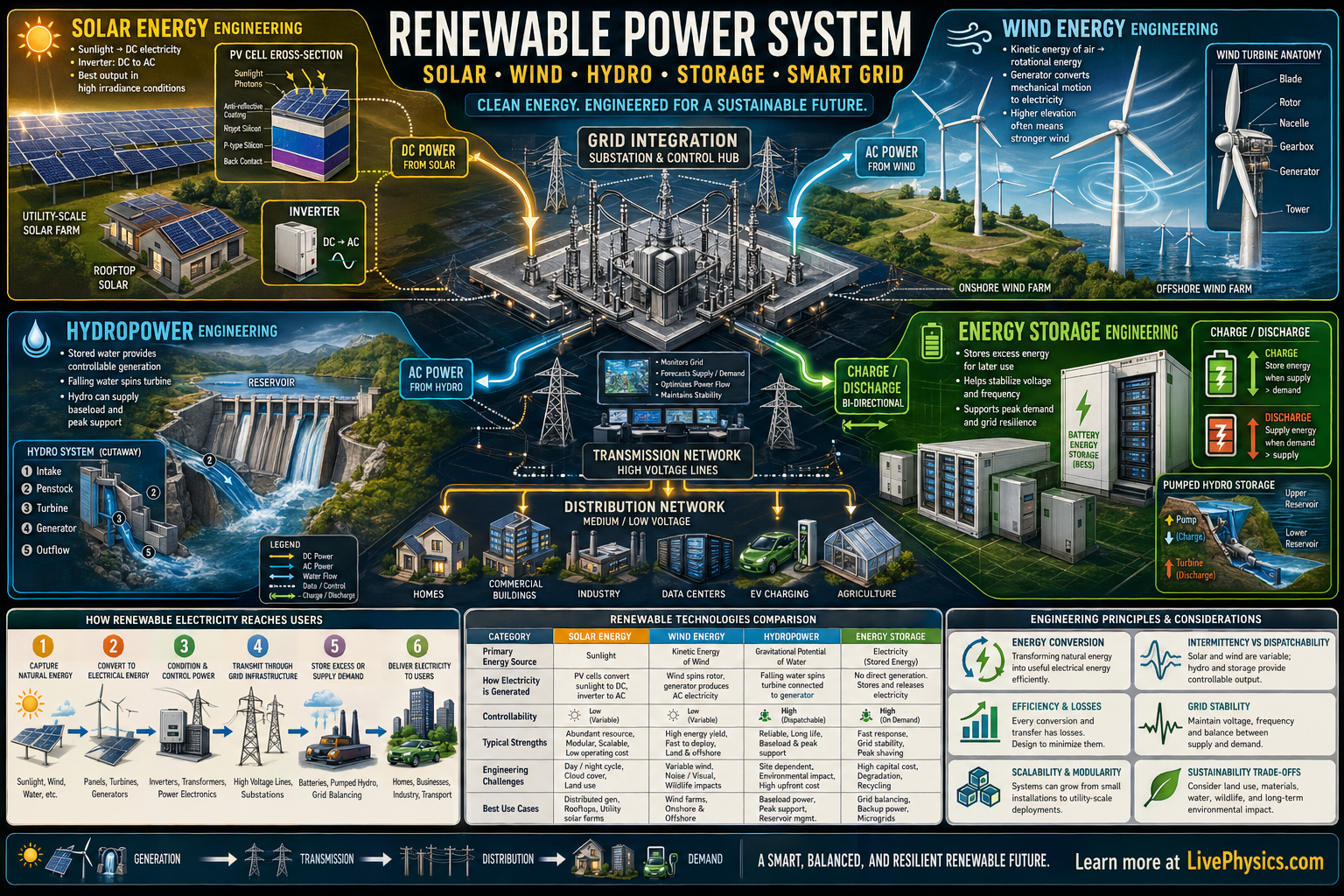
Renewable energy engineering focuses on capturing energy from natural flows such as sunlight, moving air, and flowing water, then delivering that energy reliably to homes, businesses, and industry. Solar, wind, and hydro each convert a different physical resource into electricity, so they complement one another across weather conditions, seasons, and geography. Engineers study how to design these systems for efficiency, safety, cost, and low environmental impact.
Energy storage is especially important because it helps balance supply and demand when renewable output changes.
In a modern power grid, solar panels, wind turbines, and hydroelectric plants feed electricity into transmission and distribution networks through power electronics, transformers, and control systems. Batteries and pumped hydro storage absorb extra energy when production is high and release it later when demand rises or renewable output drops. Grid operators use forecasting, sensors, and automated controls to keep voltage and frequency stable while matching generation to load.
The result is an integrated energy system that can be cleaner, more flexible, and more resilient than one based only on fossil fuels.
Understanding Renewable Energy Engineering, Solar, Wind, Hydro, and Storage
A solar cell works because light can free electric charges inside a semiconductor. Layers of silicon create an internal electric field that pushes those charges in one direction. This produces direct current electricity.
The output changes with cell temperature, shading, dirt, and the angle of the panel. A small shadow can reduce the output of many cells connected in one string. Engineers use bypass paths and careful wiring to limit this effect.
Inverters convert direct current into alternating current for buildings and power lines. They often use maximum power point tracking, which continually adjusts the electrical operating point so the panel delivers as much power as conditions allow.
Wind turbines capture energy by slowing air behind their blades. The blade shape creates lift, much like an aircraft wing, causing the rotor to turn. Rotor speed must be controlled because very fast winds can damage equipment.
A controller can turn the rotor away from the wind, change blade pitch, or stop the turbine entirely. Taller towers reach steadier, faster air, but they cost more and need stronger foundations.
The cubic link between wind speed and available power explains why site measurement matters so much. A location with slightly higher average wind can produce far more energy over a year.
Hydropower is easier to control than sunlight or wind when a dam and reservoir are available. Water stored at height has gravitational potential energy. Opening a gate sends water through a penstock, a large pipe, to spin a turbine.
The generator then converts rotation into electricity. Operators can change water flow quickly to help meet a sudden rise in demand.
This flexibility is useful, but dams change river habitats, sediment movement, and fish migration. Run of river plants avoid large reservoirs, though their output follows seasonal river flow more closely.
Storage has limits that students should notice. A battery does not return every unit of energy put into it because some energy becomes heat in cells, cables, and power electronics. Batteries also lose capacity over repeated charging cycles and at extreme temperatures.
They are valuable for short periods such as smoothing solar output during passing clouds or supplying electricity in the evening. Pumped hydro can store much larger amounts for longer periods, but it needs suitable hills, water, and land. Engineers compare storage choices by response speed, usable capacity, lifetime, safety, material needs, and cost per unit of stored energy.
Grid connection involves more than attaching wires. Electricity on an alternating current grid must stay close to a set voltage and frequency. If demand suddenly becomes greater than supply, frequency falls.
Modern inverters measure grid conditions many times each second and can adjust their output to support stability. Transformers raise voltage for long distance transmission because higher voltage reduces heating losses in wires. In homes, a smart meter may record power imported from the grid or exported from rooftop solar.
When learning this topic, separate power from energy. Power describes the rate of transfer, while energy describes the total amount delivered over time. That distinction prevents many mistakes when comparing panel ratings, battery sizes, and household electricity use.
Key Facts
- Solar photovoltaic power depends on panel area, sunlight intensity, and efficiency, P = I A eta
- Wind turbine power available in moving air is P = 0.5 rho A v^3
- Hydroelectric power can be estimated by P = rho g h Q eta
- Electrical energy stored in a battery is E = P t
- Round trip efficiency compares energy returned to energy stored, eta = E_out / E_in
- Grid balance requires generation plus storage discharge to equal demand plus storage charging and losses
Vocabulary
- Photovoltaic cell
- A photovoltaic cell is a device that converts sunlight directly into electrical energy using semiconductor materials.
- Capacity factor
- Capacity factor is the fraction of actual energy produced over time compared with the maximum possible energy if a system ran at full power continuously.
- Pumped hydro storage
- Pumped hydro storage stores energy by pumping water to a higher reservoir and later releasing it through turbines to generate electricity.
- Inverter
- An inverter is a device that converts direct current into alternating current for use on the electric grid.
- Grid stability
- Grid stability is the ability of a power system to maintain steady voltage, frequency, and reliable operation during changing conditions.
Common Mistakes to Avoid
- Assuming renewable sources always produce constant power, which is wrong because solar and wind output change with weather, time of day, and season. Engineers must include forecasting, backup generation, or storage.
- Using the wind power formula as if turbine output rises linearly with wind speed, which is wrong because power in the wind scales as v^3. A small increase in wind speed can cause a much larger increase in available power.
- Ignoring efficiency in hydro, solar, or storage calculations, which is wrong because real systems lose energy in turbines, generators, inverters, batteries, and transmission lines. Always multiply by efficiency when estimating useful output.
- Thinking storage creates energy, which is wrong because storage only saves energy produced earlier and returns less than it received due to losses. It improves timing and reliability, not total energy generation.
Practice Questions
- 1 A solar array has area 12 m^2, sunlight intensity 800 W/m^2, and efficiency 0.20. Calculate its electrical power output.
- 2 A hydro plant has water flow rate Q = 50 m^3/s, head h = 30 m, water density rho = 1000 kg/m^3, g = 9.8 m/s^2, and efficiency eta = 0.90. Calculate the electric power output.
- 3 A region has strong solar output at noon, low wind in the afternoon, and high electricity demand after sunset. Explain how storage and grid controls help maintain reliable power delivery.