Solar Panel Angle Optimizer
Adjust your location, day of year, panel tilt, and azimuth to see how panel orientation affects daily energy output. Instantly compare your setup to the optimal tilt for your latitude.
Sun Path and Panel Orientation
Panel is at the optimal year-round tilt for this latitude.
Location
Panel Orientation
Azimuth, negative = toward East, positive = toward West, 0 = South-facing
City Presets
Hourly Irradiance Curve
Reference Guide
Solar Declination
Earth's axis is tilted 23.45 degrees relative to its orbital plane. This tilt causes the sun to appear higher in the sky in summer and lower in winter. The declination angle describes how far the sun is north or south of the celestial equator.
- Summer solstice (around June 21), +23.45 degrees
- Winter solstice (around Dec 21), -23.45 degrees
- Spring and fall equinoxes, 0 degrees
At solar noon, the sun's altitude above the horizon equals 90 - latitude + declination. This is why panels produce more energy in summer at northern latitudes.
Optimal Panel Tilt
For maximum year-round energy production, a fixed panel should be tilted at an angle approximately equal to the installation latitude. This balances the seasonal variation in the sun's path.
- Year-round optimal, tilt = latitude
- Summer optimization, tilt = latitude - 15 degrees
- Winter optimization, tilt = latitude + 15 degrees
At the equator (latitude = 0), a flat panel (0 degree tilt) works well year-round because the sun passes overhead. At higher latitudes, tilting toward the equator captures more direct sunlight.
Azimuth Orientation
Panel azimuth is the compass direction the panel faces. In the northern hemisphere, facing south (azimuth = 0 in this tool) gives the highest annual output because the sun tracks across the southern sky throughout the year.
- Northern hemisphere, face panels south (azimuth = 0)
- Southern hemisphere, face panels north (azimuth = 0)
- East-facing, captures morning sun (azimuth = -90)
- West-facing, captures afternoon sun (azimuth = +90)
Deviating from the optimal azimuth by 45 degrees typically reduces annual output by 5 to 10 percent, depending on latitude.
Understanding Energy Output
Daily energy is shown in kilowatt-hours per square meter per day (kWh/m2/day). This is called Peak Sun Hours (PSH) and represents the equivalent number of hours at 1000 W/m2.
- Multiply kWh/m2 by panel area (m2) for total output
- Typical 400W panel (2 m2), output x 400 W x area
- A location with 5 kWh/m2/day gets about 5 peak sun hours
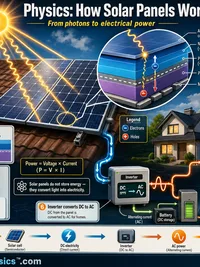
Real installations have additional losses from temperature, wiring, inverter efficiency, and shading. A typical system efficiency of 75 to 85 percent is realistic.