Fast vs Slow Earth Changes Lab
Sort earthquakes and river canyons by how fast they happen, watch volcanic islands form step by step, and apply rain, wind, and ice to slowly break down rock.
Guided ExperimentEarth Changes Investigation
Some Earth events happen in seconds, others take millions of years. Which process do you think changes the land the most - a volcanic eruption or river erosion? Why?
Write your hypothesis in the Lab Report panel, then click Next.
Controls
Explore how Earth events change the land - from earthquakes that happen in seconds to canyons that form over millions of years.
Sort Earth Events by Speed
For each Earth event, choose whether it happens Fast (seconds to days) or Slow (years to millions of years). Sort all 10 events, then check your answers.
Earthquake
Sudden shaking of the ground caused by shifting rock plates.
Volcanic Eruption
Lava and ash burst out of a volcano vent.
Tsunami
A giant ocean wave triggered by an earthquake or landslide.
Flash Flood
A sudden rush of water that carves new channels fast.
Landslide
A mass of rock and soil slides down a slope at once.
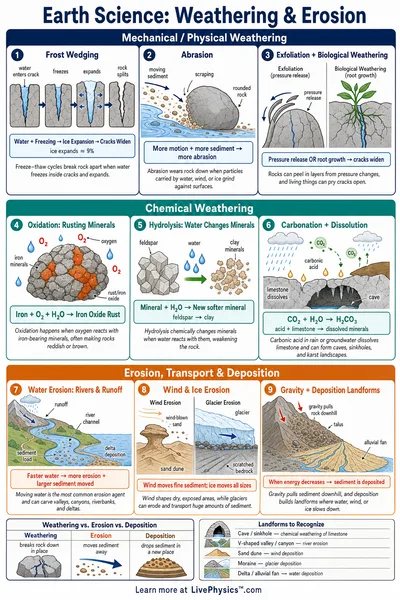
Weathering of Rocks
Rain and wind slowly break rock into smaller pieces over time.
Erosion by River
A river slowly cuts into rock and carries sediment downstream.
Glacier Movement
A river of ice that slowly grinds and sculpts the land.
Canyon Formation
Layers of rock slowly carved away by water over vast time.
Continental Drift
Continents move apart or together over millions of years.
Sort all 10 events to check your answers.
Data Table
(0 rows)| # | Earth Change | Speed | Cause / Agent |
|---|
Reference Guide
Two Speeds of Change
Earth's surface is always changing, but not always at the same speed. Some events happen in seconds or days. Others take thousands or even millions of years.
Both types of change are caused by forces acting on rock, soil, and water. Fast changes often involve sudden releases of energy. Slow changes build up gradually over vast amounts of time.
Rapid Earth Events
Rapid events change the land in seconds to days. They are often dramatic and visible
- Earthquakes - tectonic plates slip and shake the ground
- Volcanic eruptions - lava and ash build new land
- Tsunamis - ocean waves reshape coastlines
- Flash floods - rushing water carves new channels
- Landslides - hillsides collapse in moments
Gradual Earth Processes
Gradual processes take thousands to millions of years. They are hard to notice from year to year, but they create some of Earth's biggest features
- Weathering - rain, wind, and ice break rock into smaller pieces
- Erosion - water, wind, or ice carry pieces away
- Deposition - carried material settles in a new place
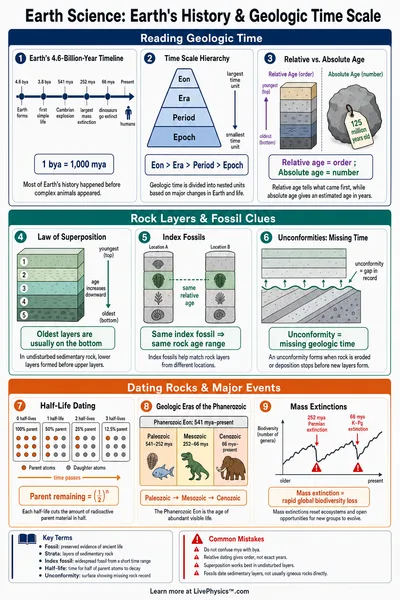
- Continental drift - plates move a few centimeters per year
Weathering, Erosion, and Deposition
These three slow processes always work together to shape the land
Weathering breaks rock apart in place. Rain dissolves minerals, ice cracks rock, and wind grinds surfaces smooth.
Erosion moves the broken pieces. A river carries sand. Wind blows dust. A glacier drags boulders.
Deposition drops the pieces in a new location. A river delta builds up where a river meets the sea.