Rock Layers & Landscape Change Explorer
Rock layers are pages in Earth's history book. Each stripe records a different chapter - an ancient sea, a volcanic eruption, or a desert of blowing sand.
Explore Rock Layers
Tap any colored band to discover what it is, how old it is, and what formed it.
Surface (newest)🌱
Deep underground (oldest)🌋
🪨 Sedimentary🔥 Igneous💎 Metamorphic
Tap a layer above to learn more
🪨Sedimentary - from layers of sediment
🔥Igneous - from cooled magma or lava
💎Metamorphic - changed by heat and pressure
Rock Layers Reference
Law of Superposition
In undisturbed rock layers, the oldest layers are at the bottom and the newest are at the top.
This is because new sediment settles on top of older sediment over time.
- Bottom layer = formed first, oldest
- Top layer = formed last, youngest
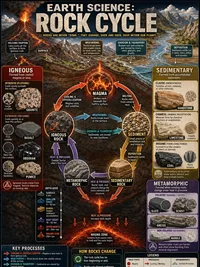
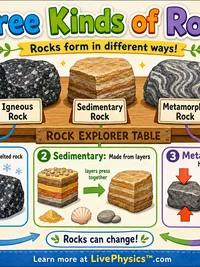
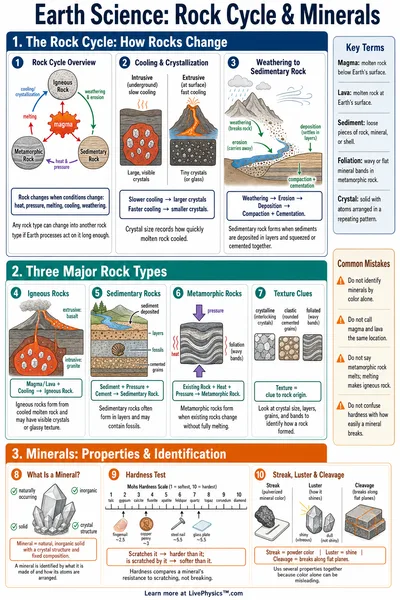
Three Types of Rock
- Sedimentary formed from compressed sand, mud, and shells. Often contains fossils.
- Igneous formed from cooled magma or lava. No fossils - too hot.
- Metamorphic existing rock changed by heat and pressure. Fossils may be distorted.
Events That Shape Rock Layers
- Sea floor shells and sediment accumulate as limestone
- Flood deposit rivers leave mud and silt that becomes shale
- Volcanic eruption lava cools into dark igneous rock
- Desert dunes wind-blown sand compresses into sandstone
- Glacier ice and pressure transforms rock into metamorphic
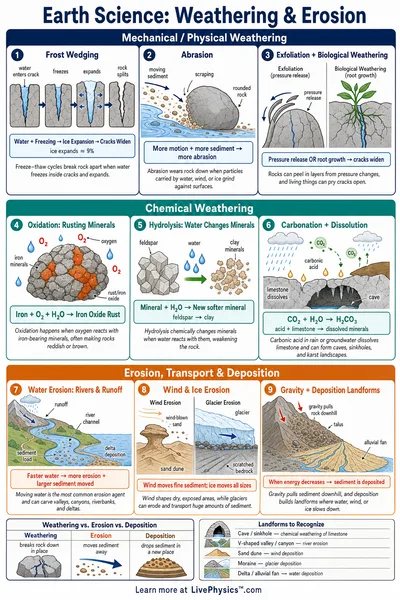
- Erosion wind and water remove rock, creating a gap in layers
Reading Fossils in Layers
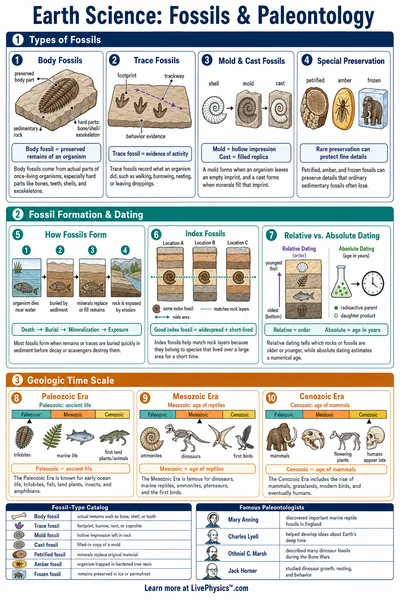
Fossils are remains of ancient life preserved in rock. Where you find a fossil tells you what lived at that time and place.
- Marine fossils (trilobites, ammonites) mean a sea once covered the area
- Plant fossils (ferns) mean a warm, wet environment like a swamp or riverbank
- No fossils in igneous rock - the heat destroys organic material
Related Content
Related Tools
Earthquake Magnitude Calculator
Four modes, magnitude scales (Richter Mₗ, moment magnitude M𝑤, energy), energy comparison (each step = 31.6× more energy, logarithmic bar chart), Modified Mercalli Intensity I-XII with descriptions, and Richter magnitude from seismograph amplitude. Presets include Minor M3 through Great M8, 1906 San Francisco M7.9, and 2011 Japan M9.1.
Carbon Footprint Calculator
Estimate annual CO₂ emissions from transportation (car miles, fuel type, flights), home energy (electricity, heating, AC), diet (meat consumption, food waste), and lifestyle (shopping, recycling). Pie chart breakdown, country comparison bar chart, trees-to-offset and equivalent-driving metrics. Five presets, Average American, Eco-Conscious, Heavy Commuter, Frequent Flyer, Work from Home.
Star Lifecycle Visualizer
Three modes: interactive HR diagram with 23 real stars (click to see properties), stellar evolution pathway from nebula to end state (white dwarf, neutron star, or black hole based on initial mass), and star properties calculator (luminosity L∝M^3.5, radius, lifetime t∝M^-2.5, apparent magnitude). Six presets: Sun, Red Dwarf (0.3 M☉), Sirius A (2 M☉), Blue Giant (20 M☉), Betelgeuse (15 M☉), Supergiant (50 M☉). Includes spectral class colour strip and SVG star visualization.
H-R Diagram Explorer
Three modes, plot a single star on the Hertzsprung-Russell diagram from temperature, radius, and mass (Stefan-Boltzmann luminosity, spectral class O-M, absolute magnitude, HR region); compare multiple stars side by side; and browse the spectral atlas with typical properties for each class. 23 reference stars plotted, 6 presets from Proxima Centauri to Rigel.
Related Labs
Fossils & Ancient Environments Lab
Examine fossil evidence and match each fossil to its ancient environment. Discover what fossils tell us about Earth's past. Grades 3-5.
Fast vs Slow Earth Changes Lab
Sort Earth events by speed, explore before-and-after change sequences, and simulate rock weathering through Rain, Wind, and Ice agents. NGSS 4-ESS2-1. Grades 3–5.
Soil Layers & Permeability Lab
Investigate how soil composition affects water drainage using Darcy's Law. Build a soil column by adding layers of sand, loam, silt, and clay with adjustable thicknesses. The lab calculates effective hydraulic conductivity (harmonic mean), drainage time, Darcy velocity, permeability class, and runoff potential. An animated water-flow visualization shows drainage rate. Data table tracks layer configurations and drainage results.
Soil Conservation Lab
Measure how slope steepness and conservation practices affect erosion rates using the USLE. Progressively add cover crops, contour farming, terracing, and buffer strips to reduce soil loss