Fossils & Ancient Environments Lab
Examine fossil clues to reconstruct ancient environments. Discover why scientists find shark teeth in deserts, coral reefs in mountains, and swamp forests beneath coal mines.
Guided ExperimentFossils and Ancient Environments Investigation
Before you start, predict, if scientists find shark teeth in the middle of a desert, what does that tell them? Write your prediction.
Write your hypothesis in the Lab Report panel, then click Next.
Controls
Select a fossil to examine the evidence it provides. Add observations to your data table.
Choose a Fossil to Examine
Click any fossil card to see what it tells us about the ancient environment.
Trilobite
Body fossilOriginal Organism
Ancient marine arthropod
What Changed?
Now dry land, once a shallow sea
Ancient Environment
Shallow Ocean
What Does This Tell Us?
- 1Trilobites only lived in salt water
- 2Found in limestone, a marine sedimentary rock
- 3This area was once covered by a warm, shallow sea
Data Table
(0 rows)| # | Fossil Name | Fossil Type | Ancient Environment | Key Evidence | What Changed? |
|---|
Reference Guide
What Is a Fossil?
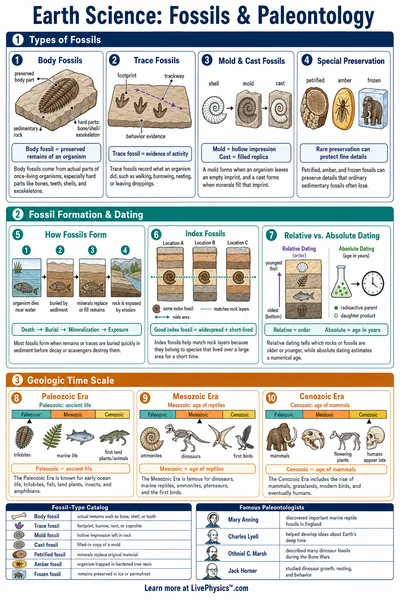
A fossil is the preserved remains or traces of an organism that lived long ago. Most fossils form when an organism dies in water, gets buried by sediment, and the soft parts decay while the hard parts slowly turn to rock over thousands to millions of years.
Scientists who study fossils are called paleontologists. By examining fossils, they can learn what ancient organisms looked like, how they behaved, and what environments they lived in.
Types of Fossils
- Body fossils. Preserved hard parts of the organism itself, such as bones, teeth, shells, and wood.
- Trace fossils. Evidence of an organism's activity, footprints, burrows, and feeding marks. The organism itself is not preserved.
- Mold and cast fossils. A mold forms when the organism dissolves, leaving a hollow impression. A cast forms when minerals fill that mold.
- Replacement fossils. Original material is replaced atom by atom by minerals, as in petrified wood.
Reading Fossil Evidence
Every fossil carries clues about the environment where the organism lived. Scientists use these clues to reconstruct ancient environments called palaeoenvironments.
- Marine organisms (trilobites, sharks, coral) mean the area was once underwater.
- Tropical plants (ferns, palms) mean the climate was once warm and wet.
- Large herbivore teeth with heavy enamel mean tough grassland vegetation.
- Trace fossils reveal behavior, a burrow shows an organism needed shelter.
How Environments Change
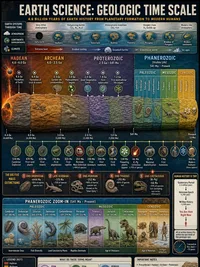
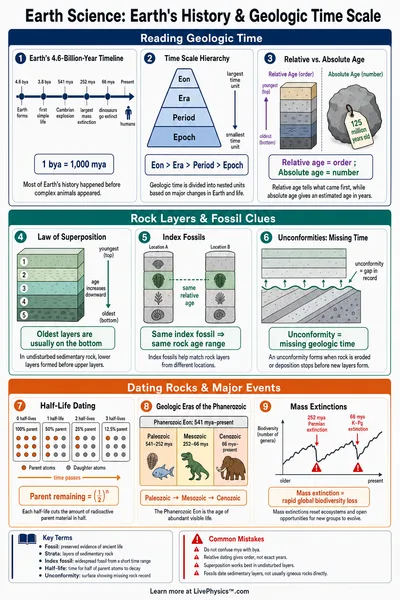
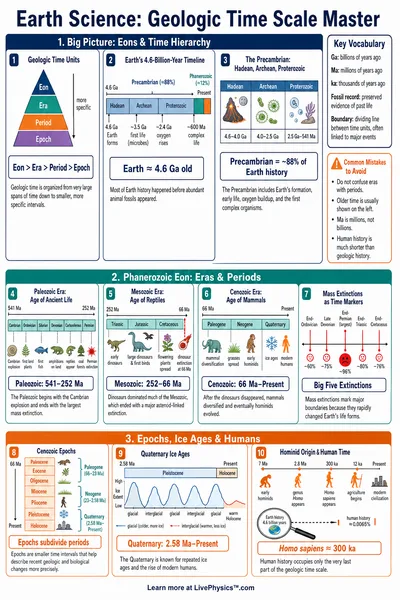
Earth's environments have changed dramatically over millions of years. Oceans have covered areas that are now dry land. Tropical forests once grew where deserts now exist. Mountains have risen from ancient seafloors.
These changes happen because of plate tectonics (moving continents), climate shifts, sea level changes, and geological processes. Fossils are the primary evidence scientists use to understand these ancient conditions.
- NGSS 3-LS4-1, analyze and interpret fossil data to provide evidence of environments in which organisms once lived